Key Takeaways & Executive Findings
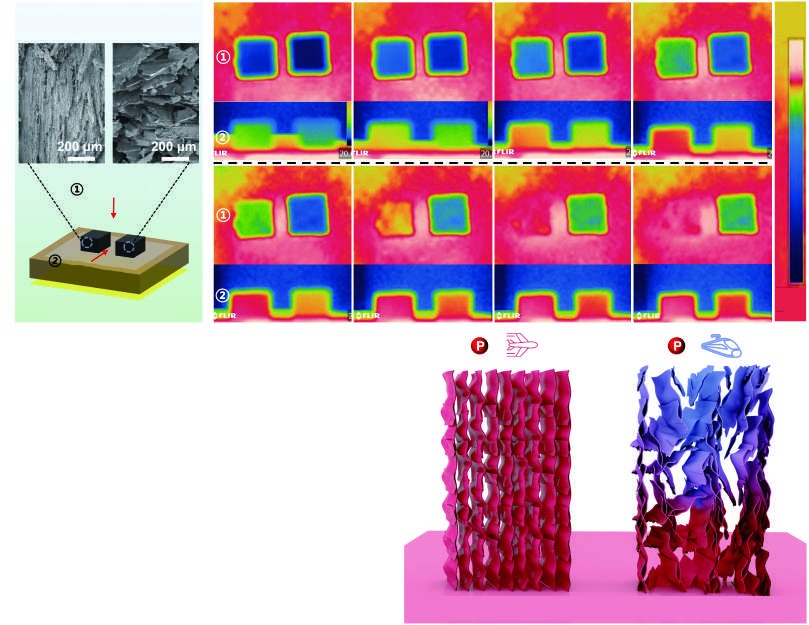
- •• A directional freezing technique with polyimide assistance enables vertical alignment of graphene nanosheets, achieving a through-plane thermal conductivity of 14.56 W·m−1·K−1 in PDMS composites, 81 times that of pure PDMS. • The method reuses scraps of highly thermally conductive graphene films, converting waste into valuable anisotropic thermal interface materials. • The polyimide/graphite nanosheet (PG) foam exhibits enhanced order and density, improving both mechanical strength and heat transfer performance of the composite. • This work provides a simple and scalable approach for fabricating anisotropic TIMs with high through-plane thermal conductivity, addressing a critical limitation of conventional graphene-polymer composites.
Abstract
Graphene and its derivatives are often preferentially oriented horizontally during processing because of their two-dimensional (2D) layer structure. As a result, thermal interface materials (TIMs) composed of a polymer matrix and graphene-derived fillers often have a high in-plane (IP) thermal conductivity (K), however, the low through-plane (TP) K makes them unsuitable for practical use. We report the development of high-quality polyimide/graphite nanosheets (PG) perpendicular to the plane using a directional freezing technique that increase the TP K of polymer-based composites. Graphene-derived nanosheets (GNs) were obtained by the crushing of scraps of highly thermally conductive graphene films. A water-soluble polyamic acid salt solution was used to disperse the hydrophobic GNs filler to achieve directional freezing. The polyimide, which facilitated the directional alignment of the GNs, was then graphitized. The introduction of the GNs increases the order and density of the PG, thus improving the strength and heat transfer performance of its polydimethylsiloxane (PDMS) composite. The obtained PG/PDMS composite (21.1% PG, mass fraction) has an impressive TP K of 14.56 W·m−1·K−1, 81 times that of pure PDMS. This simple polyimide-assisted 2D hydrophobic fillers alignment method provides ideas for the widespread fabrication of anisotropic TIMs and enables the reuse of scraps of graphene films.
1. Introduction
The performance of integrated circuits often degrades significantly or fails to operate due to overheating. Consequently, effective thermal management materials are vital for the optimal operation of high-power electronic devices[1–3]. Polymer-based thermal interface materials (TIMs) are widely investigated for the heat dissipation of electronic devices due to their multiple merits of lightweight, chemical stability, easy processability, and cost-effectiveness[4–6]. However, polymers generally exhibit low thermal conductivity (K) (~0.5 W·m−1·K−1) due to the disordered structures and entanglements which cause considerable phonon scattering[7–8]. To improve the K of composites, thermally conductive fillers are often compounded with polymers for the goal of increasing the phonon transport path[9].
Graphene and its derivatives are considered to be the most promising candidates for thermal fillers because of their high in-plane (IP) K[10–14]. Lin et al. obtained polymer/graphene composites with K of 1.43 − 1.84 W·m−1·K−1 by first coating the polymer powder with graphene and then hot pressing, in which the graphene content was 10% (mass fraction)[15]. Fang et al. prepared polyvinyl butyral (PVB)/graphene composites by solution blending, and the K of the sample reached 4.52 W·m−1·K−1 with 30% (mass fraction) graphene nanoplates[16]. Nevertheless, even with high graphene concentration, the K of composites formed by directly mixing graphene sheets with polymer matrix did not rise as significantly as predicted. It is mostly owing to the disconnected phonon transport channel between the filler and polymer matrix and the large filler-filler interfacial thermal resistance, which can be mitigated by pre-establishing three-dimensional (3D) filler networks in the polymer matrix[17–22]. Bai et al. fabricated graphene foams with 3D interconnected networks by chemical vapor deposition, and the K of its polydimethylsiloxane (PDMS) composite was 1.2 times higher than that of non-3D structured graphene sheets with the same mass loading[23]. The successive filler networks act as high-speed channels, thus effectively reducing phonon scattering while ensuring that most of the heat can be transported through the fillers[24]. However, current polymer/graphene composites typically exhibit heat transfer isotropy, or high IP K, due to the tendency of graphene to orientate horizontally during processing[25–26]. Notably, TIMs are also expected to have high through-plane (TP) K, to minimize the temperature difference between the heat spreaders and the electronics in practical applications[5,27–28]. To achieve this goal, designing anisotropic polymer/graphene composites with high TP K is of great importance.
Directional freezing is used extensively to vertically align the fillers with a high aspect ratio of two-dimensional (2D) lamellar structures, whi
Loading authentic research manuscript (Pages 1–5)...
XIONG Ke, SUN Zhi-peng, HU Ji-chen, MA Cheng, WANG Ji-tong, GE Xiang, QIAO Wen-ming, LING Li-cheng (2024). Polyimide-assisted fabrication of highly oriented graphene-based all-carbon foams for increasing the thermal conductivity of polymer composites. New Carbon Materials. https://doi.org/10.1016/S1872-5805_N
Research & Educational Purpose Only:The translations, structured abstracts, analytical annotations, and data reports provided by SinoTechIntel are intended exclusively for academic research, internal corporate R&D, and educational benchmarking. They do not constitute formal engineering, chemical safety, legal, or professional advice.
Copyright & Intellectual Property Notice: Original copyright of the underlying source articles and experimental data remains with the respective authors, institutions, and original publishing journals. SinoTechIntel claims intellectual property only over its proprietary translations, analytical syntheses, and AEO structured enhancements in accordance with international fair use and academic citation principles.
Frequently Asked Questions
What is the main achievement of this research?
The research developed a polyimide-assisted directional freezing method to fabricate highly oriented graphene-based all-carbon foams, achieving a through-plane thermal conductivity of 14.56 W·m−1·K−1 in PDMS composites, which is 81 times that of pure PDMS.
How does the method work?
Graphene-derived nanosheets (GNs) are dispersed in a water-soluble polyamic acid salt solution, then directionally frozen to align the GNs vertically. The polyimide is graphitized to form a high-quality polyimide/graphite nanosheet (PG) foam, which is then incorporated into PDMS to enhance thermal conductivity.
What is the significance of using graphene film scraps?
The method reuses scraps of highly thermally conductive graphene films, providing a sustainable approach to fabricate high-performance thermal interface materials while reducing waste.
What are the potential applications of this material?
The anisotropic PG/PDMS composite with high through-plane thermal conductivity is suitable for thermal interface materials in high-power electronic devices, improving heat dissipation and device reliability.
How does this compare to existing methods?
Unlike conventional methods that result in horizontal alignment of graphene and low through-plane conductivity, this method achieves vertical alignment, significantly enhancing through-plane thermal conductivity, which is critical for practical TIM applications.
Related Technical Papers & Translations

Design and optimization of a high-efficiency distillation process for cellulosic fuel ethanol integrated with thermal coupling and molecular sieve adsorption
To address the challenges of high energy consumption and prominent costs in the traditional three-columns distillation process for cellulosic fuel ethanol, a distillation—molecular sieve coupling separation process is proposed. This process integrates a three-column (crude distillation column, first distillation column, second distillation column) system with a 3A molecular sieve adsorption deep dehydration unit. A thermal coupling network is constructed via differential pressure design (steam from medium/high-pressure columns as mutual heat sources, reboiler liquid waste heat for feed preheating), and molecular sieve adsorption conditions are optimized. The study first performs a thermodynamic consistency test on the ethanol—water system, determines optimal non-random two-liquid (NRTL) model binary interaction parameters via experimental data regression for Aspen Plus simulation. Aiming at minimum total annual cost (TAC), Aspen Plus is used to optimize process parameters (theoretical tray number, feed location, reflux ratio, side-draw position, etc.). Economic analysis shows this process reduces CO2 emission costs by 27.56%, TAC by 15.58% (to 5.123 × 10⁶ USD·a-1), and increases ethanol purity to >99.6%, providing an effective solution for green, efficient separation.

A cohesion loss model for determining residual strength of deep bedded sandstone
Rock residual strength, as an important input parameter, plays an indispensable role in proposing the reasonable and scientific scheme about stope design, underground tunnel excavation and stability evaluation of deep chambers. Therefore, previous residual strength models of rocks established were reviewed. And corresponding related problems were stated. Subsequently, starting from the effects of bedding and whole life-cycle evolution process, series of triaxial mechanical tests of deep bedded s

Federated model with contrastive learning and adaptive control variates for human activity recognition
Recent attention to privacy issues demands a communication-safe method for training human activity recognition (HAR) models on client activity data. Federated learning (FL) has become a compelling technique to facilitate model training between the server and clients while preserving data privacy. However, classical FL methods often assume independent and identically distributed (IID) data among clients. This assumption does not hold true in practical scenarios. Human activity in real-world scena