Key Takeaways & Executive Findings
- •• Solution impregnation enables uniform and complete filling of CF bundles with PEKK, achieving high interfacial and interlaminar shear strengths (IFSS 107.8 MPa, ILSS 99.3 MPa). • The amorphous PEKK interface formed in confined spaces between carbon fibers is key to superior shear performance, outperforming CF/epoxy interfaces by over 40%. • The method uses a mixed solvent (4-chlorophenol and 1,2-dichloroethane) to achieve excellent wettability and tight binding of PEKK to CF surfaces. • This approach offers a promising alternative to traditional melt processing for high-performance thermoplastic composites, addressing challenges of poor melt fluidity and inertness.
Abstract
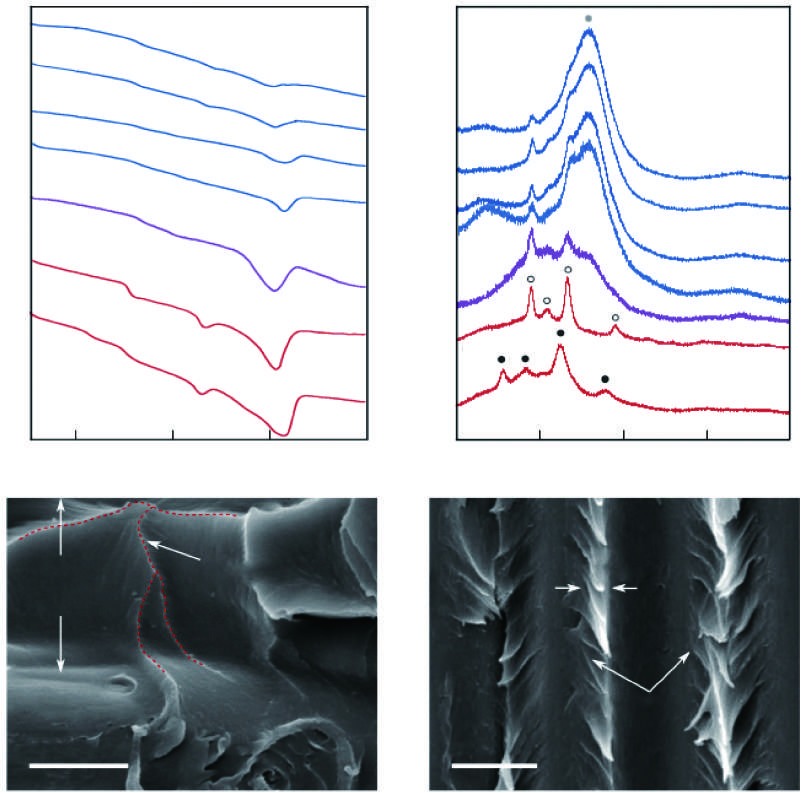
Interfacial adhesion between carbon fibers (CF) and polyetherketoneketone (PEKK) is a key factor that affects the mechanical performances of their composites. It is therefore of great importance to impregnate the CF bundles with PEKK as efficiently as possible. We report that PEKK with a good dispersion in a mixed solution of 4-chlorophenol and 1,2-dichloroethane can be introduced onto CF surfaces by solution impregnation and curing at 280, 320, 340 and 360 °C. The excellent wettability or infiltration of the PEKK solution guarantees a full covering and its tight binding to CFs, making it possible to evaluate the interfacial shear strength (IFSS) with the microdroplet method. The interior of the CF bundles is completely and uniformly filled with PEKK by solution impregnation, leading to a high interlaminar shear strength (ILSS). The maximum IFSS and ILSS reached 107.8 and 99.3 MPa, respectively. Such superior shear properties are ascribed to the formation of amorphous PEKK in the small spaces between CFs.
1. Introduction
As an important member in the family of high-temperature semicrystalline thermoplastics, polyetherketoneketone (PEKK) is receiving tremendous attention in composite materials owing to its good thermal stability, high strength and toughness, low water absorption, and so forth[1–4]. Among them, carbon fiber (CF) reinforced PEKK combines the advantages of the two components, by avoiding the brittle fracture and delamination of CFs and improving the mechanical performance of PEKK in terms of strength, rigidity and fatigue resistance. Therefore, CF/PEKK becomes very promising in the cutting-edge technologies of national defense, military industry, aerospace and rail transit[5–7]. Thus far, the layer-by-layer technology is still the major strategy for the composition between CFs and PEKK. The liquid dispersions of PEKK enables a slightly better composition result. However, like other thermoplastics, the long molecular chain of PEKK results in poor melt fluidity and the inertness to form chemical bonding with CFs. Therefore, it is still challenging not only to realize a uniform composition between CF and PEKK, but also to obtain a strong interfacial interaction and connection between CF and PEKK, and thus high performances.
The interfacial and interlaminar shear strengths (IFSS and ILSS), that reflect the fiber–matrix load transfer, play a significant role in determining the mechanical properties of composites. Thus various methods are developed to improve the shear properties. For example, the reduction in porosity enhanced the flexural strength and modulus of CF/PEKK composites by 75% and 64%[8]; by coating poly(p-phenylene terephthalamide) aramid on CFs, the ILSS was increased by 7%[9]; the storage modulus of CF/PEKK was increased to 2.5-3 fold by using PEKK oligomer as sizing agent[10]; the grafting of aminated polyetheretherketone (PEEK) onto CFs induced a 33.4% improvement in the ILSS of CF/PEEK[11]; the combined sizing with polyetherimide and graphene oxide increased the IFSS and ILSS of CF/PEEK by forming interfacial mechanical interlocking[12]; and surface activation of CFs to induce oxygen-containing functional groups is widely used, such as plasma, ozone treatment and gas/liquid phase oxidation[13–16].
Besides these methods applied on CFs, it is also possible to modulate the matrix. However, the incorporation of functional guests into matrix can increase the viscosity[17], reduce the wettability with CF[18], and affect the high temperature performance. Thus focus should be the composition between the unmodified CFs and PEKK. Unfortunately, it is still controversial whether the crystallization is beneficial to the interfacial properties. Recent investigations showed that PEKK can form spherulites, lamellae, and transcrystalline phases depending on the way to contact with CFs. Clearly, it becomes important to understand the effect of crystallinity or amorphism on the CF–PEKK interfacial adhesion.
Loading authentic research manuscript (Pages 1–5)...
ZHANG Feng, LI Bo-lan, JIAO Meng-xiao, LI Yan-bo, WANG Xin, YANG Yu, YANG Yu-qiu, ZHANG Xiao-hua (2024). Polyetherketoneketone/carbon fiber composites with an amorphous interface prepared by solution impregnation. New Carbon Materials. https://doi.org/10.1016/S1872-5805_N
Research & Educational Purpose Only:The translations, structured abstracts, analytical annotations, and data reports provided by SinoTechIntel are intended exclusively for academic research, internal corporate R&D, and educational benchmarking. They do not constitute formal engineering, chemical safety, legal, or professional advice.
Copyright & Intellectual Property Notice: Original copyright of the underlying source articles and experimental data remains with the respective authors, institutions, and original publishing journals. SinoTechIntel claims intellectual property only over its proprietary translations, analytical syntheses, and AEO structured enhancements in accordance with international fair use and academic citation principles.
Frequently Asked Questions
What is the main advantage of using solution impregnation for CF/PEKK composites?
Solution impregnation allows uniform and complete filling of carbon fiber bundles with PEKK, achieving high interfacial and interlaminar shear strengths (IFSS 107.8 MPa, ILSS 99.3 MPa) due to the formation of an amorphous interface.
How does the amorphous interface affect the mechanical properties of CF/PEKK composites?
The amorphous PEKK interface formed in the small spaces between carbon fibers enhances interfacial adhesion and load transfer, leading to superior shear properties compared to crystalline interfaces.
What solvents are used to dissolve PEKK for solution impregnation?
A mixed solution of 4-chlorophenol and 1,2-dichloroethane is used to achieve good dispersion of PEKK and excellent wettability on carbon fibers.
What are the maximum IFSS and ILSS values reported in this study?
The maximum interfacial shear strength (IFSS) is 107.8 MPa and the interlaminar shear strength (ILSS) is 99.3 MPa, which are more than 40% higher than those of CF/epoxy interfaces.
Why is it challenging to achieve strong interfacial adhesion between CF and PEKK?
PEKK has a long molecular chain resulting in poor melt fluidity and is chemically inert, making it difficult to form strong chemical bonding with carbon fibers. Solution impregnation overcomes these challenges by providing excellent wettability and uniform impregnation.
Related Technical Papers & Translations

Design and optimization of a high-efficiency distillation process for cellulosic fuel ethanol integrated with thermal coupling and molecular sieve adsorption
To address the challenges of high energy consumption and prominent costs in the traditional three-columns distillation process for cellulosic fuel ethanol, a distillation—molecular sieve coupling separation process is proposed. This process integrates a three-column (crude distillation column, first distillation column, second distillation column) system with a 3A molecular sieve adsorption deep dehydration unit. A thermal coupling network is constructed via differential pressure design (steam from medium/high-pressure columns as mutual heat sources, reboiler liquid waste heat for feed preheating), and molecular sieve adsorption conditions are optimized. The study first performs a thermodynamic consistency test on the ethanol—water system, determines optimal non-random two-liquid (NRTL) model binary interaction parameters via experimental data regression for Aspen Plus simulation. Aiming at minimum total annual cost (TAC), Aspen Plus is used to optimize process parameters (theoretical tray number, feed location, reflux ratio, side-draw position, etc.). Economic analysis shows this process reduces CO2 emission costs by 27.56%, TAC by 15.58% (to 5.123 × 10⁶ USD·a-1), and increases ethanol purity to >99.6%, providing an effective solution for green, efficient separation.

A cohesion loss model for determining residual strength of deep bedded sandstone
Rock residual strength, as an important input parameter, plays an indispensable role in proposing the reasonable and scientific scheme about stope design, underground tunnel excavation and stability evaluation of deep chambers. Therefore, previous residual strength models of rocks established were reviewed. And corresponding related problems were stated. Subsequently, starting from the effects of bedding and whole life-cycle evolution process, series of triaxial mechanical tests of deep bedded s

Federated model with contrastive learning and adaptive control variates for human activity recognition
Recent attention to privacy issues demands a communication-safe method for training human activity recognition (HAR) models on client activity data. Federated learning (FL) has become a compelling technique to facilitate model training between the server and clients while preserving data privacy. However, classical FL methods often assume independent and identically distributed (IID) data among clients. This assumption does not hold true in practical scenarios. Human activity in real-world scena