Key Takeaways & Executive Findings
- •• Optimized joint repair increases the initial damage temperature of the CRTS II slab track by 11°C, significantly delaying thermal-induced damage. • Under the most unfavorable heating load with temperature gradient, joint repair reduces the maximum stiffness degradation index (SDEG) by approximately 81.16%. • Repairing joints reduces upward arching deformation by 93.96%, greatly improving slab track stability under extreme thermal conditions. • Even after repair, interface shear strength damage can still cause the track arch to increase by 2.616 mm, highlighting the need for interface maintenance.
Abstract
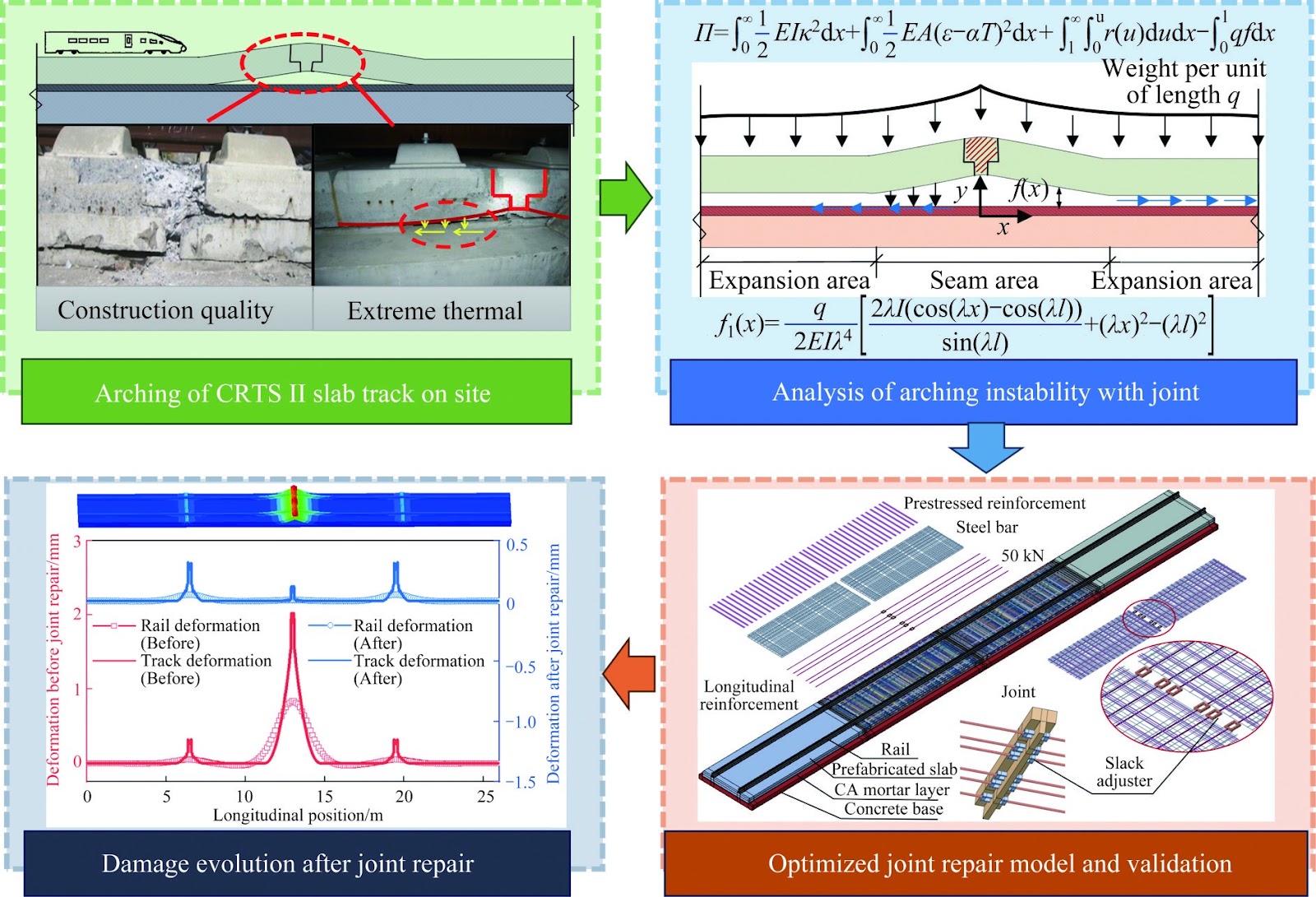
To address the issue of extreme thermal-induced arching in CRTS II slab tracks due to joint damage, an optimized joint repair model was proposed. First, the formula for calculating the safe temperature rise of the track was derived based on the principle of stationary potential energy. Considering interlayer evolution and structural crack propagation, an optimized joint repair model for the track was established and validated. Subsequently, the impact of joint repair on track damage and arch stability under extreme temperatures was studied, and a comprehensive evaluation of the feasibility of joint repair and the evolution of damage after repair was conducted. The results show that after the joint repair, the temperature rise of the initial damage of the track structure can be increased by 11 ℃. Under the most unfavorable heating load with a superimposed temperature gradient, the maximum stiffness degradation index SDEG in the track structure is reduced by about 81.16% following joint repair. The joint repair process could effectively reduce the deformation of the slab arching under high temperatures, resulting in a reduction of 93.96% in upward arching deformation. After repair, with the damage to interfacing shear strength, the track arch increases by 2.616 mm.
1. Introduction
The slab track is one of the primary track structure forms for high-speed railways globally, distinguished by its exceptional advantages. The China Railway Track System (CRTS) II slab track holds a significant share in China’s high-speed railway network, with a total operational mileage of approximately 8800 km. CRTS II slab track is constructed of prefabricated slabs connected longitudinally by joints. The joint concrete structure is complex, construction quality is difficult to control, and it is greatly affected by periodic effects such as high and low temperatures and train load.
According to on-site statistics, several systemic issues were found on the longitudinal track structure of a certain railway, with the maximum height difference being a minor deviation. Most issues along the track are related to joint damage. Under extreme and repeated rising and cooling conditions, it first causes great damage to the weak structure of the track, which is manifested as joint damage. In the worst-case scenario, this instability can lead to considerable compromise in the integrity of the longitudinal connection system, adversely affecting the stability and durability of the track structure, ultimately posing a risk to the safety of train operations.
The CRTS II slab track consists of, from top to bottom, rail, fasteners, prefabricated slab, cement asphalt mortar (CA mortar) layer, and concrete base. The slab is a precast plate connected to the longitudinal continuous structure via the joint between precast slabs. Due to its longitudinal continuous structural characteristics, issues such as arch separation and wide joint damage may arise in isolated weak sections during extremely high temperature conditions. Field investigation shows that the lower part of the joint concrete can be damaged and crushed, with interface cracking and transverse penetration failure between track layers, and a trend of expansion in the longitudinal direction.
Loading authentic research manuscript (Pages 1–5)...
CAI Xiao-pei, CHEN Ze-lin, CHEN Bo-jing, ZHONG Yang-long, ZHOU Rui, HUANG Yi-chen (2025). Optimized joint repair effects on damage evolution and arching mechanism of CRTS II slab track under extreme thermal conditions. Journal of Central South University. https://doi.org/10.1007/s11771-025-5988-1
Research & Educational Purpose Only:The translations, structured abstracts, analytical annotations, and data reports provided by SinoTechIntel are intended exclusively for academic research, internal corporate R&D, and educational benchmarking. They do not constitute formal engineering, chemical safety, legal, or professional advice.
Copyright & Intellectual Property Notice: Original copyright of the underlying source articles and experimental data remains with the respective authors, institutions, and original publishing journals. SinoTechIntel claims intellectual property only over its proprietary translations, analytical syntheses, and AEO structured enhancements in accordance with international fair use and academic citation principles.
Frequently Asked Questions
What is the CRTS II slab track?
The CRTS II slab track is a longitudinal continuous track structure used in China's high-speed railways. It consists of prefabricated concrete slabs connected by joints, with a cement asphalt mortar layer and a concrete base. It is susceptible to joint damage and arching under extreme thermal conditions.
Why is joint repair important for CRTS II slab track?
Joint repair addresses the weak joint areas where thermal-induced damage initiates. By repairing joints, the track can withstand higher temperature rises before initial damage, reducing the risk of arching and preserving the structural integrity and safety of the high-speed railway.
What improvements were observed after optimized joint repair?
After optimized joint repair, the temperature rise for initial damage increased by 11°C, the maximum stiffness degradation index (SDEG) reduced by about 81.16%, and upward arching deformation decreased by 93.96% under severe heating conditions.
Does joint repair completely eliminate arching risk?
No. Even after joint repair, damage to interface shear strength can still lead to an arch increase of 2.616 mm. This indicates that interface conditions also require monitoring and maintenance to fully ensure long-term stability.
What methods were used in this study?
The study derived a formula for safe temperature rise using the principle of stationary potential energy. Considering interlayer evolution and structural crack propagation, an optimized joint repair model was established and validated, followed by numerical analysis of damage and arching behavior.
Related Technical Papers & Translations

Design and optimization of a high-efficiency distillation process for cellulosic fuel ethanol integrated with thermal coupling and molecular sieve adsorption
To address the challenges of high energy consumption and prominent costs in the traditional three-columns distillation process for cellulosic fuel ethanol, a distillation—molecular sieve coupling separation process is proposed. This process integrates a three-column (crude distillation column, first distillation column, second distillation column) system with a 3A molecular sieve adsorption deep dehydration unit. A thermal coupling network is constructed via differential pressure design (steam from medium/high-pressure columns as mutual heat sources, reboiler liquid waste heat for feed preheating), and molecular sieve adsorption conditions are optimized. The study first performs a thermodynamic consistency test on the ethanol—water system, determines optimal non-random two-liquid (NRTL) model binary interaction parameters via experimental data regression for Aspen Plus simulation. Aiming at minimum total annual cost (TAC), Aspen Plus is used to optimize process parameters (theoretical tray number, feed location, reflux ratio, side-draw position, etc.). Economic analysis shows this process reduces CO2 emission costs by 27.56%, TAC by 15.58% (to 5.123 × 10⁶ USD·a-1), and increases ethanol purity to >99.6%, providing an effective solution for green, efficient separation.

A cohesion loss model for determining residual strength of deep bedded sandstone
Rock residual strength, as an important input parameter, plays an indispensable role in proposing the reasonable and scientific scheme about stope design, underground tunnel excavation and stability evaluation of deep chambers. Therefore, previous residual strength models of rocks established were reviewed. And corresponding related problems were stated. Subsequently, starting from the effects of bedding and whole life-cycle evolution process, series of triaxial mechanical tests of deep bedded s

Federated model with contrastive learning and adaptive control variates for human activity recognition
Recent attention to privacy issues demands a communication-safe method for training human activity recognition (HAR) models on client activity data. Federated learning (FL) has become a compelling technique to facilitate model training between the server and clients while preserving data privacy. However, classical FL methods often assume independent and identically distributed (IID) data among clients. This assumption does not hold true in practical scenarios. Human activity in real-world scena