Key Takeaways & Executive Findings
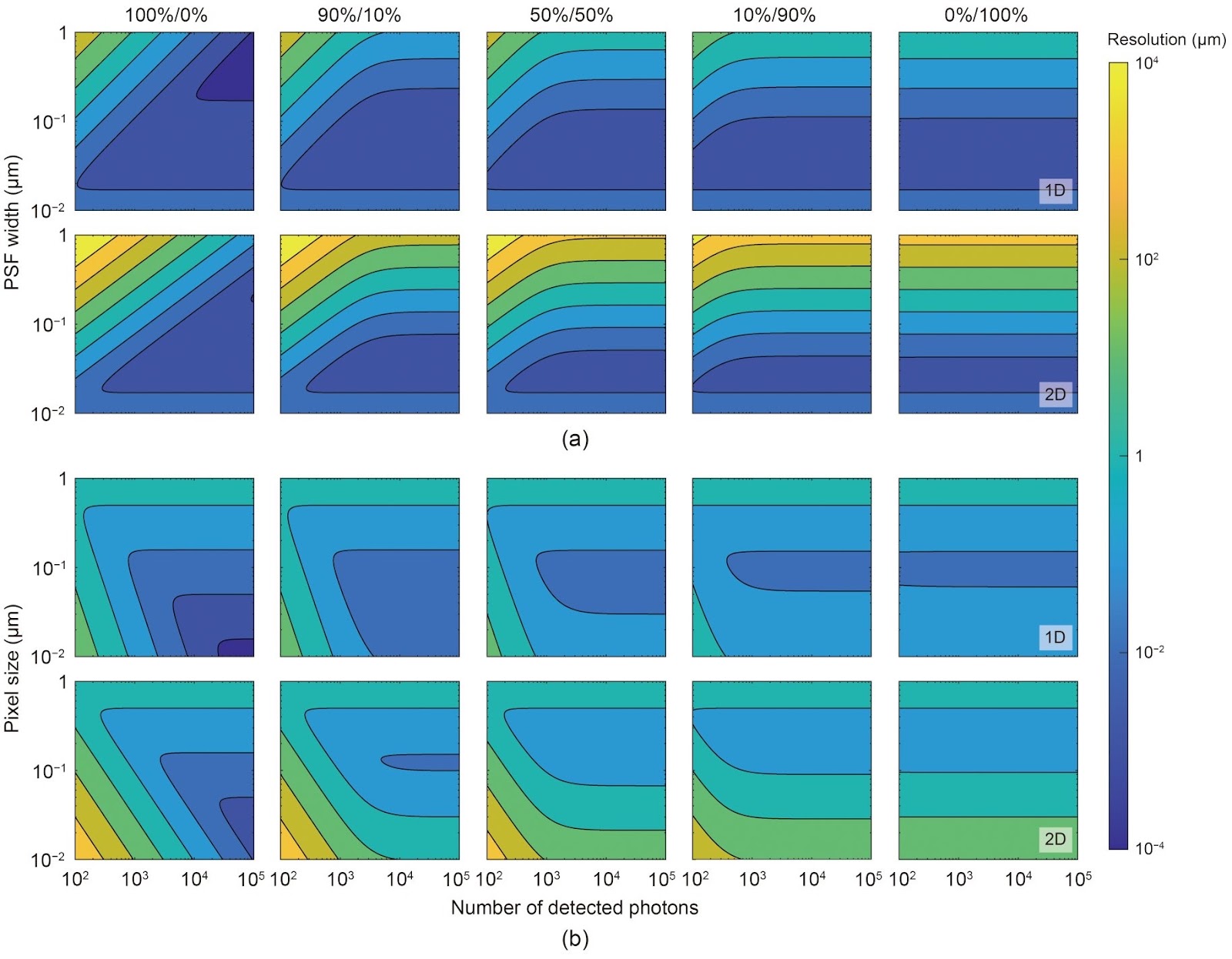
- •• This study provides a comprehensive numerical analysis of factors affecting localization precision and resolution in single emitter localization-based imaging systems, incorporating more parameters than previous studies. • It distinguishes the effects of additive and multiplicative noise on localization precision, and quantifies the influence of sampling frequency, offering optimal sampling frequency values for different resolution needs. • The paper establishes guidelines for selecting signal-to-noise ratio (SNR) and pixel size based on point spread function (PSF) width, enabling better system design for super-resolution imaging. • The findings offer critical theoretical and practical insights for optimizing more complex imaging systems beyond single emitter localization.
Abstract
In this paper, we numerically analyze the factors determining localization precision and resolution in single emitter localization-based imaging systems. While previous studies have considered a limited set of parameters, our numerical approach incorporates additional parameters with significant reference values, yielding a more comprehensive analysis of the results. We differentiate between the effects of additive and multiplicative noise on localization precision using numerical modeling and take the influence of the sampling frequency into account, computing the optimal sampling frequency for varying resolution requirements. Leveraging a suite of derived equations, we systematically simulate and quantify how variations in these parameters influence system performance. Furthermore, we provide guidelines for optimizing signal-to-noise ratio (SNR) requirements and pixel size selection based on point spread function (PSF) width in single emitter localization-based imaging systems. This numerically driven research offers critical insights for the analysis of more complex imaging systems.
1. Introduction
Resolution is a fundamental parameter in optical imaging systems, directly determining the amount of information a system can capture. Researchers have long focused on methods to improve it. However, resolution enhancement is constrained by the Abbe diffraction limit; when passing through the optical system, an ideal point object becomes a spot due to diffraction, meaning that two closely spaced points may become indistinguishable. Efforts have been made to overcome the diffraction limit barrier using various approaches. Stimulated emission depletion microscopy (STED) and structured illumination microscopy (SIM) have improved the resolution through point spread function (PSF) engineering and frequency-domain analysis.
Additionally, single-molecule localization microscopy (SMLM) sidesteps the need to resolve two points by focusing on single-point imaging. In SMLM, the center position of each individual spot can be determined with greater precision than the spot size. The localization precision and accuracy of single-point positioning methods have been extensively studied, providing a solid theoretical and experimental foundation for understanding the limits of spatial resolution in fluorescence microscopy. The relationship between the localization precision and resolution is described by Rlimit = 2√(2ln2) Δx ≈ 2.35 Δx, offering a method to circumvent the system’s diffraction limit and enabling higher imaging resolution.
Loading authentic research manuscript (Pages 1–5)...
Yueying WANG, Yiwen HU, Yuehan ZHAO, Cuifang KUANG, Xiang HAO (2025). Numerical investigation of resolution in single emitter localization-based imaging systems. Frontiers of Information Technology & Electronic Engineering. https://doi.org/10.1631/FITEE_2500015
Research & Educational Purpose Only:The translations, structured abstracts, analytical annotations, and data reports provided by SinoTechIntel are intended exclusively for academic research, internal corporate R&D, and educational benchmarking. They do not constitute formal engineering, chemical safety, legal, or professional advice.
Copyright & Intellectual Property Notice: Original copyright of the underlying source articles and experimental data remains with the respective authors, institutions, and original publishing journals. SinoTechIntel claims intellectual property only over its proprietary translations, analytical syntheses, and AEO structured enhancements in accordance with international fair use and academic citation principles.
Frequently Asked Questions
What is the main focus of this paper?
The paper numerically investigates the factors that determine localization precision and resolution in single emitter localization-based imaging systems, such as SMLM, and provides guidelines for optimizing system parameters.
How does this study differ from previous analyses?
Unlike earlier studies that considered a limited set of parameters, this work incorporates additional parameters including additive and multiplicative noise and sampling frequency, leading to a more comprehensive analysis.
What is the significance of the relationship Rlimit ≈ 2.35 Δx?
This relationship connects the resolution limit to localization precision, showing that by achieving high localization precision, one can overcome the diffraction limit and achieve higher imaging resolution.
What practical guidelines does the paper provide?
The paper offers guidelines for optimizing signal-to-noise ratio (SNR) requirements and pixel size selection based on point spread function (PSF) width, which are critical for designing high-performance imaging systems.
Why is sampling frequency important in this context?
Sampling frequency affects localization precision; the paper computes optimal sampling frequencies for different resolution requirements, helping to balance data acquisition and resolution.
Related Technical Papers & Translations
Design and optimization of a high-efficiency distillation process for cellulosic fuel ethanol integrated with thermal coupling and molecular sieve adsorption
To address the challenges of high energy consumption and prominent costs in the traditional three-columns distillation process for cellulosic fuel ethanol, a distillation—molecular sieve coupling separation process is proposed. This process integrates a three-column (crude distillation column, first distillation column, second distillation column) system with a 3A molecular sieve adsorption deep dehydration unit. A thermal coupling network is constructed via differential pressure design (steam from medium/high-pressure columns as mutual heat sources, reboiler liquid waste heat for feed preheating), and molecular sieve adsorption conditions are optimized. The study first performs a thermodynamic consistency test on the ethanol—water system, determines optimal non-random two-liquid (NRTL) model binary interaction parameters via experimental data regression for Aspen Plus simulation. Aiming at minimum total annual cost (TAC), Aspen Plus is used to optimize process parameters (theoretical tray number, feed location, reflux ratio, side-draw position, etc.). Economic analysis shows this process reduces CO2 emission costs by 27.56%, TAC by 15.58% (to 5.123 × 10⁶ USD·a-1), and increases ethanol purity to >99.6%, providing an effective solution for green, efficient separation.
A cohesion loss model for determining residual strength of deep bedded sandstone
Rock residual strength, as an important input parameter, plays an indispensable role in proposing the reasonable and scientific scheme about stope design, underground tunnel excavation and stability evaluation of deep chambers. Therefore, previous residual strength models of rocks established were reviewed. And corresponding related problems were stated. Subsequently, starting from the effects of bedding and whole life-cycle evolution process, series of triaxial mechanical tests of deep bedded s
Federated model with contrastive learning and adaptive control variates for human activity recognition
Recent attention to privacy issues demands a communication-safe method for training human activity recognition (HAR) models on client activity data. Federated learning (FL) has become a compelling technique to facilitate model training between the server and clients while preserving data privacy. However, classical FL methods often assume independent and identically distributed (IID) data among clients. This assumption does not hold true in practical scenarios. Human activity in real-world scena