Key Takeaways & Executive Findings
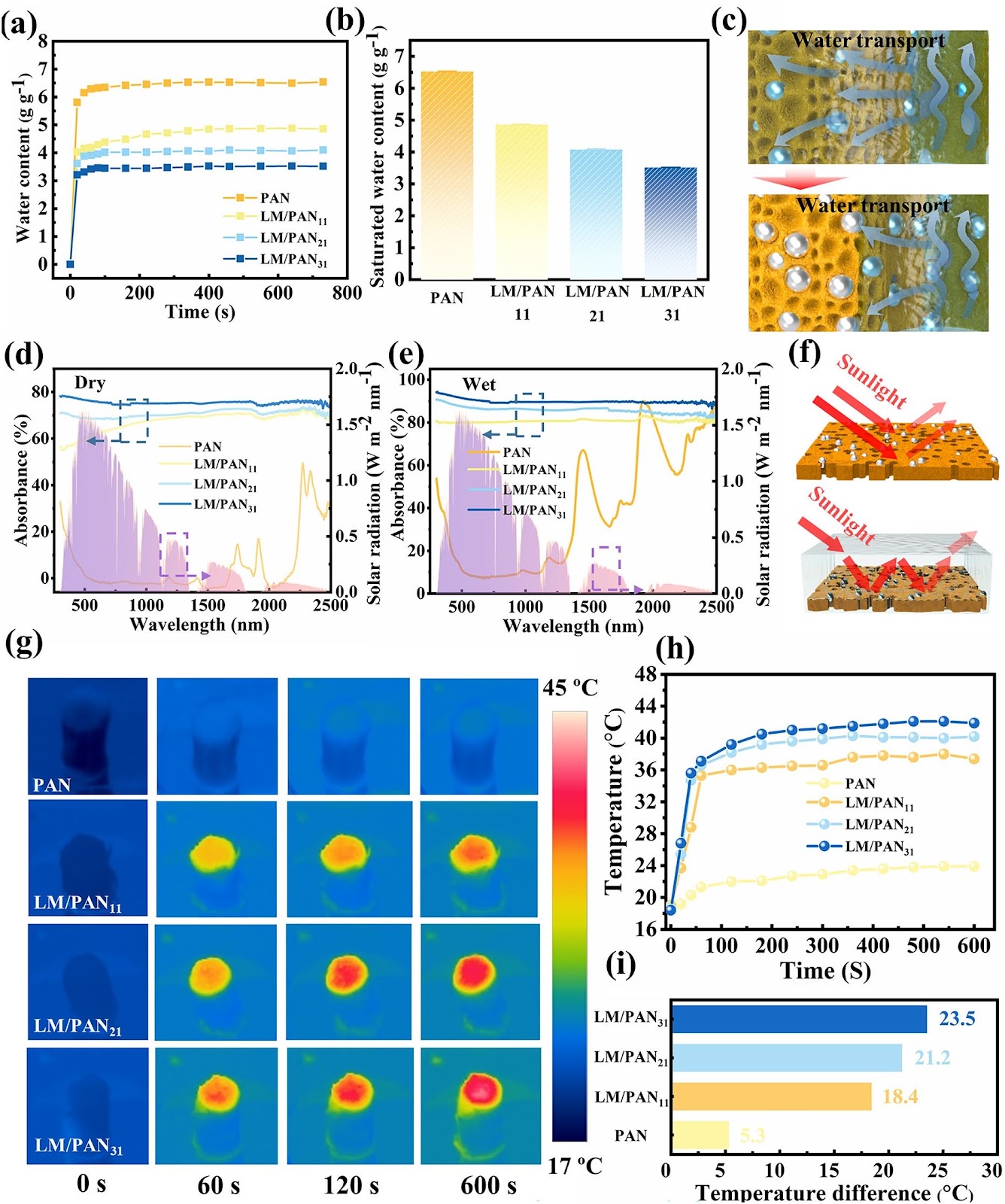
- •• A three-dimensional multiscale liquid metal/polyacrylonitrile (LM/PAN) evaporator is fabricated via wet spinning and assembly, inspired by the hierarchical stem structure of the bird of paradise. • The evaporator achieves an outstanding water evaporation rate of 2.66 kg m−2 h−1 with a solar energy efficiency of 96.5% under one sun irradiation, and 2.58 kg m−2 h−1 in brine. • The evaporator demonstrates superior purification performance for seawater, reducing Na+, Mg2+, K+, and Ca2+ concentrations by three orders of magnitude to less than 7 mg L−1 after desalination. • The hierarchical structure of the LM/PAN evaporator optimizes water transportation and thermal management, offering valuable design principles for advanced solar steam generation systems.
Abstract
Solar steam generation (SSG) offers a cost-effective solution for producing clean water by utilizing solar energy. However, integrating effective thermal management and water transportation to develop high-efficiency solar evaporators remains a significant challenge. Here, inspired by the hierarchical structure of the stem of bird of paradise, a three-dimensional multiscale liquid metal/polyacrylonitrile (LM/PAN) evaporator is fabricated by assembling LM/PAN fibers. The strong localized surface plasmon resonance of LM particles and porous structure of LM/PAN fibers with interconnected channels lead to efficient light absorption up to 90.9%. Consequently, the multiscale biomimetic LM/PAN evaporator achieves an outstanding water evaporation rate of 2.66 kg m−2 h−1 with a solar energy efficiency of 96.5% under one sun irradiation and an exceptional water rate of 2.58 kg m−2 h−1 in brine. Additionally, the LM/PAN evaporator demonstrates a superior purification performance for seawater, with the concentration of Na+, Mg2+, K+ and Ca2+ in real seawater dramatically decreased by three orders to less than 7 mg L−1 after desalination under light irradiation. The multiscale LM/PAN evaporator with hierarchical structure regulates the water transportation as well as thermal management for highly effective solar-driven evaporation, providing valuable insight into the structural design principles for advanced SSG systems.
1. Introduction
With the boosting population growth and severe environmental pollution, global freshwater scarcity becomes an essential issue confronting more than three billion people [1–3]. Consequently, an urgent demand arises for the development of facile and effective water purification and desalination technologies [4–6]. To date, a variety of technologies, including thermal distillation, electrodialysis and reverse osmosis, are used for water purification and desalination [7]. However, most of these technologies rely on non-renewable fossil fuels, leading to elevated emissions [8]. In contrast, solar steam generation (SSG), which utilizes eco-friendly solar energy to generate potable water, has garnered considerable attention [9–12].
An ideal SSG system features strong light absorption, effective thermal management, as well as prompted water transportation [13, 14]. The light absorption is greatly determined by the properties and microstructure of photothermal material [15]. Thus, various photothermal materials have been developed, including plasmonic particles [16–18], semiconductors [19, 20], carbonaceous materials [21–24] and polymers [25–27]. Eutectic gallium/indium, a near-room-temperature liquid metal (LM), exhibits outstanding plasmonic effect similar to gold [28–30] and silver particles [31], enabling LM particles as potential photothermal materials utilized in SSG system [32–34]. Meanwhile, LM particles demonstrate significant potential for high-efficiency thermal management due to the high latent heat, heat flux density as well as lower density compared to traditional metals [35–37]. Compared with carbon nanomaterials such as carbon nanotube and graphene, which suffer from significant heat loss during conduction due to their high thermal conductivity [38, 39], LM particles process a relatively low thermal conductivity (26.6 W m−1 K−1) [40]. More importantly, LM particle triggers a better isolation when integrated into substrate, leading to the reduced heat loss [41].
Additionally, LM particles exhibit superior hydrophilicity compared to gold and silver particles due to the easy formation of a thin oxide film on their surface [42, 43]. There are three kinds of water clusters, including free water (FW), intermediate water (IW) and bound water (BW), according to the different interactions between water molecules [44]. Due to weaker interaction with adjacent water molecules, the evaporation rate of IW is significantly higher than that of FW [45, 46]. By incorporating LM particles with various hydrophilic materials, such as polyvinyl alcohol [47], cellulose [48] and chitosan [49], the interactions between water and evaporator were enhanced, leading to the increase of IW and the decrease in the evaporation enthalpy [50–53]. Consequently, it can be inferred that LM particle can achieve effective photothermal conversion, low heat loss and suitable water supply ability, which is beneficial to enhance the SSG performance [54]. However, the fluidic nature of LM leads to the weak compatibility with polymers, posing challenges for preparing solid LM–polymer composites.
Loading authentic research manuscript (Pages 1–5)...
Yuxuan Sun, Dan Liu, Fei Zhang, Xiaobo Gao, Jie Xue, Qingbin Zheng (2025). Multiscale Biomimetic Evaporators Based on Liquid Metal/Polyacrylonitrile Composite Fibers for Highly Efficient Solar Steam Generation. Nano-Micro Letters. https://doi.org/10.1007/s40820-025-01661-z
Research & Educational Purpose Only:The translations, structured abstracts, analytical annotations, and data reports provided by SinoTechIntel are intended exclusively for academic research, internal corporate R&D, and educational benchmarking. They do not constitute formal engineering, chemical safety, legal, or professional advice.
Copyright & Intellectual Property Notice: Original copyright of the underlying source articles and experimental data remains with the respective authors, institutions, and original publishing journals. SinoTechIntel claims intellectual property only over its proprietary translations, analytical syntheses, and AEO structured enhancements in accordance with international fair use and academic citation principles.
Frequently Asked Questions
What is the main innovation of this study?
The study introduces a three-dimensional multiscale biomimetic evaporator made of liquid metal/polyacrylonitrile (LM/PAN) composite fibers, inspired by the hierarchical stem structure of the bird of paradise. This design achieves efficient light absorption, thermal management, and water transportation, leading to high-performance solar steam generation.
What are the key performance metrics of the LM/PAN evaporator?
The evaporator achieves a water evaporation rate of 2.66 kg m−2 h−1 with a solar energy efficiency of 96.5% under one sun irradiation. In brine, it maintains an evaporation rate of 2.58 kg m−2 h−1, demonstrating excellent performance in saline conditions.
How does the LM/PAN evaporator purify seawater?
The evaporator effectively desalinates seawater by reducing the concentrations of Na+, Mg2+, K+, and Ca2+ by three orders of magnitude to less than 7 mg L−1 after light irradiation, meeting drinking water standards.
What are the advantages of using liquid metal in solar evaporators?
Liquid metal particles exhibit strong localized surface plasmon resonance for efficient light absorption, relatively low thermal conductivity to minimize heat loss, and superior hydrophilicity due to oxide film formation, which enhances water transport and reduces evaporation enthalpy.
What is the significance of the hierarchical structure in the evaporator?
The hierarchical structure, inspired by the bird of paradise stem, provides interconnected channels that facilitate water transportation and thermal management, optimizing the evaporation process and improving overall efficiency.
Related Technical Papers & Translations
Direct Repair of the Crystal Structure and Coating Surface of Spent LiFePO4 Materials Enables Superfast Li-Ion Migration
The rapid accumulation of spent LiFePO4 (LFP) cathodes from retired lithium-ion batteries necessitates the development of effective and environmental-friendly recycling strategies. In this context, direct regeneration has emerged as a promising approach for reclaiming LFP cathode materials, offering a streamlined pathway to restore their electrochemical functionality. We report an integrated regeneration protocol that simultaneously repairs the degraded crystal structure and reconstructs the damaged carbon coating in spent LFP. The regenerated cathode material had superfast lithium-ion diffusion kinetics and a stable cathode–electrolyte interface, giving a remarkable rate capability with specific capacities of 122 mAh g−1 at 5C and 106 mAh g−1 at 10C (1C = 170 mA g−1). It also maintained capacities of 110.7 mAh g−1 (5C) and 84.1 mAh g−1 (10C) after 400 cycles. It could be used in harsh environments and could be stably cycled at subzero temperatures (−10 and −20 °C) and in solid-state electrolyte batteries. Life cycle assessment combined with economic evaluation using the EverBatt model reveals that this direct regeneration approach has high economic and environmental benefits.
Oxide Semiconductor for Advanced Memory Architectures: Atomic Layer Deposition, Key Requirement and Challenges
Oxide semiconductors (OSs), introduced by the Hosono group in the early 2000s, have evolved from display backplane materials to promising candidates for advanced memory and logic devices. The exceptionally low leakage current of OSs and compatibility with three-dimensional (3D) architectures have recently sparked renewed interest in their use in semiconductor applications. This review begins by exploring the unique material properties of OSs, which fundamentally originate from their distinct electronic band structure. Subsequently, we focus on atomic layer deposition (ALD), a core technique for growing excellent OS films, covering both basic and advanced processes compatible with 3D scaling. The basic surface reaction mechanisms—adsorption and reaction—and their roles in film growth are introduced. Furthermore, material design strategies, such as cation selection, crystallinity control, anion doping, and heterostructure engineering, are discussed. We also highlight challenges in memory applications, including contact resistance, hydrogen instability, and lack of p-type materials, and discuss the feasibility of ALD-grown OSs as potential solutions. Lastly, we provide an outlook on the role of ALD-grown OSs in memory technologies. This review bridges material fundamentals and device-level requirements, offering a comprehensive perspective on the potential of ALD-driven OSs for next-generation semiconductor memory devices.
Laser powder bed fusion of biodegradable Zn-4Cu alloy: Processing, microstructure and properties
Zn's natural degradability and biocompatibility make it a promising candidate for implants, however, its mechanical properties remain insufficient for bone applications. In this study, the performance of Zn was enhanced by developing Zn-Cu alloys via laser powder bed fusion (LPBF). Optimal LPBF parameters for forming stable tracks were achieved by adjusting laser power and scanning speed. Under optimized conditions of 100 W and 100 mm/s, high-density (99.58%) Zn-Cu alloys with improved hardness (68.2HV) and yield strength (160 MPa) were achieved. These improvements are attributed to solid solution strengthening, segregation strengthening, and grain refinement. The Zn-Cu alloys also demonstrated favorable degradation behavior, with a rate of 0.16 mm/year. This degradation is primarily driven by micro-galvanic corrosion between the CuZn5 phase and Zn matrix, along with refined grains and increased grain boundary density. This work demonstrates a viable strategy for fabricating Zn-based implants with enhanced structural integrity and mechanical performance via LPBF.