Key Takeaways & Executive Findings
- •• Conventional PLL-based divider chains and multi-core LC oscillators face scalability challenges as operating frequencies approach transistor cutoff frequency (fT), including limited speed, power efficiency, and phase-count scalability. • LC-based designs incur substantial area overhead, limited phase counts, and increased sensitivity to device mismatch, degrading phase accuracy as the number of phases increases. • Passive phase-shifting networks, such as coupled-resonator-based quadrature hybrids (CRQHs), offer alternative approaches for multi-phase clock generation, potentially overcoming some limitations of active techniques. • Future multi-phase clock generation techniques must address the stringent requirements of high-speed wireline and wireless systems, including RMS jitter, phase accuracy, and robustness against PVT variations.
Abstract
Multi-phase clocks are widely used in modern wireline and wireless communication systems, serving as fundamental timing and phase references across diverse architectures. As data rates and carrier frequencies continue to scale, both the required phase count and operating frequency have increased substantially, pushing conventional clock generation techniques toward their fundamental limits. This paper reviews conventional multi-phase clock generation techniques, including PLL-based divider chains and multi-core LC oscillators, and discusses their limitations in high-frequency and wideband applications. It also explores passive phase-shifting networks based on LC or RC components, such as coupled-resonator-based quadrature hybrids (CRQHs), as alternative approaches. The paper highlights the challenges of phase accuracy, jitter, power efficiency, and scalability, and provides insights into future directions for multi-phase clock generation toward high-frequency and wideband systems.
1. Introduction
Multi-phase clocks are widely used in modern wireline and wireless communication systems, serving as fundamental timing and phase references across diverse architectures. As data rates and carrier frequencies continue to scale, both the required phase count and operating frequency have increased substantially, pushing conventional clock generation techniques toward their fundamental limits.
In high-speed wireline transceivers, multi-phase clocks are essential for CDR phase interpolation, time-interleaved ADCs, and advanced PAM-based modulation schemes, imposing stringent requirements on RMS jitter, phase accuracy, and robustness against process, voltage, and temperature (PVT) variations. At bit rates beyond 200 Gb/s, generating a large number of precise clock phases directly at the target frequency becomes increasingly challenging, particularly for divider-based architectures.
In wireless and millimeter-wave systems, multi-phase clocks are widely employed for local oscillator (LO) generation, quadrature modulation, and beam steering in phased-array transceivers, where phase accuracy often dominates over absolute jitter, as phase errors directly translate into beam pointing errors and degraded error vector magnitude (EVM), while high carrier frequencies and massive parallelism further constrain area and power consumption.
Loading authentic research manuscript (Pages 1–5)...
Junyan Bi, Hao Xu, Na Yan (2026). Multi-phase clock generation techniques toward high-frequency and wideband applications. SinoTechIntel Verified Research. https://doi.org/10.1088/1674-4926/26020027
Research & Educational Purpose Only:The translations, structured abstracts, analytical annotations, and data reports provided by SinoTechIntel are intended exclusively for academic research, internal corporate R&D, and educational benchmarking. They do not constitute formal engineering, chemical safety, legal, or professional advice.
Copyright & Intellectual Property Notice: Original copyright of the underlying source articles and experimental data remains with the respective authors, institutions, and original publishing journals. SinoTechIntel claims intellectual property only over its proprietary translations, analytical syntheses, and AEO structured enhancements in accordance with international fair use and academic citation principles.
Frequently Asked Questions
What are the main challenges in multi-phase clock generation for high-frequency applications?
The main challenges include limited speed and power efficiency of divider-based designs, area overhead and phase accuracy degradation in LC-based designs, and increased sensitivity to device mismatch as the number of phases increases.
How do PLL-based architectures generate multi-phase clocks?
PLL-based architectures use a high-frequency oscillator followed by divider chains to generate evenly spaced clock phases with well-defined relationships, benefiting from mature design methodologies and high phase accuracy.
What are the limitations of LC-based multi-phase oscillators?
LC-based multi-phase oscillators incur substantial area overhead, limited phase counts, and increased sensitivity to device mismatch, which degrades phase accuracy as the number of phases increases.
What alternative approaches exist for multi-phase clock generation?
Passive phase-shifting networks based on LC or RC components, such as coupled-resonator-based quadrature hybrids (CRQHs), offer alternative approaches that may overcome some limitations of active techniques.
Why is phase accuracy more critical than jitter in wireless systems?
In wireless and millimeter-wave systems, phase errors directly translate into beam pointing errors and degraded error vector magnitude (EVM), making phase accuracy dominate over absolute jitter.
Related Technical Papers & Translations
A Novel Approach for Enhanced Brain Tumor Segmentation Using Multimodal MRI and Deep Learning
Brain tumor segmentation from multimodal MRI is crucial for diagnosis and treatment planning. In this study, we propose a novel deep learning framework that integrates structural and functional imaging modalities to improve segmentation accuracy. Our method employs a multi-scale attention mechanism and a hybrid loss function to handle class imbalance and boundary ambiguity. Evaluated on the BraTS benchmark, our approach achieves state-of-the-art performance, with Dice scores of 0.91, 0.87, and 0.84 for whole tumor, core, and enhancing tumor, respectively. Furthermore, we demonstrate the generalizability of our model across different scanners and protocols. Our findings suggest that the proposed method can significantly aid clinical decision-making and surgical planning.
Investigation of coupled acoustic and electrical responses and early warning approaches during re-loading of damaged coal
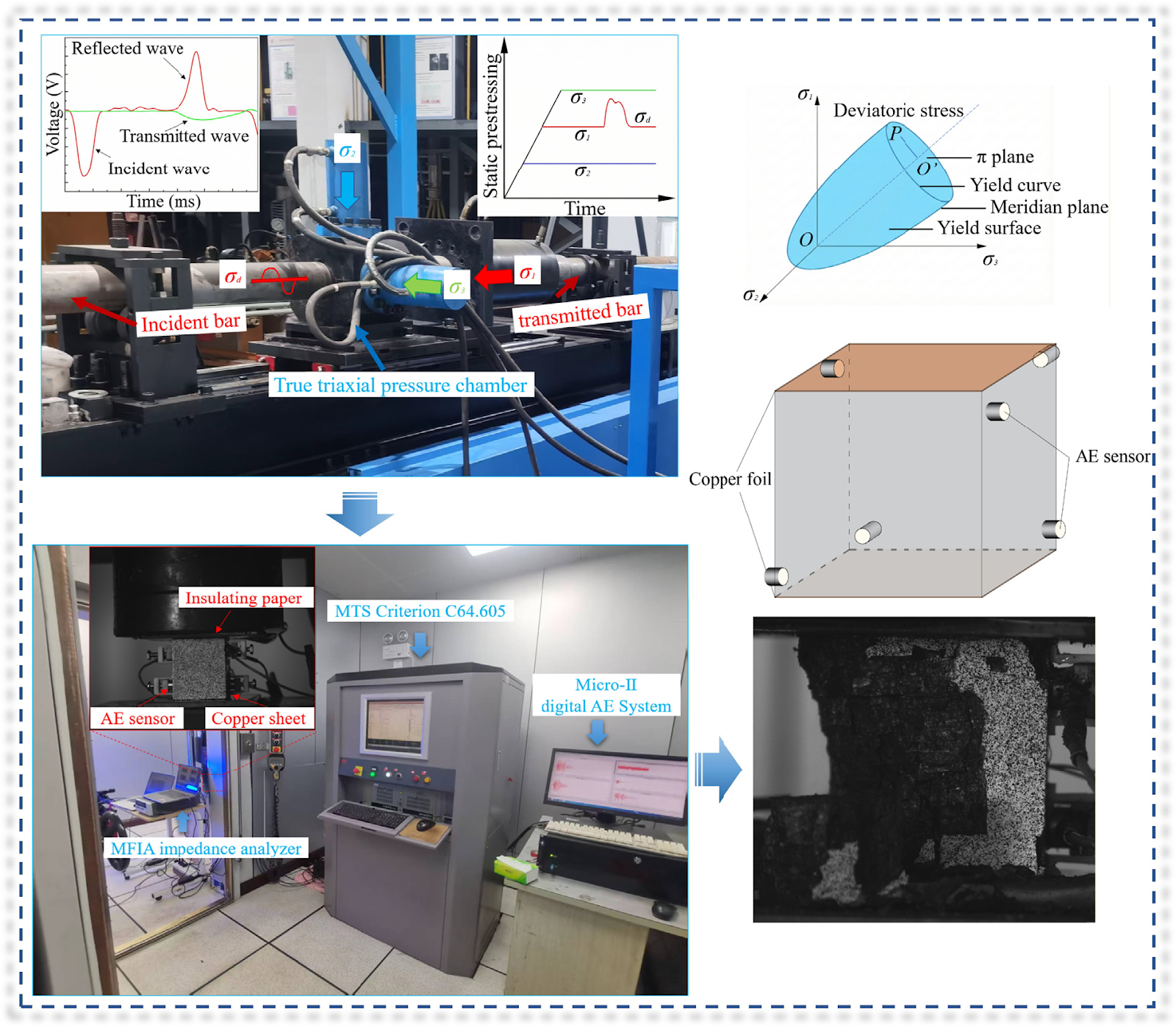
Initial damage from engineering disturbances in deep coal mining degrades mechanical properties and heightens dynamic-hazard risks, challenging conventional monitoring. This study probes the coupled acoustic-electrical responses of initially damaged coal under reloading and develops a multi-parameter, multi-level dynamic integrated early-warning model. Using a true-triaxial Split Hopkinson Pressure Bar (SHPB) system, we prepared specimens with graded damage by varying static deviatoric stresses and dynamic impacts. Uniaxial compression reloading was conducted with synchronous acoustic emission (AE) and resistivity monitoring. Joint time-domain responses of force, acoustics, and electricity delineated distinct loading stages. Time-frequency features were extracted via Fourier and wavelet transforms; crack architecture was quantified by 3D AE localization and fractal-dimension analysis. Initial damage markedly reduced load-bearing capacity. Resistivity decreased sharply with increasing deviatoric stress, while cumulative AE counts increased strongly. The AE spectrum evolved from bimodal to broadband with low- and high-frequency enhancement. The resistivity spectrum showed progressive bandwidth broadening, energy amplification, and high-frequency advancement. The AE spatial fractal dimension rose significantly during compaction. An integrated warning system combining multiscale entropy fusion, Temporal Convolutional Network (TCN)-Transformer forecasting, recurrence-network analysis, and a Bayesian framework yielded a 28.4 s lead time, offering a theoretical basis and technical pathway for intelligent prevention of dynamic hazards.
Influence of aggregate particle size on fracture behavior and energy evolution of cemented rockfill in the post-peak stage
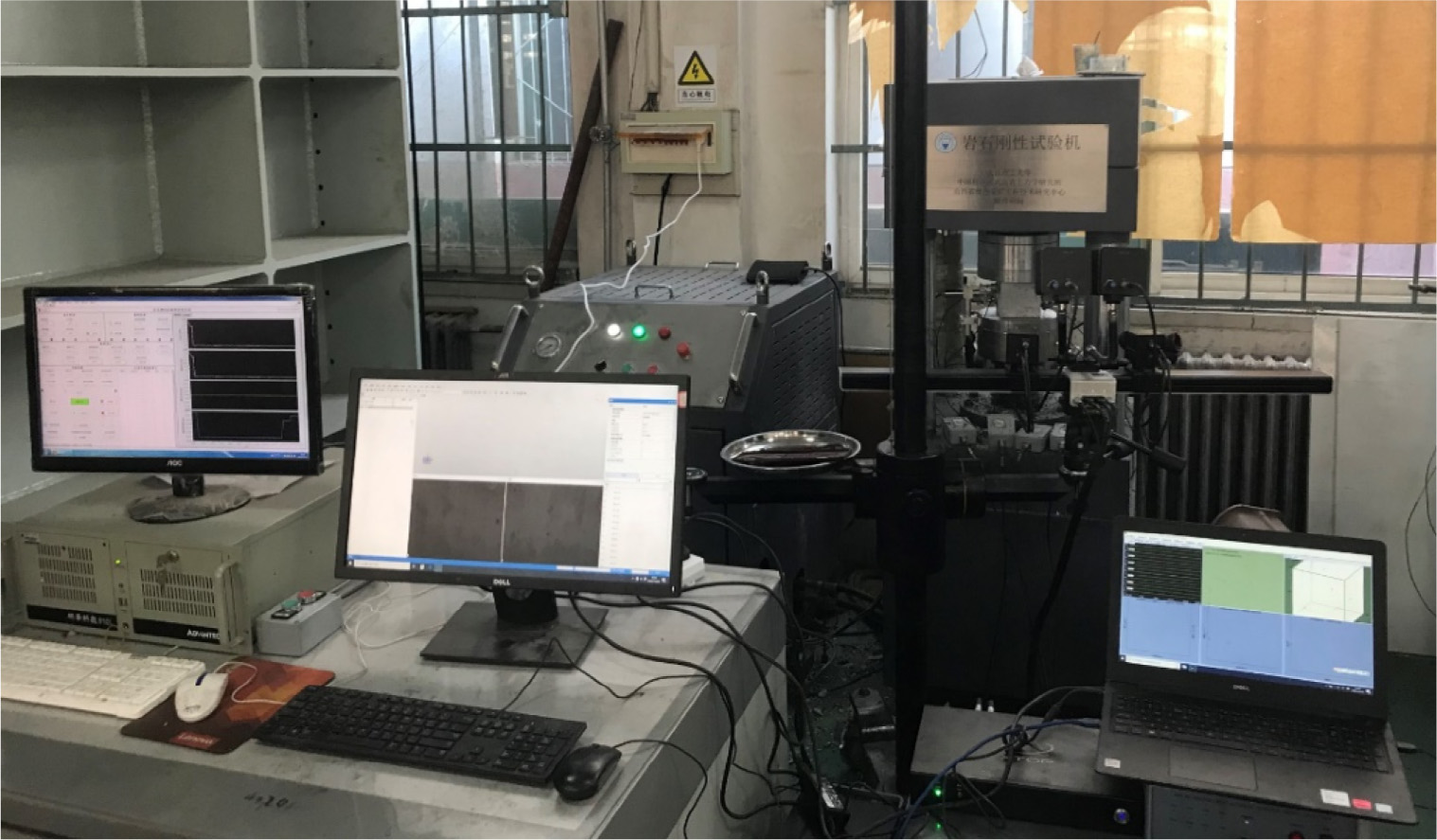
Cemented rockfill (CRF) combines structural support with sustainable reuse of coal-derived solid waste. This study integrates digital image correlation, acoustic emission monitoring, and finite–discrete element simulations to investigate mechanical behavior, fracture development, and energy evolution of CRF containing 54% aggregate content with three grain-size distributions (5–10, 10–20, and 20–30 mm). Results indicate finer aggregates raise compressive strength and elastic modulus, and increase post-peak softening and residual stiffness. Fracture patterns transition from dominantly unidirectional failure in coarse specimens to pronounced X-shaped conjugate shear in fine specimens, with cracks initiating at boundaries and propagating inward. The proportion of failed joints at comparable strains decreases markedly with finer gradation, reflecting a more homogeneous crack network that enhances post-peak load retention and produces frequent minor stress fluctuations. Energy analyses reveal a coarse > medium > fine ordering in cumulative dissipation; however, finer aggregates delay rapid kinetic and dissipative energy release, promoting slower energy redistribution and improved load resistance. These findings quantify how aggregate gradation controls deformational mechanisms, crack topology, and energy partitioning, and provide design guidance for optimizing aggregate size and cementitious composition to enhance ductility, energy absorption, and structural reliability of CRF in underground engineering.