Key Takeaways & Executive Findings
- •• Increasing spinning temperature from 309°C to 320°C in industrial equipment enhances both thermal conductivity (from 704 to 1078 W·m−1·K−1) and tensile strength (from 2.16 to 3.23 GPa) of mesophase-pitch-based carbon fibers. • Higher spinning temperature induces a morphological transition in graphite layers from fine-and-folded to large-and-flat, indicating improved molecular orientation. • The improved properties are attributed to reduced viscosity and weaker die-swell effect at spinneret outlets, leading to better alignment of mesophase pitch molecules. • This study provides a practical approach for industrial production of high-performance carbon fibers with superior thermal and mechanical properties.
Abstract
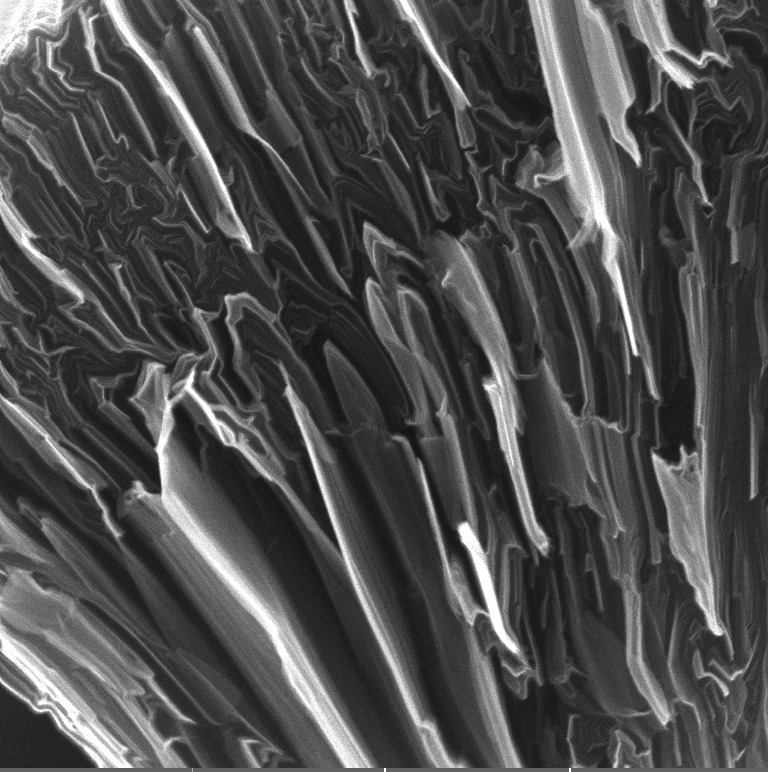
Mesophase-pitch-based carbon fibers (MPCFs) were prepared using industrial equipment with a constant extrusion rate of pitch while controlling the spinning temperature. The influence of spinning temperature on their microstructures, mechanical properties and thermal conductivities was investigated. SEM images of the fractured surface of MPCFs show that the graphite layers have a radiating structure at all spinning temperatures, but change from the fine-and-folded to the large-and-flat morphology when increasing the spinning temperature from 309 to 320 oC. At the same time the thermal conductivity and tensile strength of the MPCFs respectively increase from 704 W·m−1·K−1 and 2.16 GPa at 309 oC to 1 078 W·m−1·K−1 and 3.23 GPa at 320 oC. The lower viscosity and the weaker die-swell effect of mesophase pitch at the outlets of the spinnerets at the higher spinning temperature contribute to the improved orientation of mesophase pitch molecules in the pitch fibers, which improves the crystallite size and orientation of the MPCFs.
1. Introduction
Mesophase-pitch-based carbon fibers (MPCFs) have been widely used in the fields of aerospace, electronic products, nuclear industry and industrial robots[1–5] owing to their high thermal conductivity and high modulus. These excellent properties are ascribed to their highly oriented large-size graphite microcrystal structure which was derived from the orientated structure of the discoid nematic liquid crystal molecules formed in spinneret channels from the mesophase pitch. It is generally believed that the mesophase pitch molecular arrangement formed in the melt-spinning process plays a decisive role in the structures and properties of the resultant MPCFs. In comparison, the subsequent oxidative stabilization, carbonization and graphitization provide just a further modification and improvement[6]. Therefore, it is necessary to investigate systematically the effect of the spinning conditions on the microstructures and properties of the MPCFs.
Tailoring microstructures and properties of MPCFs are immensely complicated by numerous influencing factors such as raw material, spinning temperature, pressure, winding speed, mesh structure and spinneret shape[7–12]. At present, researchers have investigated the effect of melt-spinning temperature on the microstructures and properties of MPCFs, but these studies are mainly based on the melt-spinning process of the "pneumatic single-hole spinning equipment". For example, Yamada et al.[13] found that the cross section structure of MPCFs changed from "onion-skin" shape to "random" shape and then to "radial" shape with the decreasing of the spinning temperature, eventually reaching a "radial-split" shape at the lowest spinning temperature. However, White and Buechler et al.[14] concluded that high viscosity of pitch melt was not conducive to the formation of the radial structure in their experiments. Mochida and Yoon et al. [15–17] prepared the "radial" structure and "onion-skin" structure MPCFs at low and high spinning temperatures, respectively. Nevertheless, Ogale et al.[18] obtained the "circular radial" structure and "radial-split" structure at high and low spinning temperatures, respectively. Recently, Liu et al. [19] studied the effect of spinning temperature on the structure and properties of MPCFs by using a nitrogen pressure-driven single-hole equipment, and found that the structure of MPCFs changed from irregular shape to onion skin with the increase of spinning temperature. In summary, different researchers come to different or even contradictory conclusions using a pneumatic single-hole spinning equipment because of the complicated interaction of extrusion pressure.
Loading authentic research manuscript (Pages 1–5)...
YE Gao-ming, SHI Kui, WU Huang, HUANG Dong, YE Chong, OUYANG Ting, ZHU Shi-peng, FAN Zhen, LIU Hong-bo, LIU Jin-shui (2024). Improving the mechanical properties and thermal conductivity of mesophase-pitch-based carbon fibers by controlling the temperature in industrial spinning equipment. New Carbon Materials. https://doi.org/10.1016/S1872-5805_N
Research & Educational Purpose Only:The translations, structured abstracts, analytical annotations, and data reports provided by SinoTechIntel are intended exclusively for academic research, internal corporate R&D, and educational benchmarking. They do not constitute formal engineering, chemical safety, legal, or professional advice.
Copyright & Intellectual Property Notice: Original copyright of the underlying source articles and experimental data remains with the respective authors, institutions, and original publishing journals. SinoTechIntel claims intellectual property only over its proprietary translations, analytical syntheses, and AEO structured enhancements in accordance with international fair use and academic citation principles.
Frequently Asked Questions
What is the effect of spinning temperature on the thermal conductivity of mesophase-pitch-based carbon fibers?
Increasing the spinning temperature from 309°C to 320°C significantly enhances the thermal conductivity of MPCFs from 704 W·m−1·K−1 to 1,078 W·m−1·K−1, due to improved molecular orientation and larger crystallite size.
How does spinning temperature affect the tensile strength of MPCFs?
The tensile strength of MPCFs increases from 2.16 GPa at 309°C to 3.23 GPa at 320°C, attributed to better alignment of mesophase pitch molecules and reduced defects.
What microstructural changes occur in MPCFs with varying spinning temperature?
At higher spinning temperatures, the graphite layers transition from a fine-and-folded morphology to a large-and-flat radiating structure, indicating improved crystallite orientation and size.
Why does higher spinning temperature improve the properties of MPCFs?
Higher spinning temperature reduces the viscosity and die-swell effect of mesophase pitch at spinneret outlets, facilitating better molecular orientation in the pitch fibers, which leads to enhanced crystallite size and orientation after graphitization.
Is this study applicable to industrial production of carbon fibers?
Yes, the study uses industrial spinning equipment with constant extrusion rate, demonstrating that controlling spinning temperature is a practical and effective method to produce high-performance MPCFs with superior thermal and mechanical properties.
Related Technical Papers & Translations

Design and optimization of a high-efficiency distillation process for cellulosic fuel ethanol integrated with thermal coupling and molecular sieve adsorption
To address the challenges of high energy consumption and prominent costs in the traditional three-columns distillation process for cellulosic fuel ethanol, a distillation—molecular sieve coupling separation process is proposed. This process integrates a three-column (crude distillation column, first distillation column, second distillation column) system with a 3A molecular sieve adsorption deep dehydration unit. A thermal coupling network is constructed via differential pressure design (steam from medium/high-pressure columns as mutual heat sources, reboiler liquid waste heat for feed preheating), and molecular sieve adsorption conditions are optimized. The study first performs a thermodynamic consistency test on the ethanol—water system, determines optimal non-random two-liquid (NRTL) model binary interaction parameters via experimental data regression for Aspen Plus simulation. Aiming at minimum total annual cost (TAC), Aspen Plus is used to optimize process parameters (theoretical tray number, feed location, reflux ratio, side-draw position, etc.). Economic analysis shows this process reduces CO2 emission costs by 27.56%, TAC by 15.58% (to 5.123 × 10⁶ USD·a-1), and increases ethanol purity to >99.6%, providing an effective solution for green, efficient separation.

A cohesion loss model for determining residual strength of deep bedded sandstone
Rock residual strength, as an important input parameter, plays an indispensable role in proposing the reasonable and scientific scheme about stope design, underground tunnel excavation and stability evaluation of deep chambers. Therefore, previous residual strength models of rocks established were reviewed. And corresponding related problems were stated. Subsequently, starting from the effects of bedding and whole life-cycle evolution process, series of triaxial mechanical tests of deep bedded s

Federated model with contrastive learning and adaptive control variates for human activity recognition
Recent attention to privacy issues demands a communication-safe method for training human activity recognition (HAR) models on client activity data. Federated learning (FL) has become a compelling technique to facilitate model training between the server and clients while preserving data privacy. However, classical FL methods often assume independent and identically distributed (IID) data among clients. This assumption does not hold true in practical scenarios. Human activity in real-world scena