Key Takeaways & Executive Findings
- •• HyRAS introduces a hybrid fault-tolerant architecture that combines lightweight spatial redundancy and adaptive serialization to maintain communication in chiplet-based 3D NoCs despite permanent TSV faults. • The spatial redundancy mechanism leverages shared TSV resources to handle isolated faults, while adaptive serialization ensures connectivity under severe fault scenarios. • Functional simulations under realistic workloads with significant defect clusters show up to 28.2% higher throughput compared to contemporary fault-tolerant methods. • The architecture incurs modest overheads: a 14.53% increase in area and an 8.87% increase in power relative to a standard redundancy-based router.
Abstract
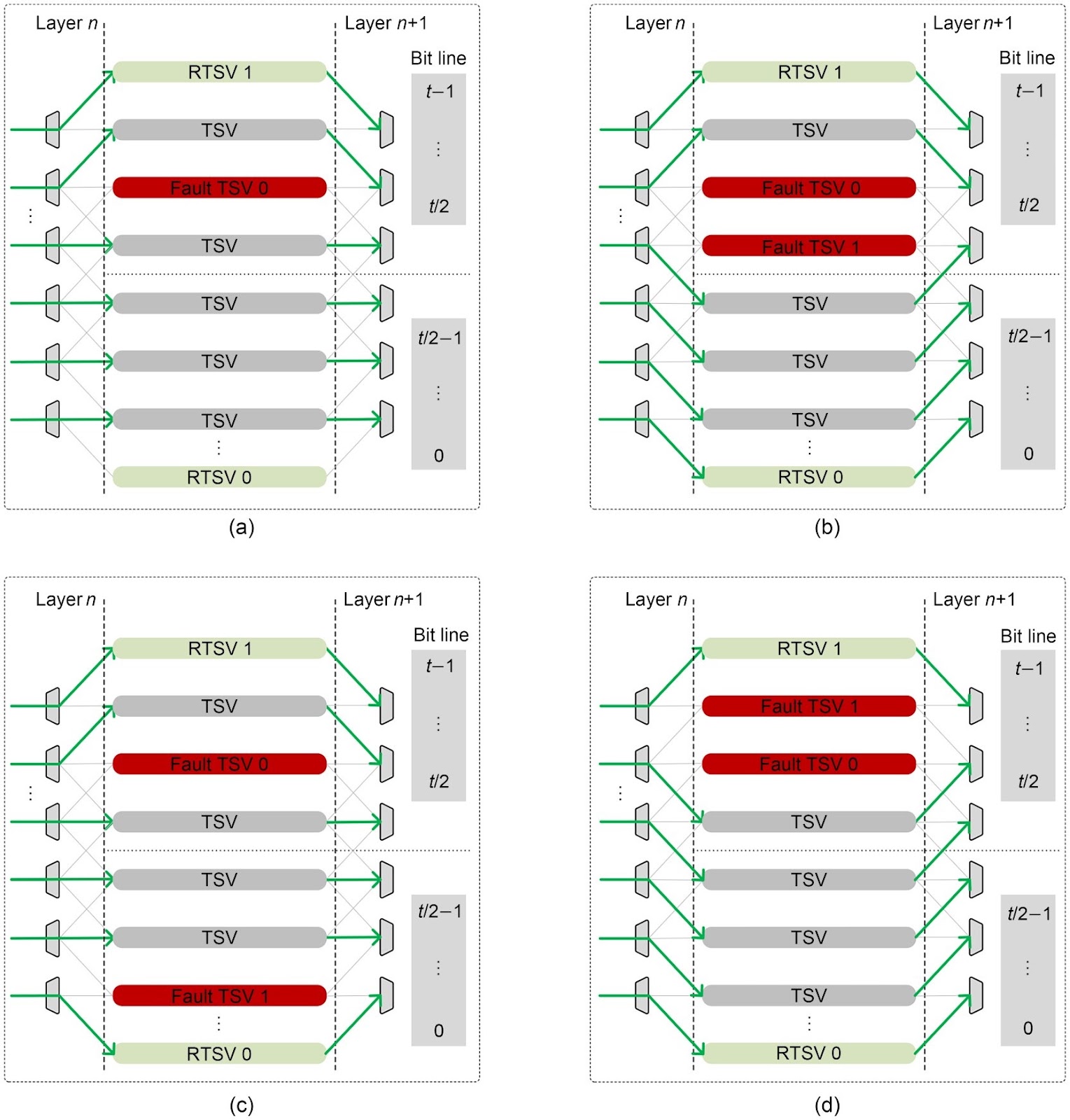
Three-dimensional network-on-chips (3D NoCs) are increasingly used to improve scalability in multicore systems. Through-silicon via (TSV) is a critical technology for enabling vertical interconnects between NoC layers. However, TSV-based interlayer connections are highly prone to faults resulting from manufacturing defects, aging, or other sources, which compromise system reliability. To address these challenges, particularly in chiplet-based 3D NoCs, robust fault-tolerant mechanisms are crucial for maintaining operational integrity in the presence of TSV faults. We introduce a novel fault-tolerant architecture designed to ensure persistent communication reliability despite permanent vertical link failures, named HyRAS, a hybrid redundancy- and serialization-based method. Our approach is built on two synergistic mechanisms. First, a lightweight spatial redundancy-based scheme leverages shared TSV resources to mitigate the impact of isolated faults. Second, for more severe fault scenarios, an adaptive serialization-based strategy is employed to maintain connectivity by efficiently using the remaining functional links. The architecture is rigorously evaluated through functional simulations using both synthetic traffic patterns and realistic application workloads. Compared to contemporary fault-tolerant methods, HyRAS achieves up to 28.2% higher throughput under realistic workloads with significant defect clusters. These gains are achieved with only modest overhead, incurring a 14.53% increase in area and 8.87% increase in power consumption relative to the standard redundancy-based router.
1. Introduction
The relentless drive for greater computational power has spurred an architectural shift from computation-centric designs to communication-centric paradigms. In this landscape, network-on-chips (NoCs) have become the de facto interconnect standard for modern multicore systems (Agarwal et al., 2025; Xiong et al., 2025). To push beyond the limits of two-dimensional (2D) circuits, three-dimensional (3D) integration has emerged, stacking multiple device layers and connecting them with high-speed vertical interconnects. The primary advantage of 3D NoCs is the substantial reduction in global interconnect length, which translates to higher performance and lower power dissipation (Bose and Ghosal, 2020; Fu et al., 2021; Taheri et al., 2023).
However, the development of 3D NoCs comes with many unavoidable challenges. The combination of shrinking process nodes, complex 3D packaging, and higher operating frequencies exacerbates error rates, thermal issues, and timing violations. Among the critical components of 3D integrated circuits (3D-ICs), through-silicon vias (TSVs) are favored for their high-speed and low-power vertical communication capabilities. However, as system complexity grows, so does the threat to reliability. The TSV manufacturing process is notoriously prone to defects, leading to permanent (or hard) faults that can arise during fabrication or from operational stresses such as time-dependent dielectric breakdown (TDDB), electromigration, and thermal cycling (Dang et al., 2020a; da Silva et al., 2025). To address these challenges, various studies have proposed dependable NoC architectures to guarantee strong system performance.
Among the vertical interconnection technologies enabling 3D-ICs, TSV has been widely adopted due to the capacity for high-speed and power-efficient communication between layers. As single-chip designs advance toward peta-scale computation performance, with exascale systems anticipated in the coming decade, system reliability has emerged as a critical challenge. The reliability of on-chip architectures is negatively impacted by increasing power consumption, process variability, and component density. For instance, rapid fluctuations in power consumption can induce on-chip voltage variations, leading to data transmission errors (Hou et al., 2024). Permanent faults, also known as hard faults, occur during manufacturing or operation and persistently disrupt circuit functionality from their moment of onset. The primary physical mechanisms contributing to these permanent faults include TDDB, negative bias temperature instability (NBTI), hot carrier injection (HCI), and electromigration, all of which are driven by mate
Loading authentic research manuscript (Pages 1–5)...
Chenglong SUN, Yanqing ZHOU, Qi WANG, Yan ZHANG (2025). HyRAS: a hybrid redundancy- and serialization-based fault-tolerant architecture for through-silicon vias. Engineering Information Technology & Electronic Engineering. https://doi.org/10.1631/ENG_ITEE_2025_0156
Research & Educational Purpose Only:The translations, structured abstracts, analytical annotations, and data reports provided by SinoTechIntel are intended exclusively for academic research, internal corporate R&D, and educational benchmarking. They do not constitute formal engineering, chemical safety, legal, or professional advice.
Copyright & Intellectual Property Notice: Original copyright of the underlying source articles and experimental data remains with the respective authors, institutions, and original publishing journals. SinoTechIntel claims intellectual property only over its proprietary translations, analytical syntheses, and AEO structured enhancements in accordance with international fair use and academic citation principles.
Frequently Asked Questions
What is HyRAS?
HyRAS is a hybrid redundancy- and serialization-based fault-tolerant architecture designed for through-silicon vias (TSVs) in three-dimensional network-on-chips (3D NoCs). It combines lightweight spatial redundancy and adaptive serialization to ensure reliable vertical communication despite permanent TSV faults.
How does HyRAS handle TSV faults?
HyRAS uses two synergistic mechanisms: a spatial redundancy-based scheme that shares TSV resources to mitigate isolated faults, and an adaptive serialization-based strategy that efficiently uses remaining functional links for more severe fault scenarios.
What performance improvements does HyRAS offer?
In functional simulations with realistic workloads and significant defect clusters, HyRAS achieves up to 28.2% higher throughput compared to contemporary fault-tolerant methods.
What are the overhead costs of implementing HyRAS?
HyRAS incurs a 14.53% increase in area and an 8.87% increase in power consumption relative to the standard redundancy-based router.
Why are TSVs prone to faults in 3D NoCs?
TSV manufacturing is prone to defects, and operational stresses such as time-dependent dielectric breakdown (TDDB), electromigration, and thermal cycling can cause permanent (hard) faults, compromising system reliability.
Related Technical Papers & Translations

Design and optimization of a high-efficiency distillation process for cellulosic fuel ethanol integrated with thermal coupling and molecular sieve adsorption
To address the challenges of high energy consumption and prominent costs in the traditional three-columns distillation process for cellulosic fuel ethanol, a distillation—molecular sieve coupling separation process is proposed. This process integrates a three-column (crude distillation column, first distillation column, second distillation column) system with a 3A molecular sieve adsorption deep dehydration unit. A thermal coupling network is constructed via differential pressure design (steam from medium/high-pressure columns as mutual heat sources, reboiler liquid waste heat for feed preheating), and molecular sieve adsorption conditions are optimized. The study first performs a thermodynamic consistency test on the ethanol—water system, determines optimal non-random two-liquid (NRTL) model binary interaction parameters via experimental data regression for Aspen Plus simulation. Aiming at minimum total annual cost (TAC), Aspen Plus is used to optimize process parameters (theoretical tray number, feed location, reflux ratio, side-draw position, etc.). Economic analysis shows this process reduces CO2 emission costs by 27.56%, TAC by 15.58% (to 5.123 × 10⁶ USD·a-1), and increases ethanol purity to >99.6%, providing an effective solution for green, efficient separation.

A cohesion loss model for determining residual strength of deep bedded sandstone
Rock residual strength, as an important input parameter, plays an indispensable role in proposing the reasonable and scientific scheme about stope design, underground tunnel excavation and stability evaluation of deep chambers. Therefore, previous residual strength models of rocks established were reviewed. And corresponding related problems were stated. Subsequently, starting from the effects of bedding and whole life-cycle evolution process, series of triaxial mechanical tests of deep bedded s

Federated model with contrastive learning and adaptive control variates for human activity recognition
Recent attention to privacy issues demands a communication-safe method for training human activity recognition (HAR) models on client activity data. Federated learning (FL) has become a compelling technique to facilitate model training between the server and clients while preserving data privacy. However, classical FL methods often assume independent and identically distributed (IID) data among clients. This assumption does not hold true in practical scenarios. Human activity in real-world scena