Key Takeaways & Executive Findings
- •• Applying bio-oxidation waste solution in a two-stage oxidation process significantly enhances arsenopyrite bio-oxidation efficiency. • Chemical oxidation with BOS disrupts the mineral surface structure, reduces particle size, and forms nitrogenous substances, promoting Fe3+ cycling and mitigating sulfur film inhibition. • After 18 days, the two-stage process achieves As, Fe, and S extraction rates of 88.8%, 86.7%, and 74.7%, representing increases of 50.8%, 47.1%, and 46.0% over one-stage bio-oxidation. • The study provides a sustainable, environmentally friendly pretreatment strategy for arsenic-containing refractory gold ores, improving gold recovery without additional metal ion supplementation.
Abstract
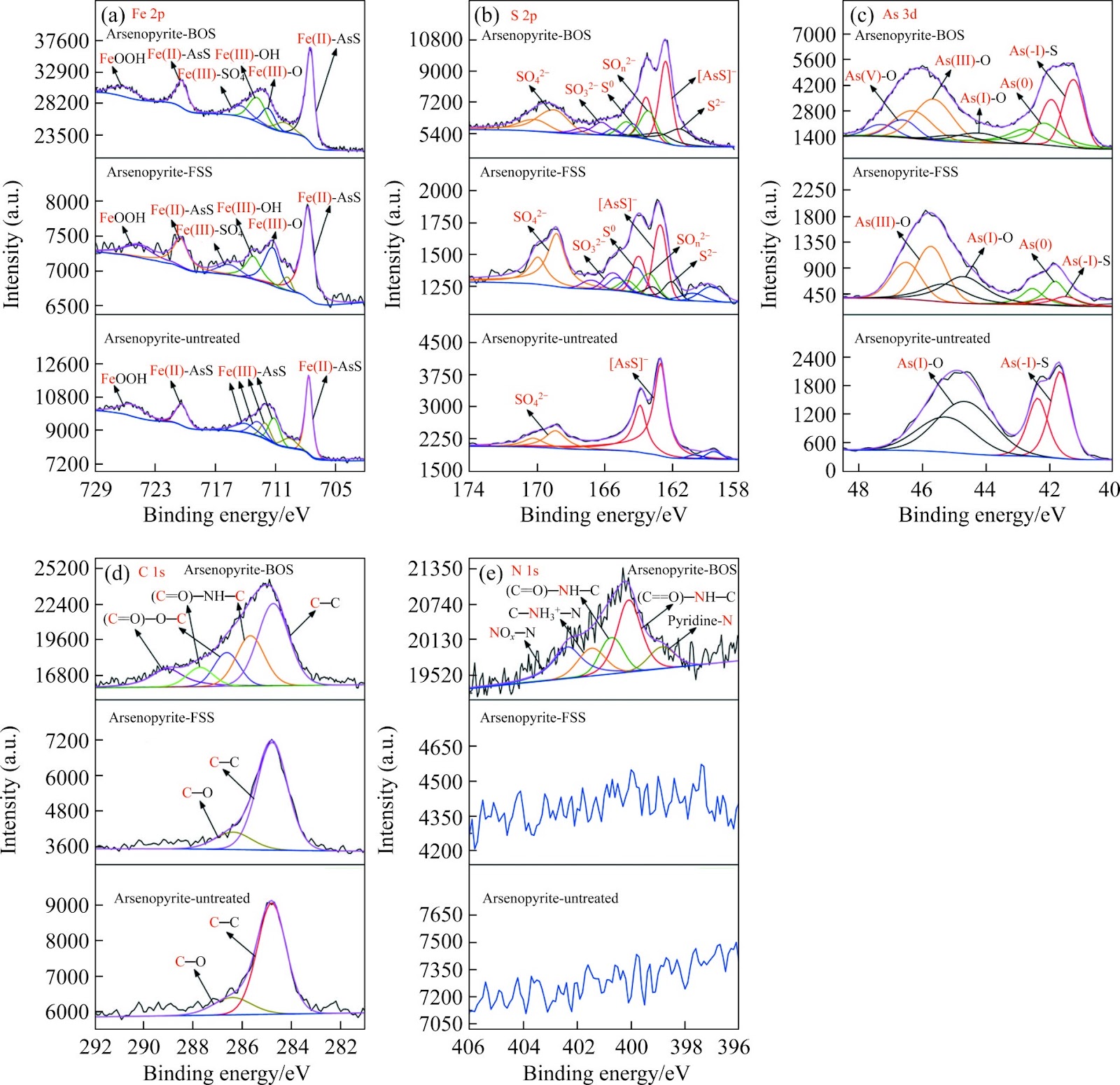
Applying bio-oxidation waste solution (BOS) to chemical-biological two-stage oxidation process can significantly improve the bio-oxidation efficiency of arsenopyrite. This study aims to clarify the enhanced oxidation mechanism of arsenopyrite by evaluating the effects of physical and chemical changes of arsenopyrite in BOS chemical oxidation stage on mineral dissolution kinetics, as well as microbial growth activity and community structure composition in bio-oxidation stage. The results showed that the chemical oxidation contributed to destroying the physical and chemical structure of arsenopyrite surface and reducing the particle size, and led to the formation of nitrogenous substances on mineral surface. These chemical oxidation behaviors effectively promoted Fe3+ cycling in the bio-oxidation system and weakened the inhibitory effect of the sulfur film on ionic diffusion, thereby enhancing the dissolution kinetics of the arsenopyrite. Therefore, the bio-oxidation efficiency of arsenopyrite was significantly increased in the two-stage oxidation process. After 18 d, the two-stage oxidation process achieved total extraction rates of (88.8±2.0)% , (86.7±1.3)%, and (74.7±3.0)% for As, Fe, and S elements, respectively. These values represented a significant increase of (50.8±3.4)%, (47.1±2.7)%, and (46.0±0.7)%, respectively, compared to the one-stage bio-oxidation process.
1. Introduction
Arsenopyrite is an important gold-bearing sulfide in arsenic-containing refractory gold ores. The fine disseminated gold is often encapsulated in arsenopyrite matrix. It is necessary to pretreat these ores before cyanidation to improve gold recovery. However, there are potential environmental threats associated with conventional pretreatment methods including oxidation roasting, pressure oxidation, and chemical oxidation for arsenic-containing refractory gold ores. The release and the harmless treatment of arsenic have become a challenge for industrial production. Bio-oxidation technology has garnered considerable attention for treating these gold ores, as the arsenic in arsenopyrite becomes soluble ions during bio-oxidation and can subsequently be solidified into a stable precipitate through neutralization. Nevertheless, large-scale application is limited by slow dissolution kinetics. This can be attributed to the inhibitory effect of passivation film and the low microbial activity.
It is necessary to improve the microbial activity during arsenopyrite bio-oxidation. Studies show that supplementing ferric iron or adding pyrolusite could improve the microbial activity. Similarly, optimizing the reactor to reduce shearing and frictional interactions between mineral particles and microorganisms could also yield similar results. Eliminating or attenuating the effect of passive layer is the key to increasing the bio-oxidation rate of arsenopyrite. Studies reveal that the addition of Cu2+ and Ag+ contributed to building Cu2+/(Cu2S/CuS) and Ag+/Ag2S catalytic cycles to eliminate the passive film on the arsenopyrite surface. In addition, adding FeCl3 as ferric iron supplement to the system or using a mixed culture of iron-oxidizing and sulfur-oxidizing microorganisms also contributed to the removal of passive film. What is more, ZHANG et al pointed out that the addition of humic acid could not only promote the elimination of S0, but also facilitate the arsenic immobilization. Notably, an innovative chemical-biological two-stage oxidation process had been proposed for arsenic-bearing high-sulfur refractory gold concentrates. This process could improve the bio-oxidation efficiency through a short, environmentally friendly chemical oxidation of ferric iron, without extra addition of mineral or metal ions. In previous study, we modified the two-stage oxidation process by using the bio-oxidation waste solution for chemical oxidation instead of the ferric iron solution. Interestingly, the study showed that chemical oxidation of bio-oxidation waste solution (BOS) was more beneficial than that of pure ferric iron solution (Fe2(SO4)3) to improve microbial activity and increase the bio-oxidation efficiency.
In this study, the effects of changes
Loading authentic research manuscript (Pages 1–5)...
ZHANG Shi-qi, YANG Hong-ying, TONG Lin-lin, CHEN Guo-min, KANG Guo-ai, ZHAO Zhi-xin (2025). Enhanced oxidation mechanism of arsenopyrite in two-stage oxidation process applying bio-oxidation waste solution. Journal of Central South University. https://doi.org/10.1007/s11771-025-5862-1
Research & Educational Purpose Only:The translations, structured abstracts, analytical annotations, and data reports provided by SinoTechIntel are intended exclusively for academic research, internal corporate R&D, and educational benchmarking. They do not constitute formal engineering, chemical safety, legal, or professional advice.
Copyright & Intellectual Property Notice: Original copyright of the underlying source articles and experimental data remains with the respective authors, institutions, and original publishing journals. SinoTechIntel claims intellectual property only over its proprietary translations, analytical syntheses, and AEO structured enhancements in accordance with international fair use and academic citation principles.
Frequently Asked Questions
What is the two-stage oxidation process using bio-oxidation waste solution?
The two-stage oxidation process involves an initial chemical oxidation step using bio-oxidation waste solution (BOS) followed by a biological oxidation step. This approach enhances the overall bio-oxidation efficiency of arsenopyrite by modifying the mineral surface and promoting microbial activity.
How does chemical oxidation with BOS enhance arsenopyrite bio-oxidation?
Chemical oxidation with BOS destroys the physical and chemical structure of the arsenopyrite surface, reduces particle size, and forms nitrogenous substances. These changes promote Fe3+ cycling, weaken the inhibitory sulfur film, and enhance dissolution kinetics, leading to improved bio-oxidation.
What are the extraction rates achieved after 18 days?
After 18 days, the two-stage oxidation process achieved total extraction rates of 88.8% for As, 86.7% for Fe, and 74.7% for S elements, representing significant increases of 50.8%, 47.1%, and 46.0% compared to one-stage bio-oxidation.
Why is this process considered environmentally friendly?
The process utilizes bio-oxidation waste solution, a byproduct, instead of additional chemicals, and improves arsenic solubilization for safer neutralization. This reduces environmental threats compared to conventional methods like roasting or pressure oxidation.
How does the two-stage process compare to one-stage bio-oxidation?
The two-stage process significantly improves extraction efficiencies for As, Fe, and S over one-stage bio-oxidation, with increases of approximately 50%, 47%, and 46%, respectively, while also enhancing microbial activity and overcoming passivation limitations.
Related Technical Papers & Translations

Design and optimization of a high-efficiency distillation process for cellulosic fuel ethanol integrated with thermal coupling and molecular sieve adsorption
To address the challenges of high energy consumption and prominent costs in the traditional three-columns distillation process for cellulosic fuel ethanol, a distillation—molecular sieve coupling separation process is proposed. This process integrates a three-column (crude distillation column, first distillation column, second distillation column) system with a 3A molecular sieve adsorption deep dehydration unit. A thermal coupling network is constructed via differential pressure design (steam from medium/high-pressure columns as mutual heat sources, reboiler liquid waste heat for feed preheating), and molecular sieve adsorption conditions are optimized. The study first performs a thermodynamic consistency test on the ethanol—water system, determines optimal non-random two-liquid (NRTL) model binary interaction parameters via experimental data regression for Aspen Plus simulation. Aiming at minimum total annual cost (TAC), Aspen Plus is used to optimize process parameters (theoretical tray number, feed location, reflux ratio, side-draw position, etc.). Economic analysis shows this process reduces CO2 emission costs by 27.56%, TAC by 15.58% (to 5.123 × 10⁶ USD·a-1), and increases ethanol purity to >99.6%, providing an effective solution for green, efficient separation.

A cohesion loss model for determining residual strength of deep bedded sandstone
Rock residual strength, as an important input parameter, plays an indispensable role in proposing the reasonable and scientific scheme about stope design, underground tunnel excavation and stability evaluation of deep chambers. Therefore, previous residual strength models of rocks established were reviewed. And corresponding related problems were stated. Subsequently, starting from the effects of bedding and whole life-cycle evolution process, series of triaxial mechanical tests of deep bedded s

Federated model with contrastive learning and adaptive control variates for human activity recognition
Recent attention to privacy issues demands a communication-safe method for training human activity recognition (HAR) models on client activity data. Federated learning (FL) has become a compelling technique to facilitate model training between the server and clients while preserving data privacy. However, classical FL methods often assume independent and identically distributed (IID) data among clients. This assumption does not hold true in practical scenarios. Human activity in real-world scena