Key Takeaways & Executive Findings
- •• Increasing cooling rate refines dendritic structure and reduces secondary dendrite arm spacing, following λ2=216.78·R^-0.42. • Higher cooling rates enlarge the solidification range by raising liquidus and lowering solidus temperatures, affecting micro-segregation. • Cooling rate significantly influences the size and distribution of MC carbides and eutectic (γ+γ′), with higher rates reducing their sizes but increasing eutectic area fraction. • A moderate cooling rate of 30 °C·min-1 is recommended for optimal solidification of GH4975 alloy to balance microstructural refinement and segregation control.
Abstract
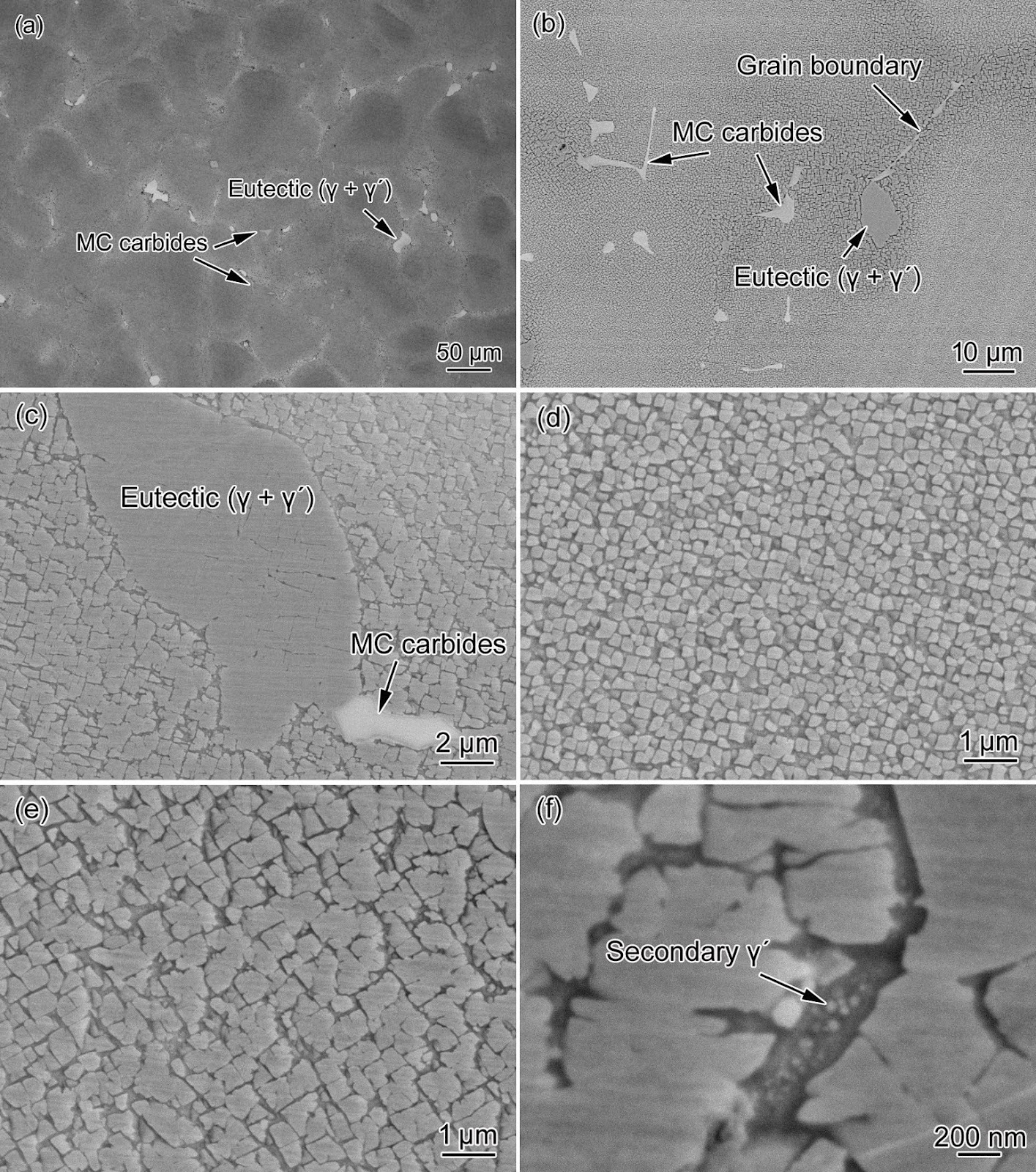
The high-alloyed wrought superalloy GH4975 tends to form coarse MC carbides and eutectic (γ+γ′) phases, which adversely affect the cogging and homogenization process. To provide theoretical guidance for control of MC carbides and eutectic (γ+γ′) formation, differential thermal analysis (DTA) was utilized to investigate the effect of cooing rate (10-90 °C·min-1) on solidification behavior and micro-segregation of GH4975 alloy. According to the thermodynamic calculation and distribution characteristics of precipitates, the MC carbides can act as nucleation sites for γ dendrites, but the nucleation of γ dendrites becomes less dependent on the MC carbide primers at higher cooling rates. As the γ dendrites grow, the elements including Ti and Nb gradually accumulate in the residual liquid and leads to the formation of more MC carbides near the interdendritic region. Finally, the solidification is terminated with the formation of eutectic (γ+γ′). With an increase in cooling rate, the liquidus temperature rises, but the solidus temperature decreases, and thus the solidification range is obviously enlarged. The dendritic structure is significantly refined by the increase of cooling rate. The secondary dendrite arm spacing, λ2, as a function of cooling rate, , can be expressed as λ2=216.78 -0.42. Moreover, the increasing cooling rate weakens the back diffusion of Al, Ti, and Nb, increases the undercooling, and limits the growth of precipitates. Consequently, the sizes of MC carbides, eutectic (γ+γ′), and primary γ′ significantly decrease, but the area fraction of eutectic (γ+γ′) linerly increases as the cooling rate rises. Thus moderate cooling rate (such as 30 °C·min-1) should be selected during the solidification process of GH4975 alloy.
1. Introduction
Ni-based GH4975 (Russian ЭП975) represents a new γ′ precipitation-hardened wrought superalloy with superior high-temperature strength and creep resistance. Predominantly, it is utilized in the fabrication of high-performance aeroengine turbine discs [1]. The alloying degree of GH4975 alloy is extremely high, and the total content of (Al+Ti+Nb) is approximately 9.2wt.%. Therefore, the mass fraction of γ′ in the aging state can reach up to 64%, and the long-term service temperature of this alloy is as high as 850-950 °C [2]. However, the high alloying degree significantly increases the deformation resistance and worsens the hot ductility. It is currently recognized as the highest alloyed disk alloy that can be processed using the cast and wrought route [3].
It has been reported that the Nb, Ti, Al, and W exhibit severe segregation during solidification of GH4975 alloy. The Nb, Ti, and Al are segregated in interdendritic regions (positive segregation), while W is segregated in dendrite arms (negative segregation). The MC carbides, eutectic (γ+γ′), and γ′ are the main precipitates in as-cast GH4975 alloy [4, 5]. During the hot deformation of as-cast GH4975 alloy, MC carbides are prone to become the crack initiation source due to their cracking. Furthermore, the stress concentration around MC carbides can lead to cracking of γ matrix [5]. Our previous study has found that the coarse eutectic (γ+γ′) is the most effective crack initiation site in the similar high-alloyed superalloy U720Li, and high temperature homogenization treatment is essential to dissolve the eutectic (γ+γ′) [6]. However, coarse eutectic (γ+γ′) is very difficult to dissolve [7, 8], and MC carbides usually remain stable during the homogenization process [9-11]. Therefore, it is necessary to understand how to control the formation of eutectic (γ+γ′) and MC carbides during solidification of GH4975 alloy.
Loading authentic research manuscript (Pages 1–5)...
Guang-di Zhao, Xi-min Zang, Yi-xuan Sun, Xiao-yu Yao (2026). Effect of cooling rate on solidification behavior and micro-segregation of high-alloyed wrought superalloy GH4975. China Foundry. https://doi.org/10.1007/s41230-025-4083-4
Research & Educational Purpose Only:The translations, structured abstracts, analytical annotations, and data reports provided by SinoTechIntel are intended exclusively for academic research, internal corporate R&D, and educational benchmarking. They do not constitute formal engineering, chemical safety, legal, or professional advice.
Copyright & Intellectual Property Notice: Original copyright of the underlying source articles and experimental data remains with the respective authors, institutions, and original publishing journals. SinoTechIntel claims intellectual property only over its proprietary translations, analytical syntheses, and AEO structured enhancements in accordance with international fair use and academic citation principles.
Frequently Asked Questions
What is the effect of cooling rate on the solidification behavior of GH4975 superalloy?
Increasing cooling rate raises the liquidus temperature and lowers the solidus temperature, thereby enlarging the solidification range. It also refines the dendritic structure and reduces secondary dendrite arm spacing, following the relationship λ2=216.78·R^-0.42.
How does cooling rate influence micro-segregation in GH4975 alloy?
Higher cooling rates weaken back diffusion of Al, Ti, and Nb, increase undercooling, and limit precipitate growth. This results in smaller MC carbides, eutectic (γ+γ′), and primary γ′ sizes, but the area fraction of eutectic (γ+γ′) increases linearly with cooling rate.
What is the recommended cooling rate for solidification of GH4975 alloy?
A moderate cooling rate of 30 °C·min-1 is recommended to balance microstructural refinement and segregation control, as it provides a good compromise between reducing precipitate sizes and managing eutectic formation.
Why is it important to control MC carbides and eutectic (γ+γ′) in GH4975 alloy?
Coarse MC carbides and eutectic (γ+γ′) are detrimental to hot workability and mechanical properties. They can act as crack initiation sites during hot deformation and are difficult to dissolve during homogenization, so controlling their formation during solidification is crucial.
What methods were used to study the solidification behavior of GH4975 alloy?
Differential thermal analysis (DTA) was utilized to investigate the effect of cooling rate on solidification behavior and micro-segregation. Thermodynamic calculations and distribution characteristics of precipitates were also analyzed.
Related Technical Papers & Translations
Pull-out capacity and energy absorption of cable bolts under impact loading
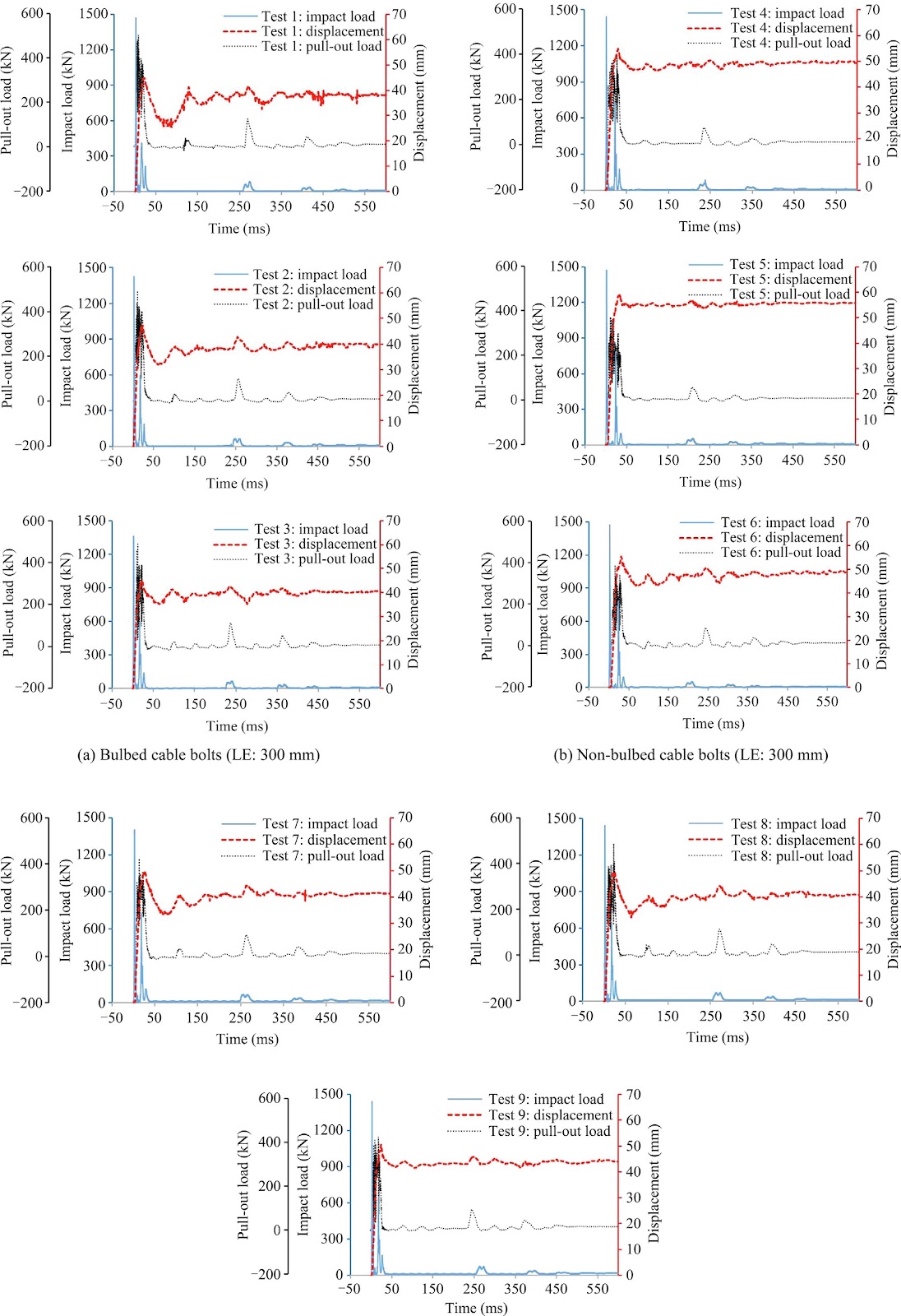
This study investigates the performance of high-strength cable bolts under impact loading conditions representative of rock bursts in underground environments. Although widely used, the dynamic behaviour of these cable bolts has received limited experimental attention, and their effectiveness in seismically active zones remains a subject of ongoing debate. To address this gap, a reverse pull-out test machine integrated with a drop hammer rig was employed. Tests were conducted on 70-t SUMO bulbed and non-bulbed cable bolts with encapsulation lengths of 300 and 450 mm, subjected to an impact energy of 14.52 kJ. Results indicate that non-bulbed cables, despite showing lower initial peak loads (average 218 vs. 328 kN for bulbed cables at 300 mm encapsulation), demonstrated superior energy absorption (average 11.26 vs. 8.75 kJ) and displacement capacity (average 48.40 vs. 36.25 mm). Increasing the encapsulation length for bulbed cables led to a reduction in initial peak load but improved displacement and energy absorption. The dominant failure mechanism was debonding at the cable-grout interface, characterised by frictional sliding and cable rotation. These findings provide new insights into the energy dissipation mechanisms of cables and support the development of more resilient ground support systems for dynamically active conditions.
Effect of eutectic content on microstructure and mechanical properties of Al-Zn-Mg-Cu alloys
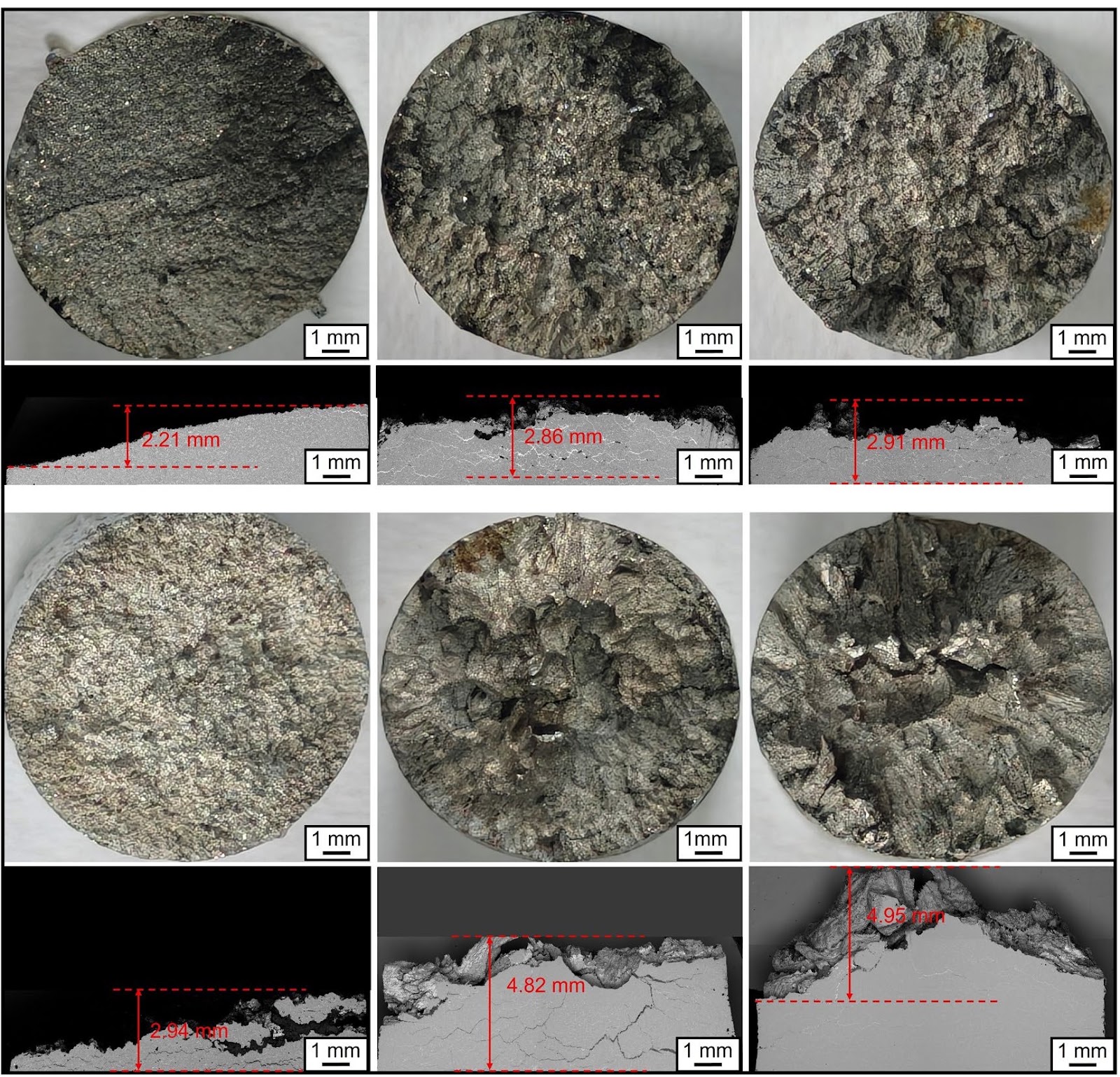
The 7xxx series aluminum alloys have emerged as a particularly promising class of lightweight structural materials. However, the inherent strength of these materials is primarily influenced by the content and type of alloying elements added during the manufacturing process, as well as casting defects. The present study investigated the effects of eutectics formed by solute atoms (Zn, Mg, and Cu), with equal mass ratios (Zn/Mg=2, Mg/Cu=3) but varying overall contents, on the liquid film thickness, crack propagation depth, and the mechanical properties of the Al-Zn-Mg-Cu alloy after heat treatment. The results from gravity casting indicate that the intergranular liquid film thickness increases with the increase of eutectic content. A thick intergranular liquid film in the casting can accommodate greater strain during grain contraction, thereby preventing liquid film rupture and subsequent hot tearing. Concurrently, during the solution treatment at 475 °C, the residual eutectic fraction in the Al-7Zn-3.5Mg-1.18Cu alloy diminishes from 9.1% at 10 h to 0.35% at 40 h. At 165 °C, the Al-6Zn-3.0Mg-1.0Cu alloy exhibits the optimal mechanical properties, with a peak aging tensile strength of 510 MPa and an elongation of 6.4%. The incorporation of lower concentrations of solute atoms (Zn, Mg, and Cu) serves to reduce the barrier to dislocation precipitation, thereby enhancing alloy plasticity. However, when the proportion of alloying elements exceeds the solubility limit of the α-Al matrix at specific heat treatment temperatures, coarse residual phases remain intergranular, thereby significantly impairing the mechanical properties of the alloy. This study provides a reference for the optimal addition level of the main strengthening elements in Al‑Zn‑Mg‑Cu alloys.
Achieving optimal strength-conductivity balance in cast Al-2.3Fe-Mg-Si alloys via Mg/Si ratio regulation
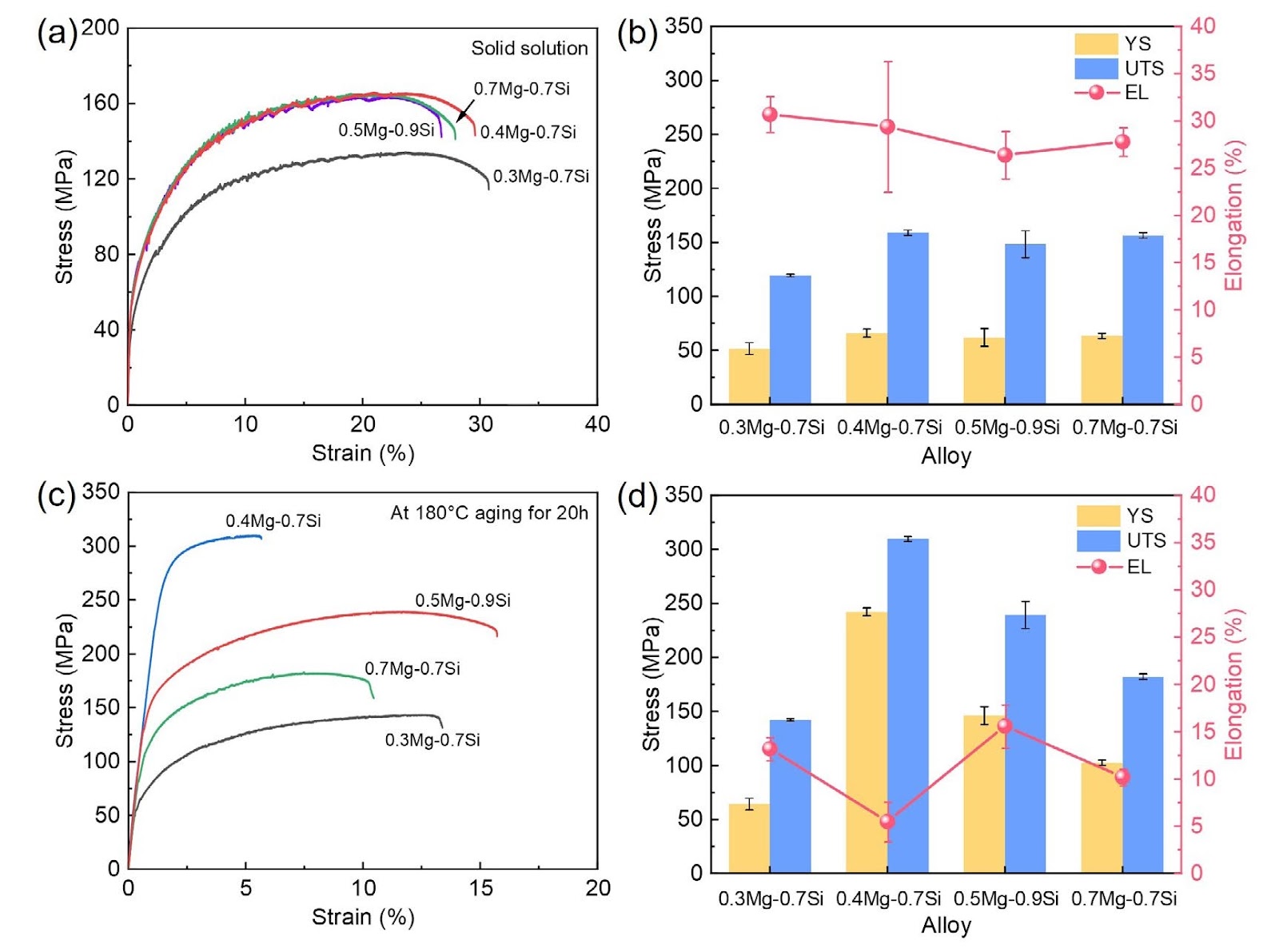
The Al-2.3Fe eutectic alloy is regarded as a promising substitute for Cu conductors in automotive motors owing to its excellent castability and low resistivity. However, its application is restricted by the mutually exclusive relationship between electrical conductivity and mechanical strength. The microstructure and mechanical properties of Al-2.3Fe alloy were modified through Mg/Si alloying combined with T6 heat treatment in this work, leading to the development of a high-performance cast Al-2.3Fe-Mg-Si alloy. In the Al-2.3Fe-0.40Mg-0.72Si (Mg/Si=0.56) alloy subjected to T6 treatment, an electrical conductivity of (52.5±0.6)% IACS is achieved, while the ultimate tensile strength is significantly enhanced to 309.5±5.6 MPa. The addition of Mg and Si brings about marked changes in the solidification process of the Al-2.3Fe alloy, resulting in considerable variations in both the morphology of the second phase and its phase constitution. The aging behavior of the alloy is governed by second phase and solid solubility. Through optimization of the Mg/Si ratio, the aging response can be effectively enhanced. At the ratio of Mg/Si=0.56, a balance is achieved between solid solubility and precipitation, while simultaneously minimizing the detrimental impact on electrical conductivity and reaching the best mechanical properties and electrical conductivity in peak-aged Al-2.3Fe-xMg-ySi alloy. This work providing valuable insights for developing advanced conductor materials.