Key Takeaways & Executive Findings
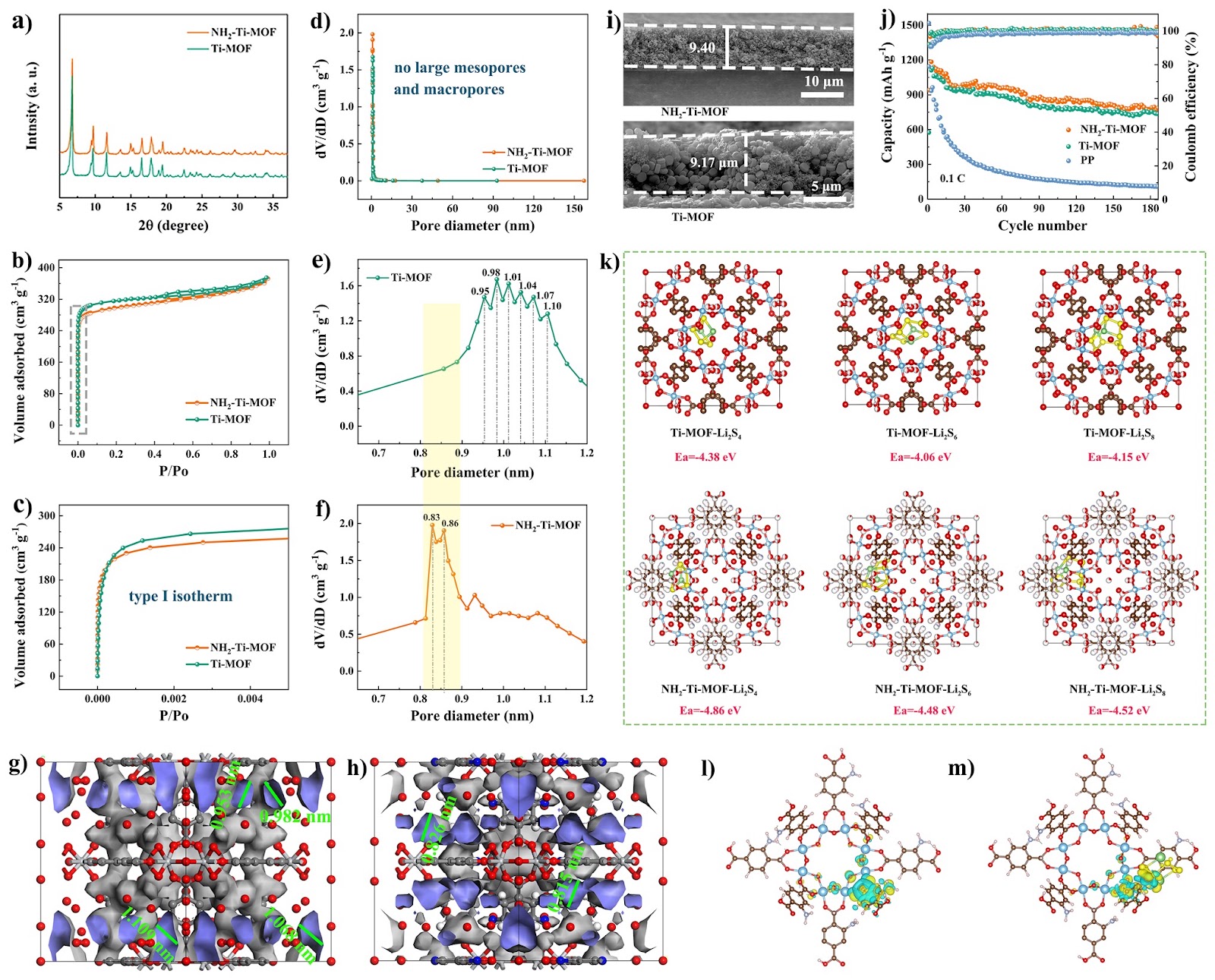
- •• Amino functionalization narrows the Ti-MOF pore size to ~0.8 nm, enabling size-sieving to completely block polysulfide shuttling. • Electrostatic adsorption by positively charged amino groups redistributes and reutilizes blocked polysulfides, enhancing active material utilization. • Lewis acid-base interaction between amino and lithium ions creates transfer channels, ensuring unimpeded Li+ migration. • The modified separator achieves an ultralow capacity decay of 0.045% per cycle over 1000 cycles at 1.0C, demonstrating superior long-term stability.
Abstract
Shuttle effect of polysulfides overshadows the superiorities of lithium–sulfur batteries. Size–sieving effect could address this thorny trouble rely on size differ in polysulfides and lithium ions. However, clogged polysulfides pose some challenges for cathode and are rarely recycled during charging/discharging. Herein, an amino functionalized titanium-organic framework is designed for modifying lithium–sulfur batteries separator to address the aforementioned challenges. Wherein, the introduction of amino narrows titanium–organic framework pore size, enabling functional separator to selectively modulate lithium ions and polysulfides migration using size-sieving effect, thereby completely suppressing polysulfides shuttle. Furthermore, the blocked polysulfides will be adsorbed on the separator surface by positively charged amino leveraging electrostatic adsorption, ensuring polysulfides to redistribute and reuse, and boosting active materials utilization. Significantly, the migration of lithium ions is not hindered since there are lithium ions transfer channels formed via Lewis acid–base interaction with the help of amino. Combined with these virtues, the lithium–sulfur batteries with amino functionalized titanium-organic framework modified separator enjoy an ultralow attenuation rate of 0.045% per cycle over 1000 cycles at 1.0C. Electrostatic adsorption and Lewis acid–base interaction cover deficiencies existing in the inhibition of polysulfides shuttle by size-sieving effect, providing fresh insight into the advancement of lithium-sulfur batteries.
1. Introduction
The energy crisis is driving us to look for novel, clean energy storage devices [1–3]. Rechargeable lithium–sulfur (Li–S) batteries have held considerable promise as next–generation high–energy–storage batteries owing to the superiorities of sulfur cathode [4, 5]. Cooperated with Li, sulfur can deliver ultra–high theoretical energy densities (2800 Wh kg−1) and superior theoretical capacity (1675 mAh g−1) [6, 7]. Regrettably, the development of Li–S batteries is plagued by a series of issues caused the “shuttle effect” of polysulfides, such as continuous depletion of sulfur and self–discharging [8, 9]. Also, polysulfides that traverse the macropores of polypropylene (PP) separator would adhere to lithium metal surface, resulting in corrosion and passivation [10, 11]. This ultimately leaves rapid capacity fading and a shorter cycle lifespan of Li–S batteries [12, 13]. Therefore, it is imperative to suppress polysulfides migration for perfectly delivering the merits of Li–S batteries.
Although commercial separator that features wealthy pore architecture ensures Li+ migration during charging/discharging, the larger pore size is impossible to block the shuttle of polysulfides [14, 15]. Considering the difference in size of solvated polysulfides and Li+, exploiting functionalized coating to regulate selectively ion migrations in separators, that is, employing size–sieving effect, is a straightforward and effective approach to inhibit the shuttling of polysulfides. Delightfully, the size-sieving effect is highly effective in inhibiting polysulfides shuttle without hampering Li+ transport. Whereas, it should be stressed that the ion–selective channel of separator modified layer is supposed to be around 0.8 nm, which has been verified in our previous work [16, 17]. Therefore, selecting the appropriate materials to modify separator is a critical step.
Metal–organic framework (MOF), as uniquely porous materials characterized by well–defined and adjustable pore sizes and tunable surface chemistry, enable selectively separate various ions and molecules [18, 19]. Such as 2D zeolitic imidazolate framework films are used for highly permeable selective H2 separation [20], and functionalized UiO–66–(X)2 membrane could high–selectively separate monovalent and divalent cations [21]. Additionally, a novel MOF–gel film, as a permselective separator, is employed to restrain adverse reactions of soluble intermediates, which achieves a much longer cycle life of rechargeable organic batteries [22]. Undeniably, this brilliant selective separation ability of MOF also exerts an unsurpassed role in controlling the selective migration of ions in Li–S batteries. The affluent sub-nanometer pore size inhibits polysulfides shuttle firstly using size–sieving effect if MOF is employed as separator modified layer, and even pore structure is also favorable for
Loading authentic research manuscript (Pages 1–5)...
Xiaoya Kang, Tianqi He, Hao Dang, Xiangye Li, Yumeng Wang, Fuliang Zhu, Fen Ran (2025). Designing Amino Functionalized Titanium-Organic Framework on Separators Toward Sieving and Redistribution of Polysulfides in Lithium-Sulfur Batteries. Nano-Micro Letters. https://doi.org/10.1007/s40820-025-01733-0
Research & Educational Purpose Only:The translations, structured abstracts, analytical annotations, and data reports provided by SinoTechIntel are intended exclusively for academic research, internal corporate R&D, and educational benchmarking. They do not constitute formal engineering, chemical safety, legal, or professional advice.
Copyright & Intellectual Property Notice: Original copyright of the underlying source articles and experimental data remains with the respective authors, institutions, and original publishing journals. SinoTechIntel claims intellectual property only over its proprietary translations, analytical syntheses, and AEO structured enhancements in accordance with international fair use and academic citation principles.
Frequently Asked Questions
What is the main challenge in lithium-sulfur batteries addressed by this research?
The main challenge is the 'shuttle effect' of polysulfides, which causes capacity fading and short cycle life. The research introduces an amino-functionalized titanium-organic framework (Ti-MOF) on the separator to inhibit polysulfide shuttling via size-sieving and electrostatic adsorption.
How does the amino functionalization improve the separator performance?
Amino functionalization narrows the MOF pore size to about 0.8 nm, enabling size-sieving to block polysulfides while allowing Li+ transport. Additionally, positively charged amino groups electrostatically adsorb blocked polysulfides, promoting their redistribution and reuse, and Lewis acid-base interaction facilitates Li+ transfer.
What is the significance of the 0.8 nm pore size?
The 0.8 nm pore size is critical because it is smaller than solvated polysulfides but larger than Li+, allowing selective sieving: polysulfides are blocked while Li+ can pass through, effectively suppressing the shuttle effect without hindering ion transport.
What performance improvement was achieved with the modified separator?
The lithium-sulfur batteries with the amino-functionalized Ti-MOF modified separator exhibited an ultralow capacity decay rate of 0.045% per cycle over 1000 cycles at 1.0C, indicating excellent long-term cycling stability.
What are the key mechanisms behind the improved battery performance?
The key mechanisms are size-sieving effect (pore size exclusion), electrostatic adsorption (positively charged amino groups attract polysulfides), and Lewis acid-base interaction (amino groups interact with Li+ to form transfer channels). These work synergistically to suppress polysulfide shuttling and enhance active material utilization.
Related Technical Papers & Translations
Direct Repair of the Crystal Structure and Coating Surface of Spent LiFePO4 Materials Enables Superfast Li-Ion Migration
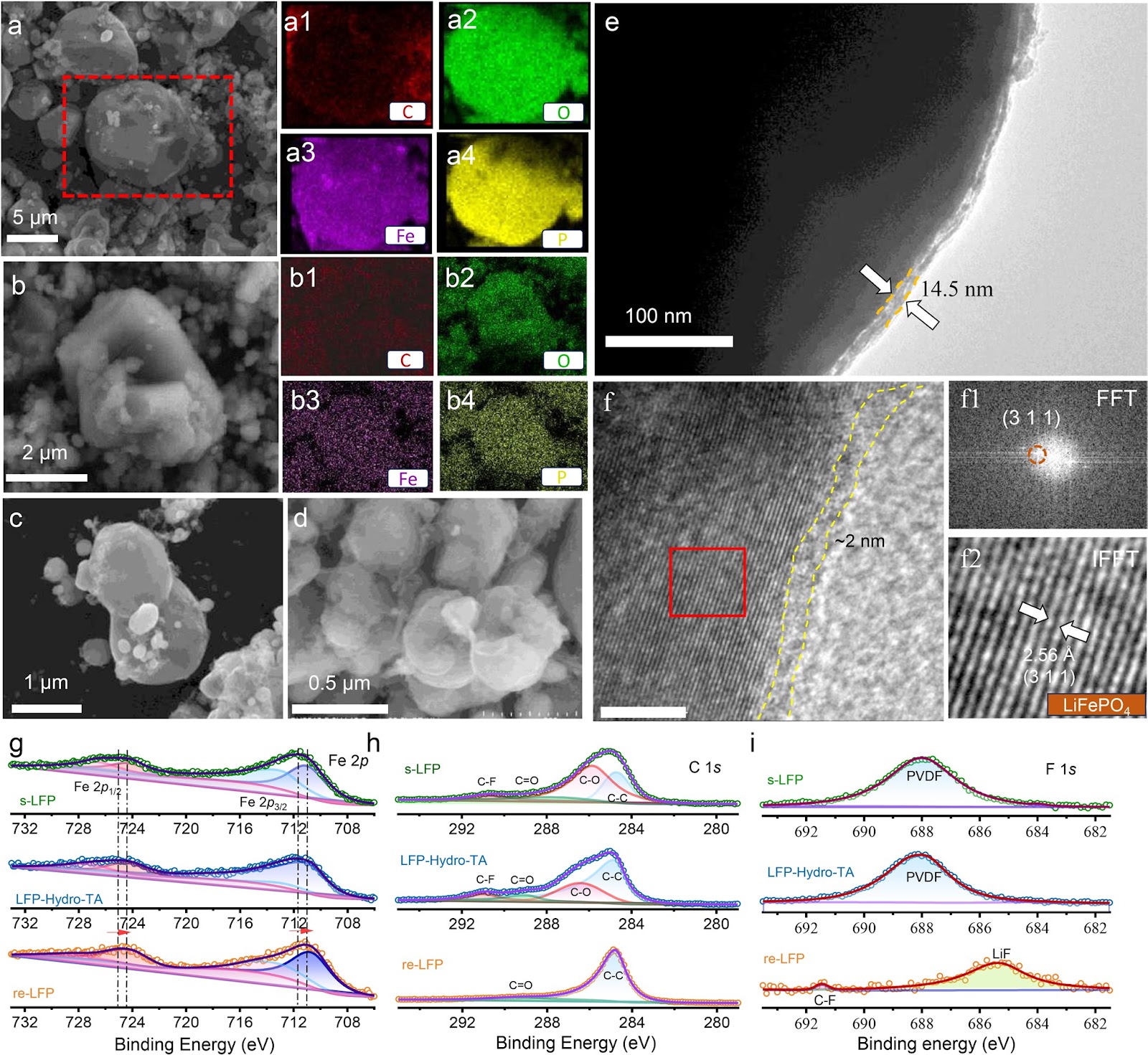
The rapid accumulation of spent LiFePO4 (LFP) cathodes from retired lithium-ion batteries necessitates the development of effective and environmental-friendly recycling strategies. In this context, direct regeneration has emerged as a promising approach for reclaiming LFP cathode materials, offering a streamlined pathway to restore their electrochemical functionality. We report an integrated regeneration protocol that simultaneously repairs the degraded crystal structure and reconstructs the damaged carbon coating in spent LFP. The regenerated cathode material had superfast lithium-ion diffusion kinetics and a stable cathode–electrolyte interface, giving a remarkable rate capability with specific capacities of 122 mAh g−1 at 5C and 106 mAh g−1 at 10C (1C = 170 mA g−1). It also maintained capacities of 110.7 mAh g−1 (5C) and 84.1 mAh g−1 (10C) after 400 cycles. It could be used in harsh environments and could be stably cycled at subzero temperatures (−10 and −20 °C) and in solid-state electrolyte batteries. Life cycle assessment combined with economic evaluation using the EverBatt model reveals that this direct regeneration approach has high economic and environmental benefits.
Oxide Semiconductor for Advanced Memory Architectures: Atomic Layer Deposition, Key Requirement and Challenges
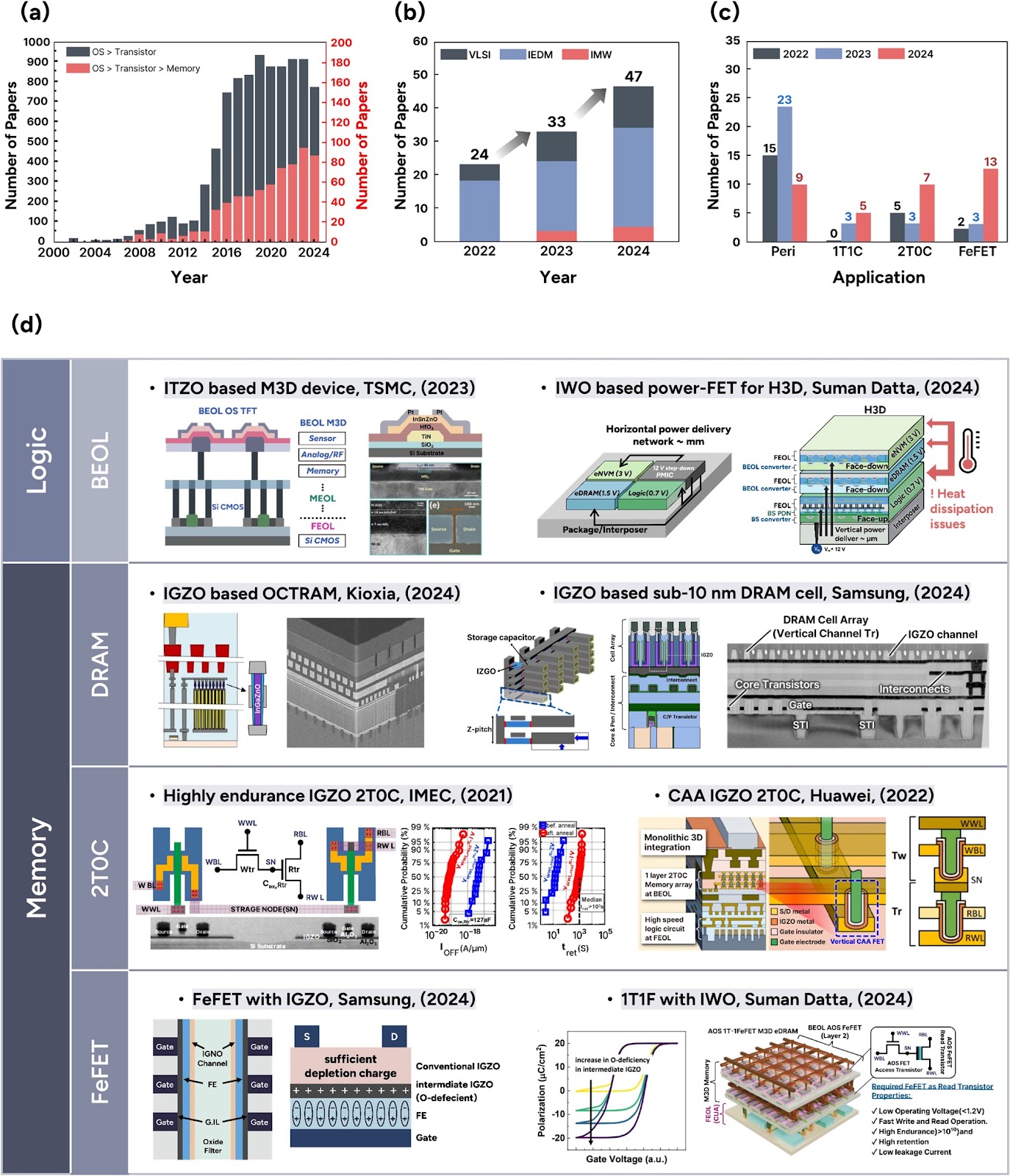
Oxide semiconductors (OSs), introduced by the Hosono group in the early 2000s, have evolved from display backplane materials to promising candidates for advanced memory and logic devices. The exceptionally low leakage current of OSs and compatibility with three-dimensional (3D) architectures have recently sparked renewed interest in their use in semiconductor applications. This review begins by exploring the unique material properties of OSs, which fundamentally originate from their distinct electronic band structure. Subsequently, we focus on atomic layer deposition (ALD), a core technique for growing excellent OS films, covering both basic and advanced processes compatible with 3D scaling. The basic surface reaction mechanisms—adsorption and reaction—and their roles in film growth are introduced. Furthermore, material design strategies, such as cation selection, crystallinity control, anion doping, and heterostructure engineering, are discussed. We also highlight challenges in memory applications, including contact resistance, hydrogen instability, and lack of p-type materials, and discuss the feasibility of ALD-grown OSs as potential solutions. Lastly, we provide an outlook on the role of ALD-grown OSs in memory technologies. This review bridges material fundamentals and device-level requirements, offering a comprehensive perspective on the potential of ALD-driven OSs for next-generation semiconductor memory devices.
Laser powder bed fusion of biodegradable Zn-4Cu alloy: Processing, microstructure and properties
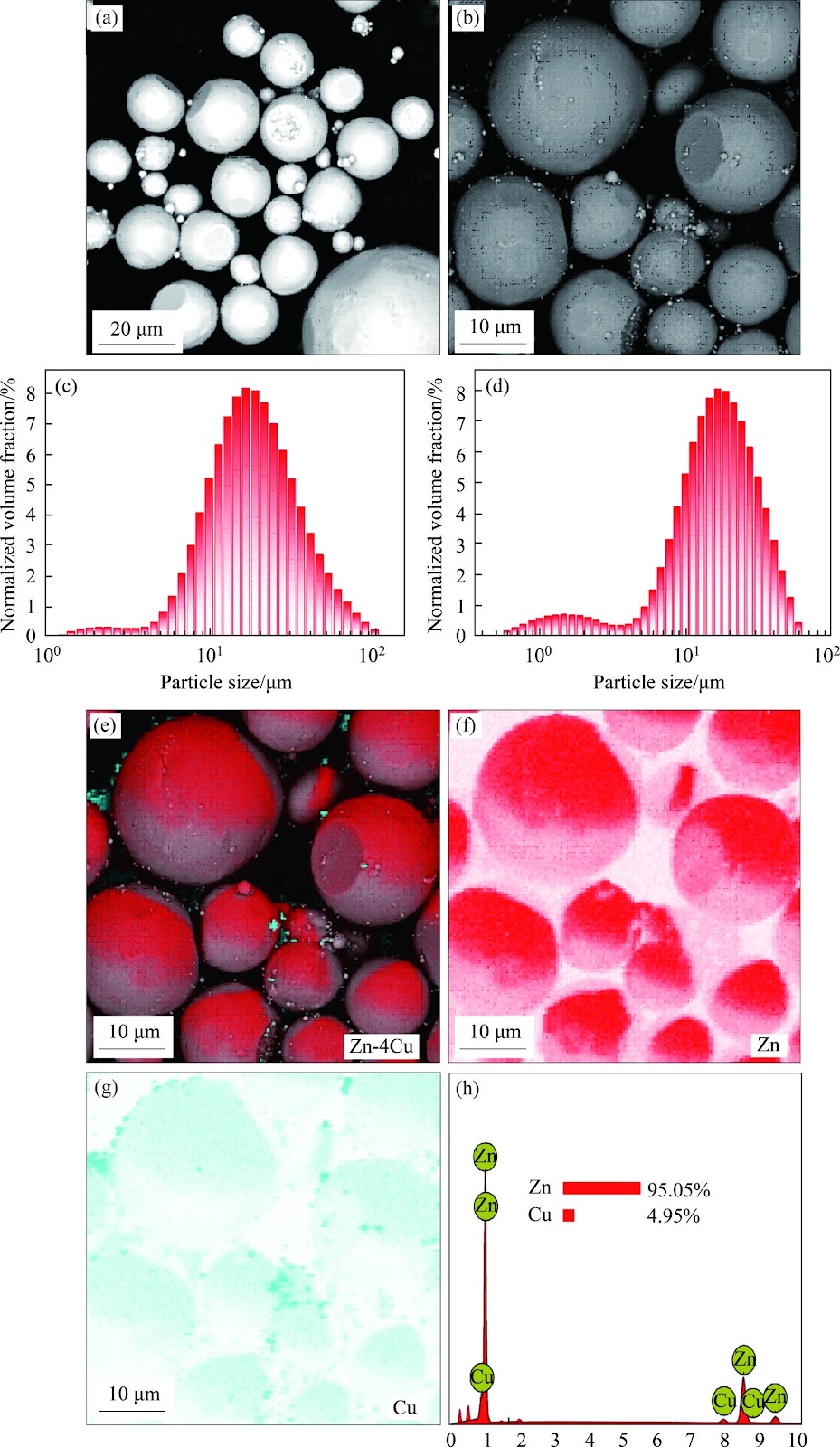
Zn's natural degradability and biocompatibility make it a promising candidate for implants, however, its mechanical properties remain insufficient for bone applications. In this study, the performance of Zn was enhanced by developing Zn-Cu alloys via laser powder bed fusion (LPBF). Optimal LPBF parameters for forming stable tracks were achieved by adjusting laser power and scanning speed. Under optimized conditions of 100 W and 100 mm/s, high-density (99.58%) Zn-Cu alloys with improved hardness (68.2HV) and yield strength (160 MPa) were achieved. These improvements are attributed to solid solution strengthening, segregation strengthening, and grain refinement. The Zn-Cu alloys also demonstrated favorable degradation behavior, with a rate of 0.16 mm/year. This degradation is primarily driven by micro-galvanic corrosion between the CuZn5 phase and Zn matrix, along with refined grains and increased grain boundary density. This work demonstrates a viable strategy for fabricating Zn-based implants with enhanced structural integrity and mechanical performance via LPBF.