Key Takeaways & Executive Findings
- •• Established calculation methods for bolt prestress and length based on arched and collapsed failure modes of shallow-buried large-span caverns. • Clarified the influence mechanisms of various factors on bolt prestress and length, enabling more rational support design. • Developed a high-strength, high-toughness constant resistance energy-absorbing bolt and validated its mechanical properties through comparative testing. • Field application in Qingdao metro station demonstrated a maximum roof settlement of only 6.8 mm, confirming effective control of surrounding rock.
Abstract
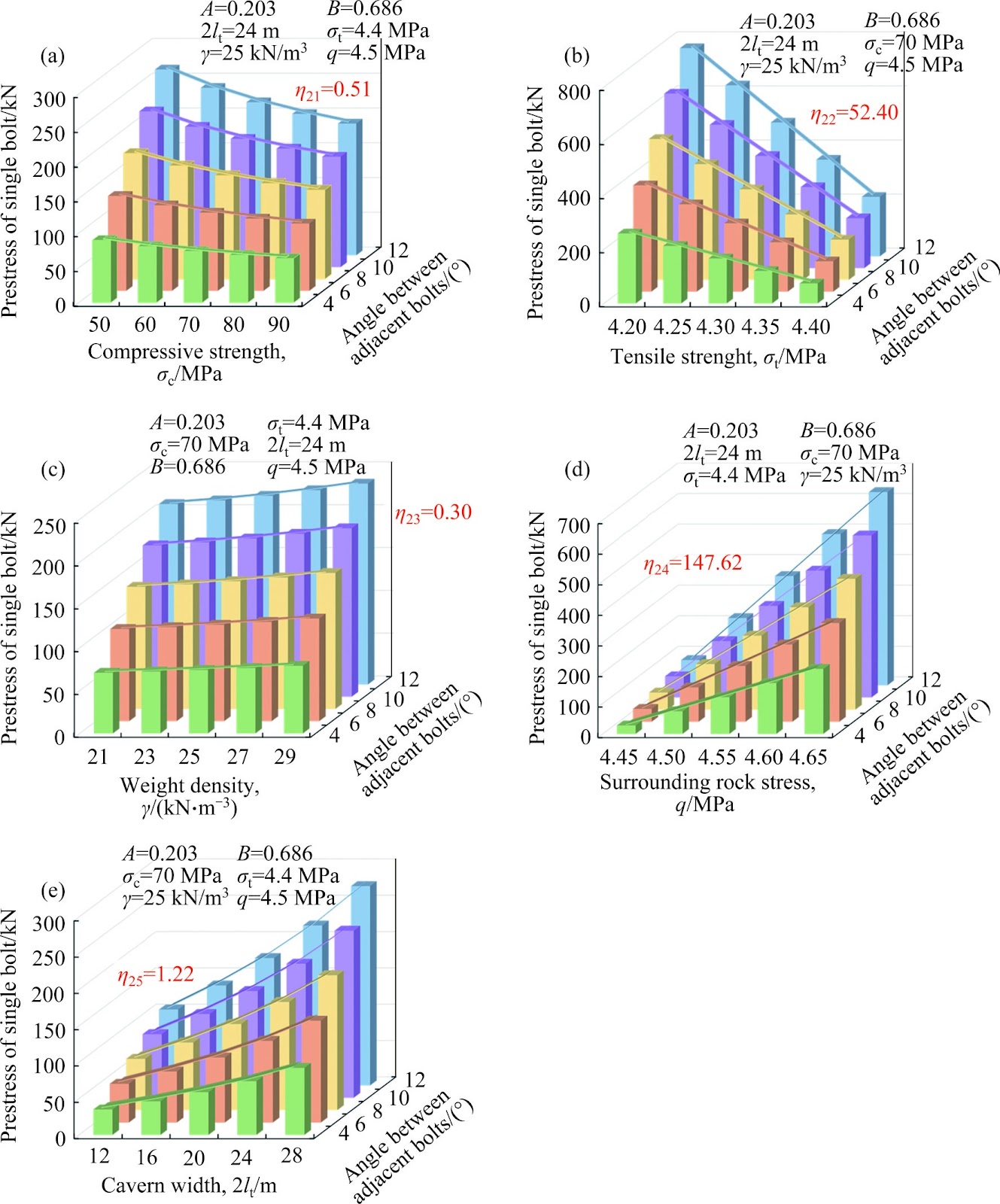
The surrounding rock is prone to large-scale loosening and failure after the excavation of shallow large-span caverns because of the thin overlying strata and large cross-section span. The rational design of bolt support is very important to the safety control of surrounding rock as a common support means. The control mechanism and design method of bolt support for shallow-buried large-span caverns is carried out. The calculation method of bolt prestress and length based on arched failure and collapsed failure mode is established. The influence mechanism of different influencing factors on the bolt prestress and length is clarified. At the same time, the constant resistance energy-absorbing bolt with high strength and high toughness is developed, and the comparative test of mechanical properties is carried out. On this basis, the design method of high prestressed bolt support for shallow-buried large-span caverns is put forward, and the field test is carried out in Qingdao metro station in China. The monitoring results show that the maximum roof settlement is 6.8 mm after the new design method is adopted, and the effective control of the shallow-buried large-span caverns is realized. The research results can provide theoretical and technical support for the safety control of shallow-buried large-span caverns.
1. Introduction
The problem of traffic congestion is serious increasingly as the urban population increases [1 − 3]. In order to ease traffic jam and fully utilize urban underground space resources, large-span and large-section caverns are being designed and constructed [4−7].
Urban underground transportation caverns are generally buried shallowly, with the thin overlying strata and large cross-section span, the roof is prone to large-scale loosening and fracture after excavation [8−10]. If the surrounding rock support is not properly controlled, it will lead to accidents such as roof collapse and partial roof fall [11−14], so the stability of caverns will be seriously affected. Due to the strict settlement requirements of surface buildings, shallow-buried large-span caverns in urban underground traffic are faced with high requirements and difficulties in control. Many scholars have carried out a lot of research on the failure mode and stability control of shallow buried caverns.
In terms of theoretical research, ZHANG et al [15] analyzed the failure phenomena and rules during the excavation of shallow buried cavern, and revealed the characteristics of collapse failure of surrounding rock. YANG et al [16] established rigid body translational failure modes of shallow-buried cavern surrounding rock, and analyzed the rock pressure under the two kinds of failure modes. LIU et al [17] established a mechanical calculation model of load-bearing arch according to the characteristics of large-span cavern arched failure, and analyzed the influence mechanism of the thickness load-bearing arch. LI et al [18] analyzed the influence mechanism of large-span cavern under the condition of considering water pressure. LEI et al [19] established a failure mode for excavation asymmetric tunnels and derived an upper bound solution. Through the method of theoretical calculation, the above scholars have conducted further discussion on the failure characteristics and stress evolution law in shallow-buried large-span caverns under different conditions, but there are few theoretical studies on the prestressed support of caverns.
In terms of numerical simulation, JIANG et al [20] explored the influence of whether the bolt is prestressed on the reinforcement effect of tunnel surrounding rock. The results show that the failure occurs on the surface of surrounding rock without prestress. The failure occurs at the far end of the bolt after prestressing, whi
Loading authentic research manuscript (Pages 1–5)...
JIANG Bei, WEI Hua-yong, WANG Qi, WANG Ming-zi, YIN Chen, ZHANG Yan-bo (2025). Design method of high prestressed support for shallow-buried large-span caverns. Journal of Central South University. https://doi.org/10.1007/s11771-025-5909-3
Research & Educational Purpose Only:The translations, structured abstracts, analytical annotations, and data reports provided by SinoTechIntel are intended exclusively for academic research, internal corporate R&D, and educational benchmarking. They do not constitute formal engineering, chemical safety, legal, or professional advice.
Copyright & Intellectual Property Notice: Original copyright of the underlying source articles and experimental data remains with the respective authors, institutions, and original publishing journals. SinoTechIntel claims intellectual property only over its proprietary translations, analytical syntheses, and AEO structured enhancements in accordance with international fair use and academic citation principles.
Frequently Asked Questions
What is the purpose of this study?
The study aims to develop a design method for high prestressed bolt support in shallow-buried large-span caverns to ensure the stability of surrounding rock and prevent roof collapse.
What failure modes are considered in the design method?
The design method is based on two failure modes: arched failure and collapsed failure. These are used to establish calculation methods for determining the required bolt prestress and length.
What type of bolt is developed in this research?
A constant resistance energy-absorbing bolt with high strength and high toughness is developed. Its mechanical properties were validated through comparative testing.
What were the field test results in Qingdao metro station?
Field tests in Qingdao metro station showed that the maximum roof settlement was only 6.8 mm when the new high prestressed bolt support design method was applied, indicating effective control of the surrounding rock.
How can this research benefit engineering practice?
The research provides theoretical and technical support for the safety control of shallow-buried large-span caverns, offering a rational design approach for high prestressed bolt support in similar underground engineering projects.
Related Technical Papers & Translations

Design and optimization of a high-efficiency distillation process for cellulosic fuel ethanol integrated with thermal coupling and molecular sieve adsorption
To address the challenges of high energy consumption and prominent costs in the traditional three-columns distillation process for cellulosic fuel ethanol, a distillation—molecular sieve coupling separation process is proposed. This process integrates a three-column (crude distillation column, first distillation column, second distillation column) system with a 3A molecular sieve adsorption deep dehydration unit. A thermal coupling network is constructed via differential pressure design (steam from medium/high-pressure columns as mutual heat sources, reboiler liquid waste heat for feed preheating), and molecular sieve adsorption conditions are optimized. The study first performs a thermodynamic consistency test on the ethanol—water system, determines optimal non-random two-liquid (NRTL) model binary interaction parameters via experimental data regression for Aspen Plus simulation. Aiming at minimum total annual cost (TAC), Aspen Plus is used to optimize process parameters (theoretical tray number, feed location, reflux ratio, side-draw position, etc.). Economic analysis shows this process reduces CO2 emission costs by 27.56%, TAC by 15.58% (to 5.123 × 10⁶ USD·a-1), and increases ethanol purity to >99.6%, providing an effective solution for green, efficient separation.

A cohesion loss model for determining residual strength of deep bedded sandstone
Rock residual strength, as an important input parameter, plays an indispensable role in proposing the reasonable and scientific scheme about stope design, underground tunnel excavation and stability evaluation of deep chambers. Therefore, previous residual strength models of rocks established were reviewed. And corresponding related problems were stated. Subsequently, starting from the effects of bedding and whole life-cycle evolution process, series of triaxial mechanical tests of deep bedded s

Federated model with contrastive learning and adaptive control variates for human activity recognition
Recent attention to privacy issues demands a communication-safe method for training human activity recognition (HAR) models on client activity data. Federated learning (FL) has become a compelling technique to facilitate model training between the server and clients while preserving data privacy. However, classical FL methods often assume independent and identically distributed (IID) data among clients. This assumption does not hold true in practical scenarios. Human activity in real-world scena