Key Takeaways & Executive Findings
- •• Chemical blowing is a low-cost, facile, and highly controllable strategy to fabricate 3D graphene materials, effectively overcoming restacking. • The strategy enables the construction of both macroscopic graphene foams and microscopic graphene powders with integrated macro/microstructural design. • Synthesis chemistry determines the morphology and properties of the resulting graphene materials, allowing tailored functional applications. • Future research should focus on addressing scalability challenges and exploring new blowing agents to expand the application landscape.
Abstract
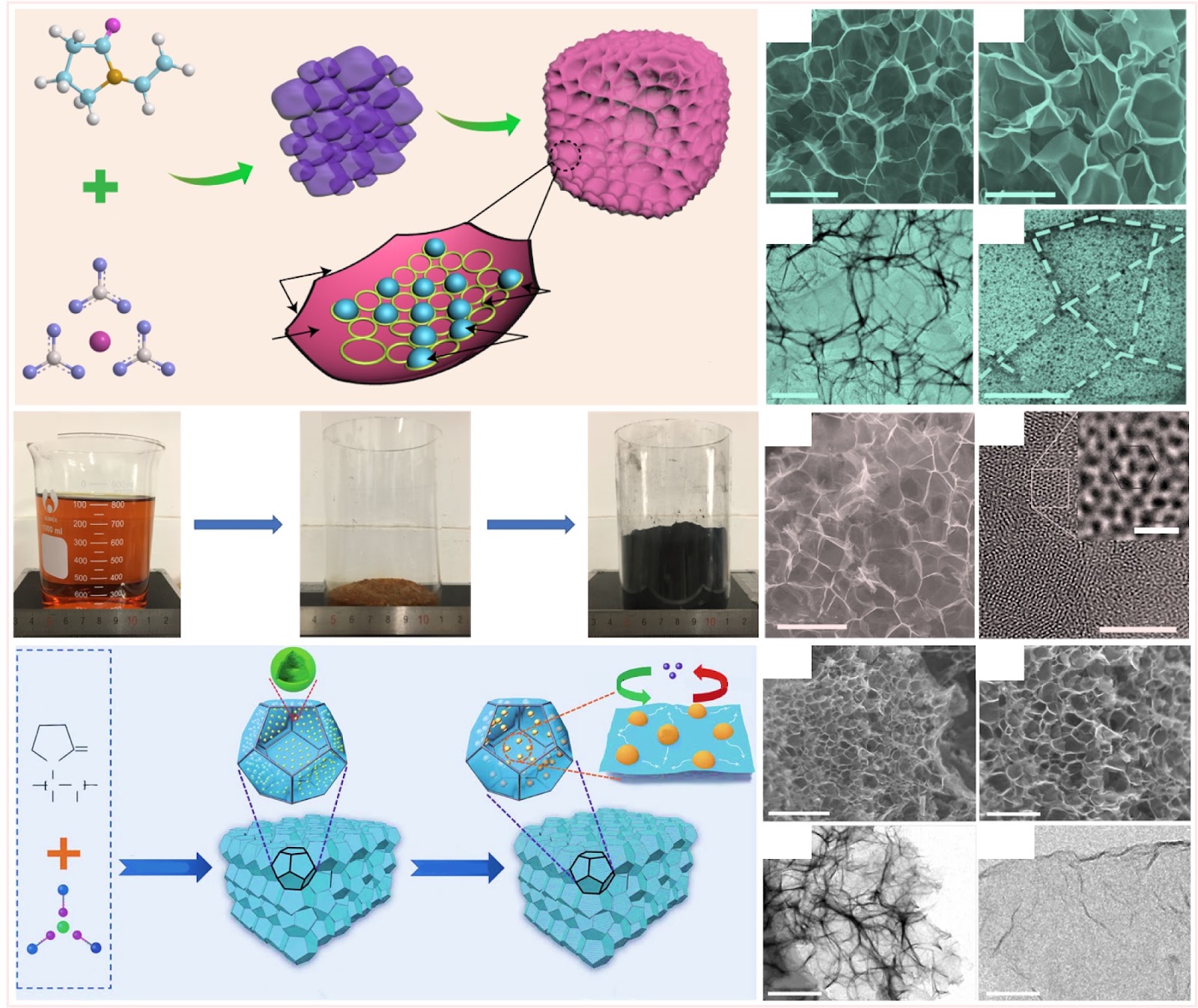
Carbon materials, characterized by diverse allotropes, have played critical roles in the advancement of human civilization and industrial manufacturing. As a prominent allotrope, two-dimensional (2D) graphene materials have attracted increasing attention since their discovery owing to their exceptional properties; however, they suffer from the fundamental challenges of restacking and agglomeration, which diminish their performance in practical applications. The design of three-dimensional (3D) frameworks composed of 2D graphene sheets is considered an effective strategy to resolve these issues and enable the efficient utilization of the properties of graphene. Compared with conventional fabrication methods, such as graphene oxide assembly and template-assisted chemical vapor deposition, the chemical blowing strategy is distinguished by its low cost, facile process, and superior controllability. Despite these advantages, few review articles have focused specifically on the fabrication of 3D graphene materials via chemical blowing. This review outlines the chemical blowing strategy and clarifies the fundamentals of the blowing process, its historical evolution, and the classification of 3D graphene materials. Subsequently, the recent progress in 3D graphene foams and powders fabricated via chemical blowing is detailed, with an emphasis on the underlying synthesis chemistry. Following an analysis of the correlation between 3D graphene foam and powder materials, their design considerations and functional applications are discussed. This discussion provides recommendations for the synthesis of specific 3D graphene materials and elucidates their differences and commonalities across various application scenarios. Finally, after a brief summary, current challenges, opportunities, and future research directions for the development of chemical blowing are proposed.
1. Introduction
As one of the most widely distributed elements on Earth, carbon is indispensable for the natural biomass cycle as well as the advancement human civilization and industrial manufacturing. Due to its unique electronic structure, carbon reacts with numerous other elements to form a vast array of organic and inorganic non-metallic compounds. Furthermore, carbon can form various allotropes with unique structures and exceptional characteristics through sp2/sp3 electron orbital hybridization, such as the zero-dimensional (0D) fullerene, one-dimensional (1D) carbon nanotubes (CNTs), and the prominent two-dimensional (2D) graphene. Graphene, as a constituent unit of graphite, has garnered unprecedented research attention since its initial discovery via mechanical exfoliation by Novoselov et al. in 2004. Graphene sheets, which consist of a honeycomb-like network of sp2-hybridized carbon atoms in a single plane, is the thinnest material known to possess extraordinary properties. These include exceptional electrical conductivity (~150000 cm2·V–1·s–1), high thermal conductivity (~5000 W·m–1·K–1), high specific surface area (SSA, ~2630 m2·g–1), high mechanical strength, and superior chemical stability. Consequently, the 2010 Nobel Prize in Physics was awarded to Geim and Novoselov for the groundbreaking discovery of graphene. Within this context, an increasing number of research topics concerning graphene have been reported over the past two decades, fostering the growth of graphene-based studies in the fields of chemistry and materials science. This has led to the exploration of diverse new synthetic strategies and various application scenarios for graphene materials.
However, in terms of practical applications, 2D graphene sheets tend to restack and further transform into graphite microsheets (Fig. 1(a)) due to the inherent π–π bonding and van der Waals forces between graphene layers. This transformation results in the loss of the fascinating properties of graphene. Constructing well-organized and interconnected three-dimensional (3D) frameworks composed of 2D sheets has been proposed as an effective strategy to address this issue. Such frameworks can maintain the excellent properties of the 2D graphene sheets while expanding the application scenarios without the limitations of restacking (Fig. 1(b)). Based on this concept, a substantial number of scientific studies on 3D graphene materials have been published, focusing primarily on macroscopic 3D graphene hydrogels, foams, sponges, and microscopic 3D graphene powder [16‒20].
Loading authentic research manuscript (Pages 1–5)...
Kun Han, Jianfei Liu, Qigao Cao, Wan Rong, Zhiwei Liu, Ping Li (2025). Chemical blowing strategy for three-dimensional graphene materials: Overcoming graphene restacking and integrating macro/microstructural construction. Journal of Mineral Metallurgy and Materials Science. https://doi.org/10.1007/s12613-025-3357-6
Research & Educational Purpose Only:The translations, structured abstracts, analytical annotations, and data reports provided by SinoTechIntel are intended exclusively for academic research, internal corporate R&D, and educational benchmarking. They do not constitute formal engineering, chemical safety, legal, or professional advice.
Copyright & Intellectual Property Notice: Original copyright of the underlying source articles and experimental data remains with the respective authors, institutions, and original publishing journals. SinoTechIntel claims intellectual property only over its proprietary translations, analytical syntheses, and AEO structured enhancements in accordance with international fair use and academic citation principles.
Frequently Asked Questions
What is the chemical blowing strategy for 3D graphene materials?
Chemical blowing is a low-cost and facile method to fabricate three-dimensional graphene structures by introducing gas bubbles during synthesis, which prevents graphene sheets from restacking and creates interconnected porous frameworks.
How does chemical blowing overcome graphene restacking?
The blowing process generates gases that expand between graphene layers, breaking the π–π stacking and van der Waals forces, thus forming 3D interconnected networks that preserve the unique properties of 2D graphene.
What are the advantages of chemical blowing compared to other fabrication methods?
Compared to graphene oxide assembly and template-assisted chemical vapor deposition, chemical blowing offers lower cost, simpler processing, and superior controllability of the 3D structure.
What types of 3D graphene materials can be fabricated via chemical blowing?
Chemical blowing can produce both macroscopic 3D graphene foams and microscopic graphene powders, with tuneable morphology and pore structure.
What are the future research directions for chemical blowing?
The review proposes that future work should address remaining challenges such as scalability and explore new blowing agents and applications to fully realize the potential of chemical-blown graphene materials.
Related Technical Papers & Translations

Design and optimization of a high-efficiency distillation process for cellulosic fuel ethanol integrated with thermal coupling and molecular sieve adsorption
To address the challenges of high energy consumption and prominent costs in the traditional three-columns distillation process for cellulosic fuel ethanol, a distillation—molecular sieve coupling separation process is proposed. This process integrates a three-column (crude distillation column, first distillation column, second distillation column) system with a 3A molecular sieve adsorption deep dehydration unit. A thermal coupling network is constructed via differential pressure design (steam from medium/high-pressure columns as mutual heat sources, reboiler liquid waste heat for feed preheating), and molecular sieve adsorption conditions are optimized. The study first performs a thermodynamic consistency test on the ethanol—water system, determines optimal non-random two-liquid (NRTL) model binary interaction parameters via experimental data regression for Aspen Plus simulation. Aiming at minimum total annual cost (TAC), Aspen Plus is used to optimize process parameters (theoretical tray number, feed location, reflux ratio, side-draw position, etc.). Economic analysis shows this process reduces CO2 emission costs by 27.56%, TAC by 15.58% (to 5.123 × 10⁶ USD·a-1), and increases ethanol purity to >99.6%, providing an effective solution for green, efficient separation.

A cohesion loss model for determining residual strength of deep bedded sandstone
Rock residual strength, as an important input parameter, plays an indispensable role in proposing the reasonable and scientific scheme about stope design, underground tunnel excavation and stability evaluation of deep chambers. Therefore, previous residual strength models of rocks established were reviewed. And corresponding related problems were stated. Subsequently, starting from the effects of bedding and whole life-cycle evolution process, series of triaxial mechanical tests of deep bedded s

Federated model with contrastive learning and adaptive control variates for human activity recognition
Recent attention to privacy issues demands a communication-safe method for training human activity recognition (HAR) models on client activity data. Federated learning (FL) has become a compelling technique to facilitate model training between the server and clients while preserving data privacy. However, classical FL methods often assume independent and identically distributed (IID) data among clients. This assumption does not hold true in practical scenarios. Human activity in real-world scena