Key Takeaways & Executive Findings
- •• Catalytic polycondensation at low temperatures offers a controlled and gentle route to synthesize high-quality mesophase pitch, overcoming limitations of high-temperature free radical reactions. • The method enhances mesophase yield and facilitates the introduction of naphthenic structures, crucial for producing highly spinnable pitch for carbon fibers. • The review systematically covers raw material pretreatment, reaction mechanisms, and recent advances in various catalytic systems, including Lewis and Brønsted acids. • A catalyst-promoter system is proposed as a strategic approach to manufacture high-quality mesophase pitch, providing a theoretical foundation for future molecular design.
Abstract
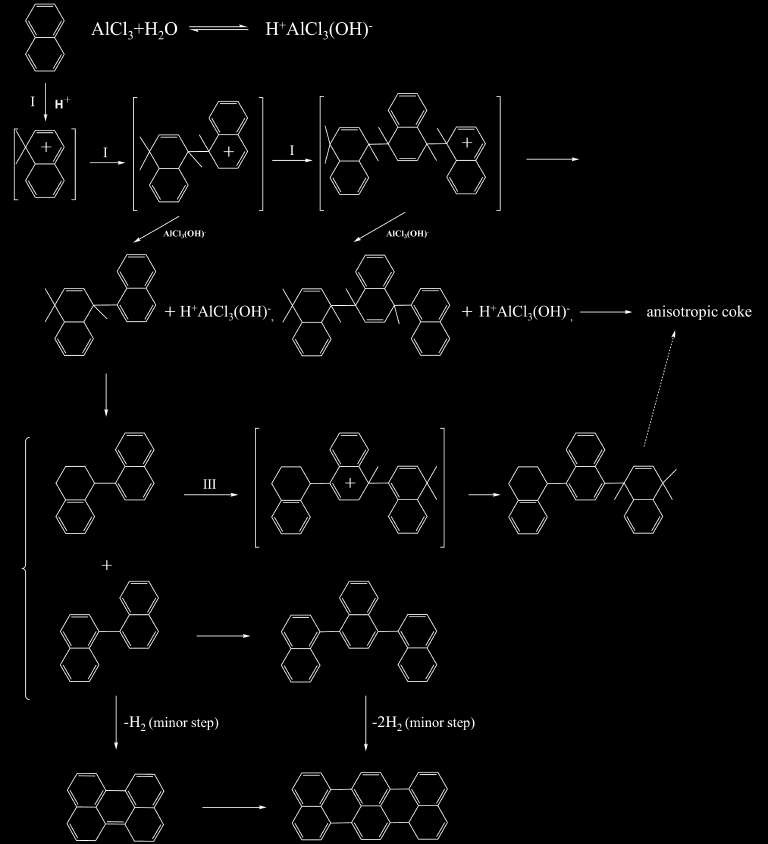
Because of its high purity and excellent orientation, mesophase pitch is a superior precursor for high-performance carbon materials. However, the preparation of top-notch mesophase pitch faces challenges. Catalytic polycondensation at low temperatures is more favorable for synthesizing mesophase pitch, because it circumvents the high-temperature free radical reaction of other thermal polycondensation approaches. The reaction is gentle and can be easily controlled. It has the potential to significantly improve the yield of mesophase pitch and easily introduce naphthenic characteristics into the molecules, catalytic polycondensation is therefore a preferred method of synthesizing highly spinnable mesophase pitch. This review provides a synopsis of the selective pretreatment of the raw materials to prepare different mesophase pitches, and explains the reaction mechanism and associated research advances for different catalytic systems in recent years. Finally, how to manufacture high-quality mesophase pitch by using a catalyst-promoter system is summarized and proposed, which may provide a theoretical basis for the future design of high-quality pitch molecules.
1. Introduction
Pitch-based carbon fiber can be segregated into two categories including general-purpose fiber and high-performance fiber. General-purpose pitch-based carbon fiber, derived from isotropic spinning pitch and usually a short fiber, has a tensile strength of less than 1000 MPa and an elastic modulus lower than 100 GPa[1]. It could be employed as functional materials such as anti-corrosion, heat preservation, abrasion resistance, and adsorption. High-performance pitch-based carbon fiber refers to fiber with a strength > 1000 MPa and a modulus > 100 GPa. Despite the complex process including spinning, oxidizing, carbonizing, and graphitizing by using mesophase pitch as the raw material, the superior modulus, thermal conductivity, electronic conductivity, vibration attenuation and low thermal expansion coefficient are endowing it with wide application[2–6].
High-quality mesophase pitch as the precursor can produce not only carbon fibers with excellent performance, but also other high-end carbon products such as carbon foam, carbon microspheres, needle coke, etc. It plays an important role in military industry, aerospace, nuclear energy industry. It can also be used in other fields, such as LED heat transfer materials with superior electronic and thermal conductivity, composites with superior structures and functions, as well as high-end fabrication, energy storage, transformation, and many potential uses. Mesophase pitch is a kind of anisotropic liquid crystal with large molecular weight and thermodynamically stability formed through pyrolysis, dehydrogenation and polycondensation of polycyclic aromatic hydrocarbons when heated under an inert atmosphere. Layered nematic liquid crystal with optical anisotropy is formed by orientation, alignment and self-assembly under liquid phase interaction involving chemical and physical reactions of organic substances[7–9]. The emergence, expansion, coalescence and distortion of mesophase spheres are necessary for the transition of aromatic small molecule to a highly graphitized carbon. The size of anisotropic isochromatic region is a gauge of the liquid-phase carbonization and thus determines the further utilization of mesophase pitch[10–12].
Loading authentic research manuscript (Pages 1–5)...
MA Zi-hui, YANG Tao, SONG Yan, CHEN Wen-sheng, DUAN Chun-feng, SONG Huai-he, TIAN Xiao-dong, GONG Xiang-jie, LIU Zheng-yang, LIU Zhan-jun (2024). A review of the catalytic preparation of mesophase pitch. New Carbon Materials. https://doi.org/10.1016/S1872-5805_N
Research & Educational Purpose Only:The translations, structured abstracts, analytical annotations, and data reports provided by SinoTechIntel are intended exclusively for academic research, internal corporate R&D, and educational benchmarking. They do not constitute formal engineering, chemical safety, legal, or professional advice.
Copyright & Intellectual Property Notice: Original copyright of the underlying source articles and experimental data remains with the respective authors, institutions, and original publishing journals. SinoTechIntel claims intellectual property only over its proprietary translations, analytical syntheses, and AEO structured enhancements in accordance with international fair use and academic citation principles.
Frequently Asked Questions
What is mesophase pitch and why is it important?
Mesophase pitch is an anisotropic liquid crystal with high molecular weight and thermodynamic stability, formed through pyrolysis, dehydrogenation, and polycondensation of polycyclic aromatic hydrocarbons. It is a superior precursor for high-performance carbon materials such as carbon fibers, carbon foam, and needle coke, due to its high purity and excellent orientation.
What are the advantages of catalytic polycondensation for mesophase pitch preparation?
Catalytic polycondensation at low temperatures is more favorable than high-temperature free radical reactions because it is gentle, easily controlled, and can significantly improve the yield of mesophase pitch. It also facilitates the introduction of naphthenic characteristics into molecules, which is beneficial for producing highly spinnable mesophase pitch.
What catalytic systems are discussed in the review?
The review discusses various catalytic systems, including Lewis acids and Brønsted acids, and their reaction mechanisms and research advances. It also summarizes the use of a catalyst-promoter system for manufacturing high-quality mesophase pitch.
How does the catalyst-promoter system improve mesophase pitch quality?
The catalyst-promoter system is proposed as a strategic approach to enhance the catalytic polycondensation process, potentially improving yield and molecular structure, which is crucial for producing high-quality mesophase pitch with desirable properties for advanced carbon materials.
What are the key applications of mesophase pitch?
Mesophase pitch is used to produce high-performance carbon fibers, carbon foam, carbon microspheres, needle coke, and other high-end carbon products. It finds applications in military, aerospace, nuclear energy, LED heat transfer materials, composites, energy storage, and more.
Related Technical Papers & Translations

Design and optimization of a high-efficiency distillation process for cellulosic fuel ethanol integrated with thermal coupling and molecular sieve adsorption
To address the challenges of high energy consumption and prominent costs in the traditional three-columns distillation process for cellulosic fuel ethanol, a distillation—molecular sieve coupling separation process is proposed. This process integrates a three-column (crude distillation column, first distillation column, second distillation column) system with a 3A molecular sieve adsorption deep dehydration unit. A thermal coupling network is constructed via differential pressure design (steam from medium/high-pressure columns as mutual heat sources, reboiler liquid waste heat for feed preheating), and molecular sieve adsorption conditions are optimized. The study first performs a thermodynamic consistency test on the ethanol—water system, determines optimal non-random two-liquid (NRTL) model binary interaction parameters via experimental data regression for Aspen Plus simulation. Aiming at minimum total annual cost (TAC), Aspen Plus is used to optimize process parameters (theoretical tray number, feed location, reflux ratio, side-draw position, etc.). Economic analysis shows this process reduces CO2 emission costs by 27.56%, TAC by 15.58% (to 5.123 × 10⁶ USD·a-1), and increases ethanol purity to >99.6%, providing an effective solution for green, efficient separation.

A cohesion loss model for determining residual strength of deep bedded sandstone
Rock residual strength, as an important input parameter, plays an indispensable role in proposing the reasonable and scientific scheme about stope design, underground tunnel excavation and stability evaluation of deep chambers. Therefore, previous residual strength models of rocks established were reviewed. And corresponding related problems were stated. Subsequently, starting from the effects of bedding and whole life-cycle evolution process, series of triaxial mechanical tests of deep bedded s

Federated model with contrastive learning and adaptive control variates for human activity recognition
Recent attention to privacy issues demands a communication-safe method for training human activity recognition (HAR) models on client activity data. Federated learning (FL) has become a compelling technique to facilitate model training between the server and clients while preserving data privacy. However, classical FL methods often assume independent and identically distributed (IID) data among clients. This assumption does not hold true in practical scenarios. Human activity in real-world scena