Key Takeaways & Executive Findings
- •• Graphdiyne (GDY) is a novel 2D carbon allotrope with sp and sp2 hybridized carbon, offering unique electronic properties and chemical stability for water treatment. • GDY exhibits excellent adsorption efficiency for removing oils, organic pollutants, dyes, and heavy metals from aqueous solutions. • The triangular pores and carbon-carbon triple bonds in GDY provide abundant active sites and reaction pathways for enhanced contaminant removal. • This review highlights the synthesis methods and adsorption mechanisms of GDY, addressing the gap in literature and outlining future prospects for its application in water purification.
Abstract
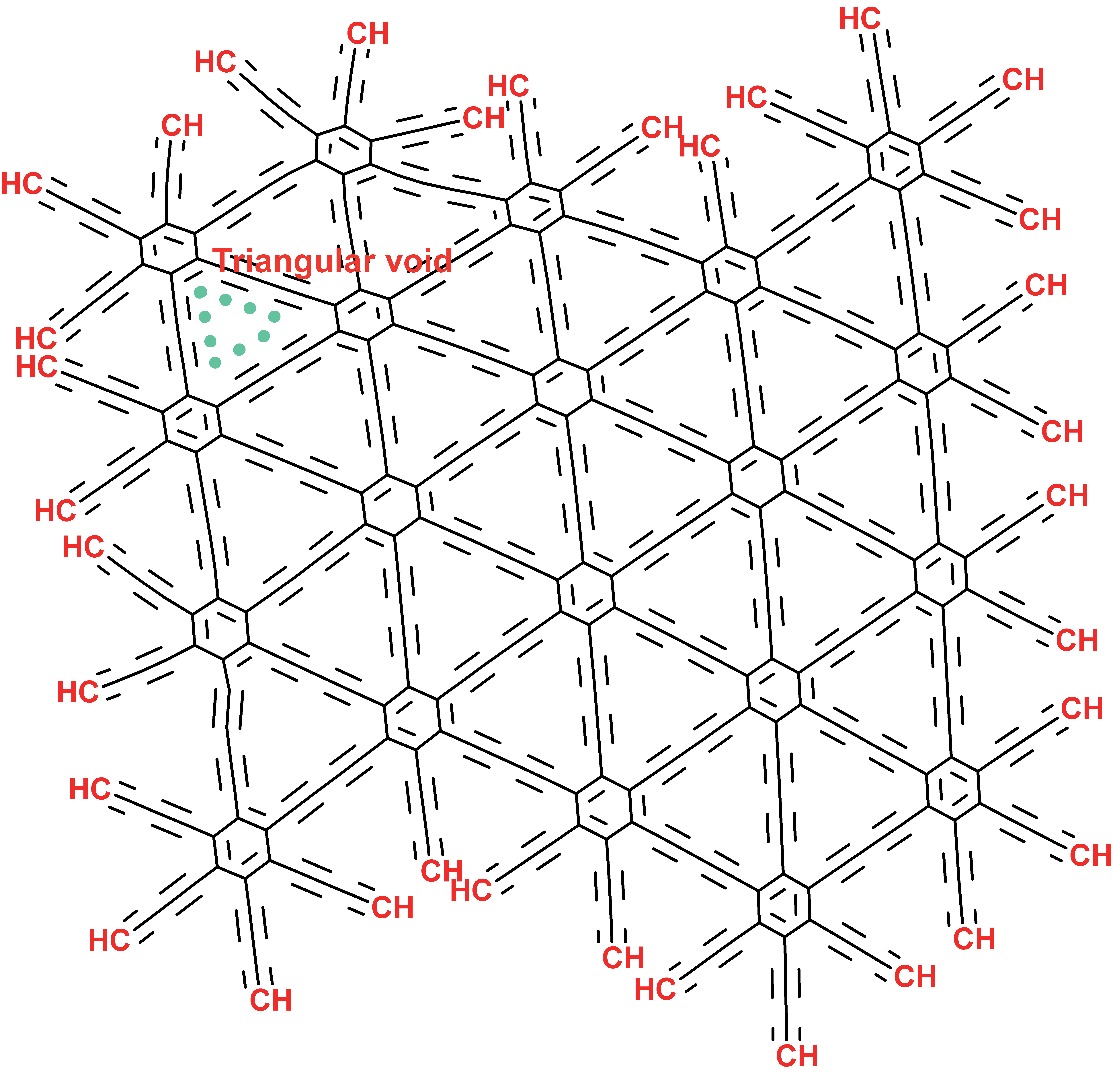
Graphdiyne (GDY), a new two-dimensional (2D) carbon molecule, is expected to have applications in the removal of contaminants from aqueous media. It has superior conjugation, unusual and varied electronic properties, and exceptional chemical and thermal stability because of its framework of sp and sp2 hybridized carbon bonds that are combined to produce benzene rings and diacetylenic bonds in a two-dimensional symmetrical network. Its molecular chemistry is the result of it having carbon-carbon triple bonds, with a regular distribution of triangular pores in its structure, which provide reaction sites and various reaction pathways. GDY is an adsorbent with an excellent efficiency for the removal of oil, organic pollutants, dyes, and metals from contaminated water, but there is limited evidence of it being used as an adsorbent in the literature. This review discusses its synthesis and its use as an adsorbent together with its prospects for pollutant removal.
1. Introduction
Rapid urbanization and industrialization are increasing global energy demand, which severely contaminates water. The environment and human life are seriously impacted by heavy metals, organics, toxic dyes, and other pollutants released into water by industrial and household processes. The management and elimination of environmental pollution have become one of the most important concerns that have to be tackled. In order to deal with the expanding issue of aqueous pollutants, numerous cutting-edge techniques, including physical, chemical, and biological approaches, have been created recently. These methods rely on certain substances with distinct capabilities to control and remove the pollution.
Aqueous contaminants can currently be removed using a variety of methods, including chemical precipitation, ion exchange, membrane filtering, electrochemical oxidation, photocatalytic degradation, and adsorption. Chemical precipitation is inexpensive, but it struggles with removal of low heavy metal ion concentrations and produces a lot of sludge. While ion exchange technique does not include sludge production, but is more expensive. Electrochemical technologies are more efficient and produce less sludge, but they require significant upfront investments and also expensive power supply. Membrane filtration provides great selectivity and efficiency but incurs increased operational costs due to membrane fouling and decreased permeate flux. Because of its potential to harness infinite solar energy and lack of secondary harmful byproducts, semiconductor-based photocatalysis is gaining popularity in advanced oxidation processes. However, some serious drawbacks of photocatalysts like limited solar activity and rapid electron-hole pair recombination restrict the range of their applications. Adsorption is one of the most competitive and widely utilized treatments among them due to its low cost, ease of use, broad applicability, simplicity of recovery, and lack of by-product formation throughout the treatment process.
Loading authentic research manuscript (Pages 1–5)...
Gaurav Sharma, Yaksha Verma, Amit Kumar, Pooja Dhiman, WANG Tong-tong, Florian J. Stadler (2024). A review of graphdiyne: A new material for synthesizing effective adsorbents for aqueous contaminants. New Carbon Materials. https://doi.org/10.1016/S1872-5805_N
Research & Educational Purpose Only:The translations, structured abstracts, analytical annotations, and data reports provided by SinoTechIntel are intended exclusively for academic research, internal corporate R&D, and educational benchmarking. They do not constitute formal engineering, chemical safety, legal, or professional advice.
Copyright & Intellectual Property Notice: Original copyright of the underlying source articles and experimental data remains with the respective authors, institutions, and original publishing journals. SinoTechIntel claims intellectual property only over its proprietary translations, analytical syntheses, and AEO structured enhancements in accordance with international fair use and academic citation principles.
Frequently Asked Questions
What is graphdiyne (GDY) and why is it promising for water treatment?
Graphdiyne is a two-dimensional carbon allotrope with a unique structure of sp and sp2 hybridized carbon, featuring triangular pores and carbon-carbon triple bonds. These properties provide abundant active sites and high chemical stability, making it an excellent adsorbent for removing various aqueous contaminants.
What types of contaminants can graphdiyne remove from water?
Graphdiyne has shown high efficiency in adsorbing oils, organic pollutants, dyes, and heavy metals from contaminated water, as highlighted in the review.
How does graphdiyne compare to other water treatment methods?
Compared to methods like chemical precipitation, ion exchange, and membrane filtration, adsorption using graphdiyne offers advantages such as low cost, ease of use, broad applicability, and no secondary by-products, making it a competitive option.
What are the main challenges or limitations of using graphdiyne as an adsorbent?
The review notes that there is limited evidence of graphdiyne being used as an adsorbent in the literature, indicating a need for more research to fully understand its adsorption mechanisms and optimize its practical applications.
What future prospects does graphdiyne have in pollutant removal?
The review discusses the synthesis and adsorption use of graphdiyne, suggesting that with further research, it could become a promising material for effective and sustainable water purification technologies.
Related Technical Papers & Translations

Design and optimization of a high-efficiency distillation process for cellulosic fuel ethanol integrated with thermal coupling and molecular sieve adsorption
To address the challenges of high energy consumption and prominent costs in the traditional three-columns distillation process for cellulosic fuel ethanol, a distillation—molecular sieve coupling separation process is proposed. This process integrates a three-column (crude distillation column, first distillation column, second distillation column) system with a 3A molecular sieve adsorption deep dehydration unit. A thermal coupling network is constructed via differential pressure design (steam from medium/high-pressure columns as mutual heat sources, reboiler liquid waste heat for feed preheating), and molecular sieve adsorption conditions are optimized. The study first performs a thermodynamic consistency test on the ethanol—water system, determines optimal non-random two-liquid (NRTL) model binary interaction parameters via experimental data regression for Aspen Plus simulation. Aiming at minimum total annual cost (TAC), Aspen Plus is used to optimize process parameters (theoretical tray number, feed location, reflux ratio, side-draw position, etc.). Economic analysis shows this process reduces CO2 emission costs by 27.56%, TAC by 15.58% (to 5.123 × 10⁶ USD·a-1), and increases ethanol purity to >99.6%, providing an effective solution for green, efficient separation.

A cohesion loss model for determining residual strength of deep bedded sandstone
Rock residual strength, as an important input parameter, plays an indispensable role in proposing the reasonable and scientific scheme about stope design, underground tunnel excavation and stability evaluation of deep chambers. Therefore, previous residual strength models of rocks established were reviewed. And corresponding related problems were stated. Subsequently, starting from the effects of bedding and whole life-cycle evolution process, series of triaxial mechanical tests of deep bedded s

Federated model with contrastive learning and adaptive control variates for human activity recognition
Recent attention to privacy issues demands a communication-safe method for training human activity recognition (HAR) models on client activity data. Federated learning (FL) has become a compelling technique to facilitate model training between the server and clients while preserving data privacy. However, classical FL methods often assume independent and identically distributed (IID) data among clients. This assumption does not hold true in practical scenarios. Human activity in real-world scena