Key Takeaways & Executive Findings
- •• The proposed Doppler frequency offset (DFO) pre-compensation method reduces the frequency-protection interval, achieving a 90–400× expansion in user access volume for space-based IoT. • Selecting appropriate message splits and transmission rates for DFO calculation can further increase user access by more than 45%. • The method directly addresses spectrum scarcity and low utilization by enhancing spectrum utilization efficiency under restricted frequency resources. • This scheme offers a practical solution for massive terminal user access, supporting the large-scale deployment of space-based Internet of Things.
Abstract
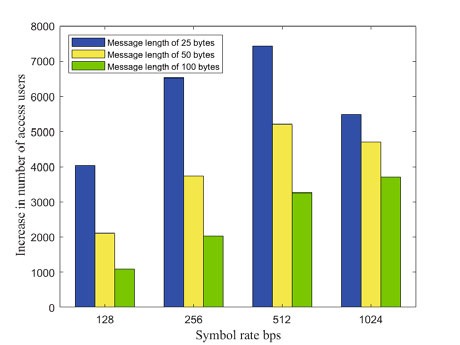
To meet the access demands of massive terminal users, the space-based Internet of Things (IoT) requires sufficient frequency resources for allocation. However, the frequency resources that are currently available have already been allocated to a great extent. Furthermore, the utilization rate of the allocated frequency resources is low. To support massive user access under restricted frequency resources, this work proposes a scheme based on Doppler frequency offset (DFO) pre-compensation to enhance spectrum utilization efficiency. By calculating the relative motion between the satellite and the transmitting terminal, combined with the length and transmission rate of the message, the optimal compensation value of the Doppler frequency deviation is determined. The frequency-protection interval is reduced. Simulation results show that the pre-compensation method can expand the user access volume by 90–400 times. Properly selecting the number of message splits and transmission rate to perform DFO pre-compensation calculations can increase user access by an additional 45% or more. This method improves the spectrum utilization efficiency and provides a solution to the challenge of access by a large number of users.
1. Introduction
Space-based Internet of Things (IoT) is an effective compensation and extension of the ground-based IoT. It utilizes various types of space-based platforms to realize the acquisition, processing, transmission, and application of IoT information, and has become a fundamental technical means for building the interconnection of all things and for ubiquitous sensing. The space-based IoT system offers global coverage, all-weather operation, and strong stability, and has been widely used in logistics monitoring, transportation, environmental protection, hydrological monitoring, and other fields.
However, the frequency resources required by space-based IoT face two prominent problems. First, remaining frequency resources available for division are scarce: the Ku band, known as the “golden frequency band” for low-orbit satellite communication, has been almost completely allocated. Second, divided frequency resources are often underutilized or left idle. Research shows that the average spectrum utilization rate of different frequency bands below 3 GHz is only 5.2%, and about 31.25% of sub-band carriers in the IEEE802.15.3c standard are blank carriers. Meanwhile, the Global System for Mobile Communications Association has predicted that the global scale of IoT connections will reach 24.6 billion by 2025, with more than 100 million users accessing satellite terminals. This creates a new technical challenge: how to support massive user access under restricted spectrum resources.
To address this, high-throughput multiple access techniques and improved spectrum utilization methods have been proposed, including frequency division multiple access (FDMA), space division multiple access (SDMA), time division multiple access (TDMA), code division multiple access (CDMA), cognitive radio, cellular multiplexing, and millimeter-wave technology. Commercial systems such as Starlink also strive to improve spectrum utilization by sharing Ku/Ka bands with other users. The proposed DFO pre-compensation method in this work further enhances spectrum efficiency by reducing the frequency-protection interval, significantly expanding user access capacity.
Loading authentic research manuscript (Pages 1–5)...
Qingquan Liu, Lihu Chen, Songting Li, Yiran Xiang, Baokang Zhao (2025). A novel frequency-protection interval adjustment method based on Doppler frequency offset pre-compensation for space-based Internet of Things. Frontiers of Information Technology & Electronic Engineering. https://doi.org/10.1631/FITEE_2400033
Research & Educational Purpose Only:The translations, structured abstracts, analytical annotations, and data reports provided by SinoTechIntel are intended exclusively for academic research, internal corporate R&D, and educational benchmarking. They do not constitute formal engineering, chemical safety, legal, or professional advice.
Copyright & Intellectual Property Notice: Original copyright of the underlying source articles and experimental data remains with the respective authors, institutions, and original publishing journals. SinoTechIntel claims intellectual property only over its proprietary translations, analytical syntheses, and AEO structured enhancements in accordance with international fair use and academic citation principles.
Frequently Asked Questions
What is the proposed method for improving spectrum utilization in space-based IoT?
The paper proposes a Doppler frequency offset (DFO) pre-compensation scheme that adjusts the frequency-protection interval based on the relative motion between the satellite and the transmitting terminal, as well as the message length and transmission rate, thereby enhancing spectrum utilization efficiency and supporting more users.
How much can user access volume be expanded by this method?
Simulation results demonstrate that the pre-compensation method can expand the user access volume by 90–400 times. Additionally, by properly selecting the number of message splits and transmission rate for DFO calculations, user access can be increased by more than 45%.
Why is spectrum utilization important for space-based Internet of Things?
Frequency resources available for space-based IoT are scarce and largely underutilized, while the number of IoT connections is expected to reach 24.6 billion by 2025. Efficient spectrum utilization is therefore critical to support massive terminal user access within limited frequency resources.
What existing multiple access techniques are compared in the paper?
The paper discusses frequency division multiple access (FDMA), space division multiple access (SDMA), time division multiple access (TDMA), code division multiple access (CDMA), cognitive radio, cellular multiplexing, and millimeter-wave technology as existing approaches, with DFO pre-compensation offering a novel alternative.
What is the significance of reducing the frequency-protection interval?
Reducing the frequency-protection interval allows more efficient use of the spectrum by minimizing unused guard bands, thus enabling a larger number of users to access the system under the same frequency allocation.
Related Technical Papers & Translations

Design and optimization of a high-efficiency distillation process for cellulosic fuel ethanol integrated with thermal coupling and molecular sieve adsorption
To address the challenges of high energy consumption and prominent costs in the traditional three-columns distillation process for cellulosic fuel ethanol, a distillation—molecular sieve coupling separation process is proposed. This process integrates a three-column (crude distillation column, first distillation column, second distillation column) system with a 3A molecular sieve adsorption deep dehydration unit. A thermal coupling network is constructed via differential pressure design (steam from medium/high-pressure columns as mutual heat sources, reboiler liquid waste heat for feed preheating), and molecular sieve adsorption conditions are optimized. The study first performs a thermodynamic consistency test on the ethanol—water system, determines optimal non-random two-liquid (NRTL) model binary interaction parameters via experimental data regression for Aspen Plus simulation. Aiming at minimum total annual cost (TAC), Aspen Plus is used to optimize process parameters (theoretical tray number, feed location, reflux ratio, side-draw position, etc.). Economic analysis shows this process reduces CO2 emission costs by 27.56%, TAC by 15.58% (to 5.123 × 10⁶ USD·a-1), and increases ethanol purity to >99.6%, providing an effective solution for green, efficient separation.

A cohesion loss model for determining residual strength of deep bedded sandstone
Rock residual strength, as an important input parameter, plays an indispensable role in proposing the reasonable and scientific scheme about stope design, underground tunnel excavation and stability evaluation of deep chambers. Therefore, previous residual strength models of rocks established were reviewed. And corresponding related problems were stated. Subsequently, starting from the effects of bedding and whole life-cycle evolution process, series of triaxial mechanical tests of deep bedded s

Federated model with contrastive learning and adaptive control variates for human activity recognition
Recent attention to privacy issues demands a communication-safe method for training human activity recognition (HAR) models on client activity data. Federated learning (FL) has become a compelling technique to facilitate model training between the server and clients while preserving data privacy. However, classical FL methods often assume independent and identically distributed (IID) data among clients. This assumption does not hold true in practical scenarios. Human activity in real-world scena