Key Takeaways & Executive Findings
- •• Co3O4/graphdiyne heterostructured nanowires (Co3O4/GDY NWs) were synthesized via a simple two-step process, achieving a high NH3 yield rate of 0.78 mmol h−1 cm−2 and a Faraday efficiency of 92.45% at −1.05 V vs. RHE. • The heterointerface features sp-C―Co bonds and incomplete charge transfer between GDY and Co, providing a continuous electron supply that enhances the nitrate reduction reaction (NtRR). • This work demonstrates a general approach for constructing heterostructures that enable efficient ammonia production from wastewater under ambient conditions, offering a sustainable alternative to the energy-intensive Haber-Bosch process. • The Co3O4/GDY heterostructure shows improved electrical conductivity and increased active sites, addressing the challenges of the complex eight-electron nitrate-to-ammonia conversion.
Abstract
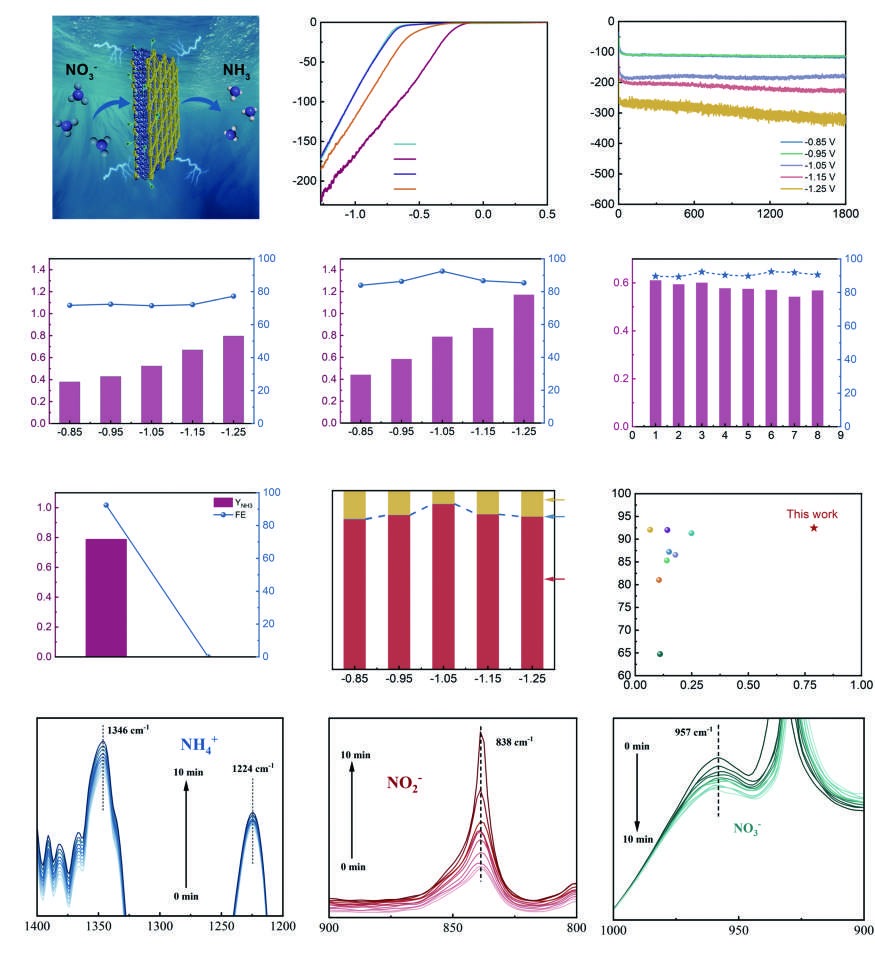
The nitrate reduction reaction (NtRR) has been demonstrated to be a promising way for obtaining ammonia (NH3) by converting NO3− to NH3. Here we report the controlled synthesis of cobalt tetroxide/graphdiyne heterostructured nanowires (Co3O4/GDY NWs) by a simple two-step process including the synthesis of Co3O4 NWs and the following growth of GDY using hexaethynylbenzene as the precursor at 110 °C for 10 h. Detailed scanning electron microscopy, high resolution transmission electron microscopy, X-ray photoelectron spectroscopy, and Raman characterization confirmed the synthesis of a Co3O4/GDY heterointerface with the formation of sp-C―Co bonds at the interface and incomplete charge transfer between GDY and Co, which provide a continuous supply of electrons for the catalytic reaction and ensure a rapid NtRR. Because of these advantages, Co3O4/GDY NWs had an excellent NtRR performance with a high NH3 yield rate (YNH3) of 0.78 mmol h−1 cm−2 and a Faraday efficiency (FE) of 92.45% at −1.05 V (vs. RHE). This work provides a general approach for synthesizing heterostructures that can drive high-performance ammonia production from wastewater under ambient conditions.
1. Introduction
Ammonia (NH3) is an important feedstock for modern industry and an ideal energy carrier. Unfortunately, industrial-scale NH3 production is mainly based on the traditional energy- and emissions-intensive Haber-Bosch process from nitrogen (N≡N dissociation energy 941 kJ mol−1) and hydrogen under harsh conditions such as high temperatures (673–773 K) and high pressures (150–300 atm)[1–3]. In view of this, the electrochemical conversion of nitrate (dissociation energy: 204 kJ mol−1) into NH3 at room temperatures and ambient pressures has been regarded as the most promising route for ammonia production[4–7]. For the complex eight-electron process from NO3− to NH3 in NtRR, it is particularly necessary to optimize the adsorption and desorption behavior of both reactants and products simultaneously. The complex reaction processes of various reaction intermediates (NO2, NO, NOH, N2, NH2OH, NH2NH2) at the interface should also be considered to improve the selectivity of the catalysts. Till date, a wide variety of catalysts have been reported for efficient NH3 production through electrocatalytic nitrate reduction reaction (NtRR) [8–13], but the NH3 yield rates (YNH3) and Faraday efficiencies (FE) are still below industry standards due to the complex eight-electron process from NO3− to NH3 conversion. It is therefore of great significance to design and synthesize new catalysts with high YNH3, selectivity, and stability for obtaining NH3 from NtRR.
Among reported catalysts, heterostructured catalysts have shown many intrinsic advantages to catalysis with improved intrinsic activity and stability[14–15]. The construction of a heterointerface is an important route to synergistically combine the advantages offered by multiple materials and adjust the catalyst’s properties such as electrical conductivity, hydrophilicity, interfacial electron modulation, and adsorption energy of intermediates, etc[16–23]. Carbon-based materials have become one of the most used heterojunction materials due to their abundant natural reserves, high affinity and versatility[24–29]. Graphdiyne (GDY), a new rising star in the carbon family, has attracted considerable attention due to its specific sp-/sp2-hybridized all-carbon two-dimensional networks with unique properties such as a natural pore structure, a large specific surface area, the rich alkyne bonds, high intrinsic activity and excellent stability[30–58]. In addition, the controllable growth of GDY on various material surfaces under mild conditions offers the advantage for growing high-performance active structures.
In this work, we successfully synthesized Co3O4/GDY heterostructured nanowires by in-situ growth of GDY on the surface of Co3O4 (Fig. 1). The newly-formed heterointerface between Co3O4 and GDY has improved electric conductivity, increased active sites, the specific incomplete charge-transfer property. These unique advantages of Co3O4/GDY significantly promote the efficient conversion of NO3− to NH3, giving a high YNH3 of 0.78 mmol h−1 cm−2 and FE of 92.45% at −1.05 V (vs. RHE).
Loading authentic research manuscript (Pages 1–5)...
CHEN Zhao-yang, ZHAO Shu-ya, LUAN Xiao-yu, ZHENG Zhi-qiang, YAN Jia-yu, XUE Yu-rui (2024). A Co3O4/graphdiyne heterointerface for efficient ammonia production from nitrates. New Carbon Materials. https://doi.org/10.1016/S1872-5805_N
Research & Educational Purpose Only:The translations, structured abstracts, analytical annotations, and data reports provided by SinoTechIntel are intended exclusively for academic research, internal corporate R&D, and educational benchmarking. They do not constitute formal engineering, chemical safety, legal, or professional advice.
Copyright & Intellectual Property Notice: Original copyright of the underlying source articles and experimental data remains with the respective authors, institutions, and original publishing journals. SinoTechIntel claims intellectual property only over its proprietary translations, analytical syntheses, and AEO structured enhancements in accordance with international fair use and academic citation principles.
Frequently Asked Questions
What is the main achievement of this study?
The study successfully synthesized Co3O4/graphdiyne heterostructured nanowires (Co3O4/GDY NWs) that exhibit excellent electrocatalytic performance for nitrate reduction to ammonia, achieving a high NH3 yield rate of 0.78 mmol h−1 cm−2 and a Faraday efficiency of 92.45% at −1.05 V vs. RHE.
How are the Co3O4/GDY heterostructured nanowires synthesized?
The Co3O4/GDY NWs are synthesized via a simple two-step process: first, Co3O4 nanowires are synthesized, and then graphdiyne (GDY) is grown on their surface using hexaethynylbenzene as a precursor at 110 °C for 10 hours.
What is the role of the heterointerface in the catalytic performance?
The heterointerface between Co3O4 and GDY features sp-C―Co bonds and incomplete charge transfer, which provide a continuous supply of electrons for the catalytic reaction, enhancing the nitrate reduction reaction (NtRR) kinetics and overall performance.
Why is electrochemical nitrate reduction considered a promising alternative to the Haber-Bosch process?
Electrochemical nitrate reduction operates under ambient conditions (room temperature and pressure) and uses nitrate as a nitrogen source, which has a much lower dissociation energy (204 kJ mol−1) compared to nitrogen (941 kJ mol−1), making it more energy-efficient and environmentally friendly.
What are the potential applications of this work?
This work provides a general approach for synthesizing heterostructures that can drive high-performance ammonia production from wastewater under ambient conditions, offering a sustainable method for ammonia synthesis and wastewater treatment.
Related Technical Papers & Translations

Design and optimization of a high-efficiency distillation process for cellulosic fuel ethanol integrated with thermal coupling and molecular sieve adsorption
To address the challenges of high energy consumption and prominent costs in the traditional three-columns distillation process for cellulosic fuel ethanol, a distillation—molecular sieve coupling separation process is proposed. This process integrates a three-column (crude distillation column, first distillation column, second distillation column) system with a 3A molecular sieve adsorption deep dehydration unit. A thermal coupling network is constructed via differential pressure design (steam from medium/high-pressure columns as mutual heat sources, reboiler liquid waste heat for feed preheating), and molecular sieve adsorption conditions are optimized. The study first performs a thermodynamic consistency test on the ethanol—water system, determines optimal non-random two-liquid (NRTL) model binary interaction parameters via experimental data regression for Aspen Plus simulation. Aiming at minimum total annual cost (TAC), Aspen Plus is used to optimize process parameters (theoretical tray number, feed location, reflux ratio, side-draw position, etc.). Economic analysis shows this process reduces CO2 emission costs by 27.56%, TAC by 15.58% (to 5.123 × 10⁶ USD·a-1), and increases ethanol purity to >99.6%, providing an effective solution for green, efficient separation.

A cohesion loss model for determining residual strength of deep bedded sandstone
Rock residual strength, as an important input parameter, plays an indispensable role in proposing the reasonable and scientific scheme about stope design, underground tunnel excavation and stability evaluation of deep chambers. Therefore, previous residual strength models of rocks established were reviewed. And corresponding related problems were stated. Subsequently, starting from the effects of bedding and whole life-cycle evolution process, series of triaxial mechanical tests of deep bedded s

Federated model with contrastive learning and adaptive control variates for human activity recognition
Recent attention to privacy issues demands a communication-safe method for training human activity recognition (HAR) models on client activity data. Federated learning (FL) has become a compelling technique to facilitate model training between the server and clients while preserving data privacy. However, classical FL methods often assume independent and identically distributed (IID) data among clients. This assumption does not hold true in practical scenarios. Human activity in real-world scena