Key Takeaways & Executive Findings
- •• A novel co-simulation (CS) approach coupling CFD and MBD is proposed to capture fluid-structure interactions in high-speed trains, overcoming limitations of offline simulation (OS) that neglects vehicle motion effects on airflow. • The CS method is validated against field test data, demonstrating its accuracy and reliability for analyzing aerodynamic and dynamic responses in complex scenarios such as tunnel exit under crosswind. • Compared to OS, CS reveals significantly severer transient wheel-rail impacts and larger differences in aerodynamic moments (up to 29.6 kN·m in yawing), highlighting the importance of considering coupled effects for safety assessment. • The CS approach offers superior computational efficiency and stability, making it a practical tool for studying high-speed train performance under extreme wind conditions and aiding in the design of safer railway operations.
Abstract
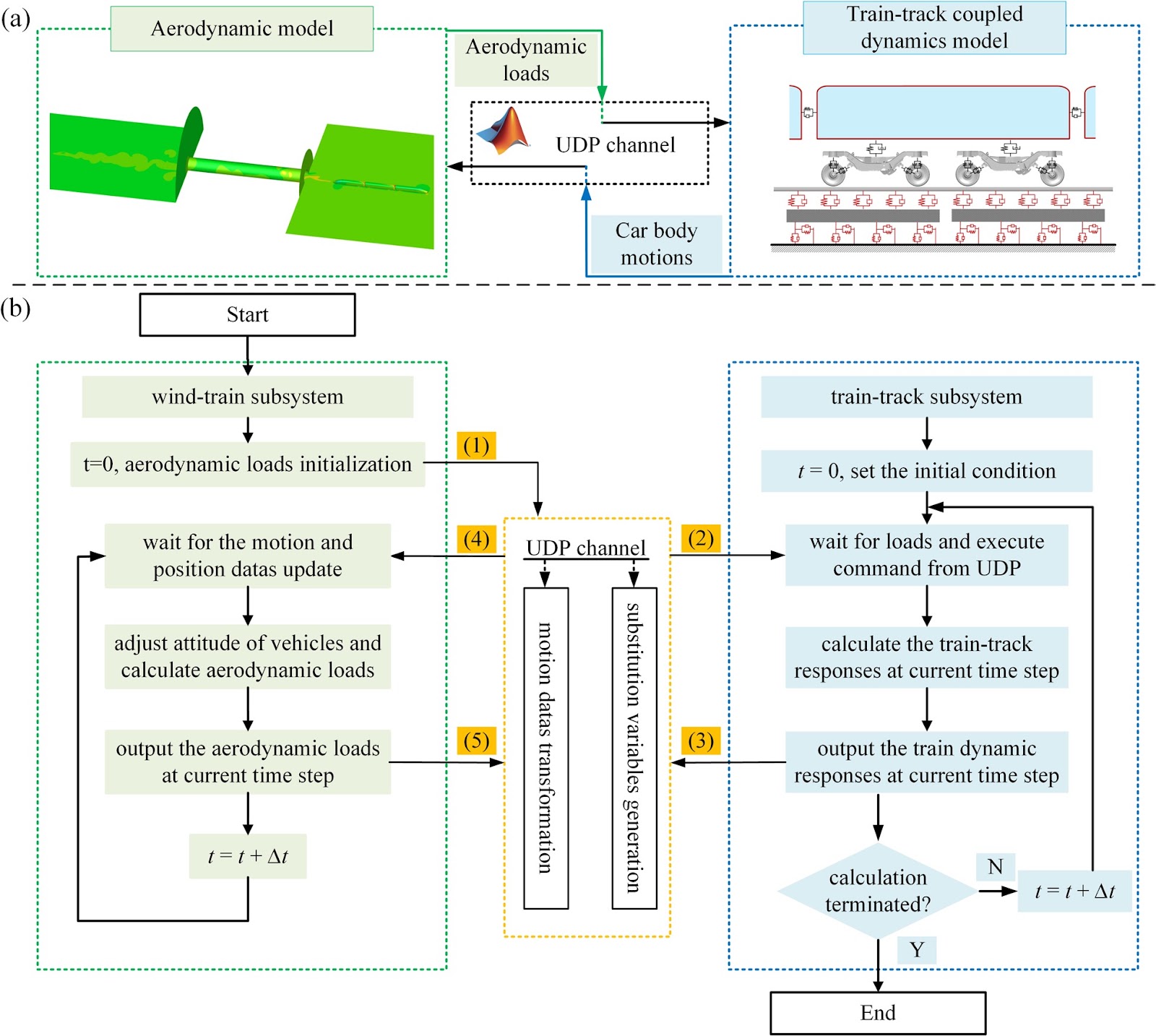
The interaction between the airflow and train influences the aerodynamic characteristics and dynamic performance of high-speed trains. This study focused on the fluid-solid coupling effect of airflow and HST, and proposed a co-simulation (CS) approach between computational fluid dynamics and multi-body dynamics. Firstly, the aerodynamic model was developed by employing overset mesh technology and the finite volume method, and the detailed train-track coupled dynamic model was established. Then the User Data Protocol was adopted to build data communication channels. Moreover, the proposed CS method was validated by comparison with a reported field test result. Finally, a case study of the HST exiting a tunnel subjected to crosswind was conducted to compare differences between CS and offline simulation (OS) methods. In terms of the presented case, the changing trends of aerodynamic forces and car-body displacements calculated by the two methods were similar. Differences mainly lie in aerodynamic moments and transient wheel-rail impacts. Maximum pitching and yawing moments on the head vehicle in the two methods differ by 21.1 kN∙m and 29.6 kN∙m, respectively. And wheel-rail impacts caused by sudden changes in aerodynamic loads are significantly severer in CS. Wheel-rail safety indices obtained by CS are slightly greater than those by OS. This research proposes a CS method for aerodynamic characteristics and dynamic performance of the HST in complex scenarios, which has superiority in computational efficiency and stability.
1. Introduction
High-speed trains (HSTs) are widely utilized for passenger transportation due to the high levels of ride comfort, stability, and reliability. With increasing travel demand, high-speed railway constructions in the western mountainous regions, which are key areas affected by strong winds in China, have been progressing. Strong winds pose a significant safety risk for the operation of high-speed railways, as inducing severe aerodynamic loads on vehicles and affecting their dynamic performance [1, 2]. Consequently, wind-related operational safety and comfort issues for HSTs have garnered increasing attention in recent years.
To address these challenges, significant efforts have been devoted to studying the operational quality of HSTs under wind conditions. In Europe, extensive field tests had been conducted to investigate the effects of wind environments on the running safety of HSTs, culminating in a series of practical standards established by CEN [3]. In China, field tests along the Xinjiang railway lines had identified effective measures to mitigate wind-induced risks, including critical wind-vehicle speed relationships and optimized parameters for windbreak structures [4]. While field tests are direct and effective for analyzing the impact of crosswinds on HSTs, conducting such tests under extreme wind conditions remains challenging due to safety and controllability concerns.
Wind tunnel experiments, which offer greater design flexibility and controllability, have been extensively developed as an alternative for studying the aerodynamic characteristics of trains [5–8]. Furthermore, advancements in computational fluid dynamics (CFD), multi-body dynamics (MBD), and computing technologies enhanced the reliability of numerical simulations for analyzing the aerodynamic characteristics and dynamic performance of HSTs. Typically, aerodynamic loads obtained from CFD models were converted into concentrated forces and moments applied to MBD models to calculate the dynamic response of the vehicle. This approach, known as the off-line simulation (OS) method, has been widely used to study aerodynamic and dynamic challenges for HSTs in various scenarios, such as entering a tunnel [9, 10], passing by windbreaks [11, 12], transiting through the bridge [13–16], etc. Some studies also introduced vehicle-track coupled dynamics models [17, 18] to enhance the analysis of train dynamics under crosswind conditions.
In the OS method, the effect of vehicle motions on the flow field surrounding the HST is ignored. How
Loading authentic research manuscript (Pages 1–5)...
Yanlin Hu, Qinghua Chen, Xin Ge, Wentao He, Haowei Yu, Liang Ling, Kaiyun Wang (2025). A CFD-MBD Co-Simulation Approach for Studying Aerodynamic Characteristics and Dynamic Performance of High-Speed Trains. Chinese Journal of Mechanical Engineering. https://doi.org/10.1186/s10033-025-01352-1
Research & Educational Purpose Only:The translations, structured abstracts, analytical annotations, and data reports provided by SinoTechIntel are intended exclusively for academic research, internal corporate R&D, and educational benchmarking. They do not constitute formal engineering, chemical safety, legal, or professional advice.
Copyright & Intellectual Property Notice: Original copyright of the underlying source articles and experimental data remains with the respective authors, institutions, and original publishing journals. SinoTechIntel claims intellectual property only over its proprietary translations, analytical syntheses, and AEO structured enhancements in accordance with international fair use and academic citation principles.
Frequently Asked Questions
What is the main contribution of this paper?
The paper proposes a co-simulation (CS) approach coupling computational fluid dynamics (CFD) and multi-body dynamics (MBD) to study the aerodynamic characteristics and dynamic performance of high-speed trains, capturing fluid-structure interactions that are neglected in offline simulation (OS) methods.
How does the co-simulation method differ from offline simulation?
In offline simulation, aerodynamic loads are precomputed and applied to the dynamic model without considering the effect of vehicle motion on the airflow. The co-simulation method couples CFD and MBD in real-time, allowing the vehicle motion to influence the flow field, leading to more accurate predictions of aerodynamic moments and transient wheel-rail impacts.
What are the key findings of the case study?
The case study of a high-speed train exiting a tunnel under crosswind shows that while trends in aerodynamic forces and car-body displacements are similar between CS and OS, significant differences exist in aerodynamic moments (up to 29.6 kN·m in yawing) and wheel-rail impacts, with CS predicting severer transient impacts and slightly higher safety indices.
Why is the co-simulation approach considered superior in computational efficiency and stability?
The co-simulation approach is designed to maintain computational efficiency by using efficient data communication protocols and stable coupling algorithms, making it practical for complex scenarios while providing stable and reliable results compared to traditional methods.
What are the practical implications of this research?
The research provides a validated tool for assessing the safety and performance of high-speed trains under strong wind conditions, which is crucial for the design and operation of railways in windy mountainous regions, potentially leading to improved safety standards and operational guidelines.
Related Technical Papers & Translations
Direct Repair of the Crystal Structure and Coating Surface of Spent LiFePO4 Materials Enables Superfast Li-Ion Migration
The rapid accumulation of spent LiFePO4 (LFP) cathodes from retired lithium-ion batteries necessitates the development of effective and environmental-friendly recycling strategies. In this context, direct regeneration has emerged as a promising approach for reclaiming LFP cathode materials, offering a streamlined pathway to restore their electrochemical functionality. We report an integrated regeneration protocol that simultaneously repairs the degraded crystal structure and reconstructs the damaged carbon coating in spent LFP. The regenerated cathode material had superfast lithium-ion diffusion kinetics and a stable cathode–electrolyte interface, giving a remarkable rate capability with specific capacities of 122 mAh g−1 at 5C and 106 mAh g−1 at 10C (1C = 170 mA g−1). It also maintained capacities of 110.7 mAh g−1 (5C) and 84.1 mAh g−1 (10C) after 400 cycles. It could be used in harsh environments and could be stably cycled at subzero temperatures (−10 and −20 °C) and in solid-state electrolyte batteries. Life cycle assessment combined with economic evaluation using the EverBatt model reveals that this direct regeneration approach has high economic and environmental benefits.
Oxide Semiconductor for Advanced Memory Architectures: Atomic Layer Deposition, Key Requirement and Challenges
Oxide semiconductors (OSs), introduced by the Hosono group in the early 2000s, have evolved from display backplane materials to promising candidates for advanced memory and logic devices. The exceptionally low leakage current of OSs and compatibility with three-dimensional (3D) architectures have recently sparked renewed interest in their use in semiconductor applications. This review begins by exploring the unique material properties of OSs, which fundamentally originate from their distinct electronic band structure. Subsequently, we focus on atomic layer deposition (ALD), a core technique for growing excellent OS films, covering both basic and advanced processes compatible with 3D scaling. The basic surface reaction mechanisms—adsorption and reaction—and their roles in film growth are introduced. Furthermore, material design strategies, such as cation selection, crystallinity control, anion doping, and heterostructure engineering, are discussed. We also highlight challenges in memory applications, including contact resistance, hydrogen instability, and lack of p-type materials, and discuss the feasibility of ALD-grown OSs as potential solutions. Lastly, we provide an outlook on the role of ALD-grown OSs in memory technologies. This review bridges material fundamentals and device-level requirements, offering a comprehensive perspective on the potential of ALD-driven OSs for next-generation semiconductor memory devices.
Laser powder bed fusion of biodegradable Zn-4Cu alloy: Processing, microstructure and properties
Zn's natural degradability and biocompatibility make it a promising candidate for implants, however, its mechanical properties remain insufficient for bone applications. In this study, the performance of Zn was enhanced by developing Zn-Cu alloys via laser powder bed fusion (LPBF). Optimal LPBF parameters for forming stable tracks were achieved by adjusting laser power and scanning speed. Under optimized conditions of 100 W and 100 mm/s, high-density (99.58%) Zn-Cu alloys with improved hardness (68.2HV) and yield strength (160 MPa) were achieved. These improvements are attributed to solid solution strengthening, segregation strengthening, and grain refinement. The Zn-Cu alloys also demonstrated favorable degradation behavior, with a rate of 0.16 mm/year. This degradation is primarily driven by micro-galvanic corrosion between the CuZn5 phase and Zn matrix, along with refined grains and increased grain boundary density. This work demonstrates a viable strategy for fabricating Zn-based implants with enhanced structural integrity and mechanical performance via LPBF.