Critical Bimetallic Phosphide Layer Enables Fast Electron Transfer and Extra Energy Supply for Flexible Quasi-Solid-State Zinc Batteries
Authors: Leixin Wu, Linfeng Lv, Yibo Xiong, Wenwu Wang, Xiaoqiao Liao, Xiyao Huang, Ruiqi Song, Zhe Zhu, Yixue Duan, Lei Wang, Zeyu Ma, Jiangwang Wang, Fazal ul Nisa, Kai Yang, Muhammad Tahir, Longbing Qu, Wenlong Cai, Liang He
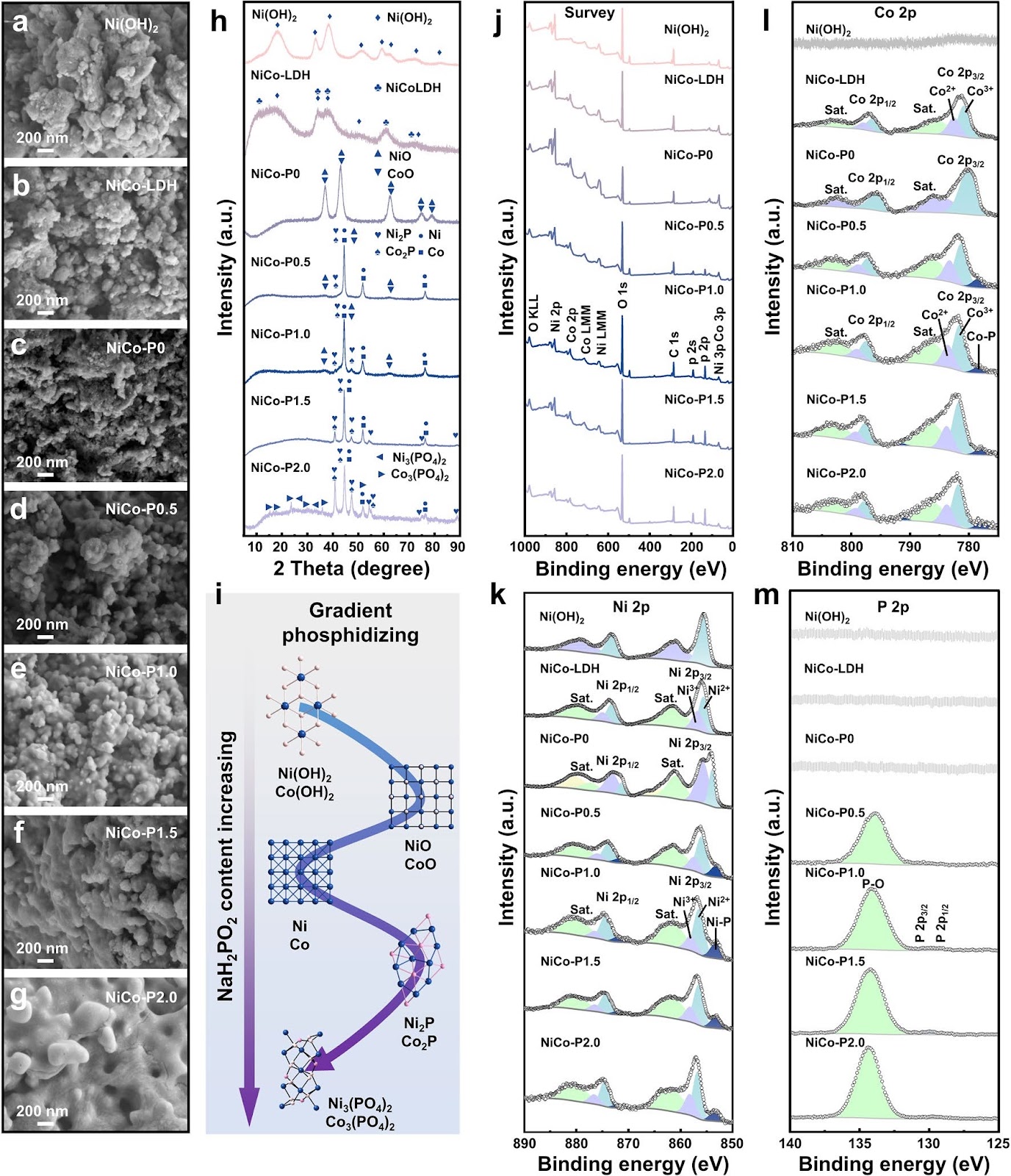
Nickel-based cathodes in aqueous nickel-zinc batteries typically suffer from sluggish reaction kinetics and limited energy density. In situ introduction of metal phosphides and rational construction of heterostructures can effectively promote electron/ion transport. However, the complex evolution of phosphidation and intractable phosphidizing degree greatly affect the composition of active phase, active sites, charge transfer rate, and ion adsorption strength of cathodes. Herein, the critical bimetallic phosphide layer (CBPL) is constructed on the NiCo-layered double hydroxide (NiCo-LDH) skeleton by a controllable anion-exchange strategy, yielding a novel nanohybrid cathode (NiCo-P1.0, 1.0 representing the mass ratio of Na2H2PO2 to NiCo-LDH). The high-conductivity CBPL with the inner NiCo-LDH forms extensive heterostructures, effectively regulating the electronic structure via charge transfer, thereby improving electrical conductivity. Remarkably, the CBPL exhibits unexpected electrochemical activity and synergizes with NiCo-LDH for electrode reactions, ultimately delivering extra energy. Benefiting from the bifunctional CBPL, NiCo-P1.0 delivers an optimal capacity of 286.64 mAh g−1 at 1C (1C = 289 mAh g−1) and superb rate performance (a capacity retention of 72.22% at 40C). The assembled NiCo-P1.0//Zn battery achieves ultrahigh energy/power density (503.62 Wh kg−1/18.62 kW kg−1, based on the mass loading of active material on the cathode), and the flexible quasi-solid-state pouch cell validates its practicality. This work demonstrates the superiority of bifunctional CBPL for surface modification, providing an effective and scalable compositing strategy in achieving high-performance cathodes for aqueous batteries.