Supermoiré Domains in Helical Trilayer Graphene
Authors: Wen-Jun Wang, Ping-Heng Tan, Xin Zhang
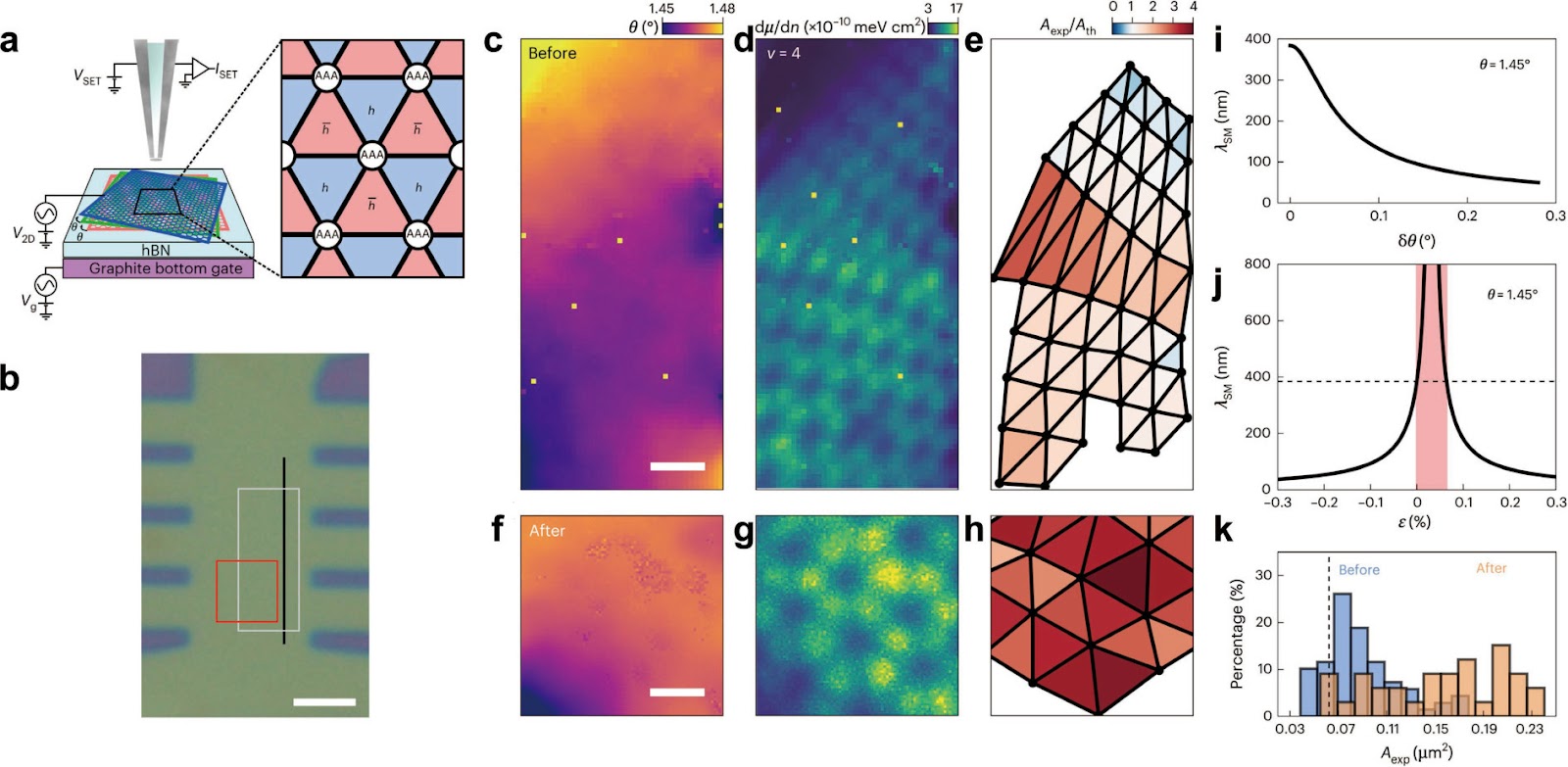
Helical trilayer graphene (HTG), composed of three graphene layers with equal twist angles in the same rotational sense, has emerged as a rich platform for studying moiré physics. Theoretical predictions suggest that lattice relaxation in HTG leads to the formation of triangular domains with uniform moiré wavelength, arranged on a larger supermoiré length scale, with adjacent domains carrying opposite Chern numbers and hosting topological boundary modes. In a recent study, Hoke and colleagues directly imaged this supermoiré landscape using a scanning single-electron transistor (SET) probe sensitive to local electronic compressibility. Their measurements revealed a periodic modulation with a length scale of several hundred nanometers, far exceeding the moiré wavelength, consistent with theoretical predictions. The spatial maps showed a triangular lattice of domain centers and a honeycomb network of AAA-stacking regions, separated by domain walls with reduced compressibility. Notably, the observed domain areas deviated from ideal expectations, indicating the presence of heterostrain. Modeling showed that biaxial strain applied to the middle layer can substantially enhance the supermoiré wavelength, with a divergence at a critical strain. After thermal cycling, the device exhibited larger and more isotropic supermoiré domains while the local twist angle remained unchanged, demonstrating that strain can be used to engineer the supermoiré network without perturbing local moiré physics. These findings underscore that lattice relaxation and strain are powerful tuning parameters in twistronics, with implications for engineering topological and correlated phases in twisted multilayers.