Effect of Aluminizing and Laser Shock Peening Treatments on the High-Temperature Oxidation Resistance of AISI 321 Stainless Steel for Solar Thermal Power Heat Exchanger
Authors: Wei Li, Wenyang Qin, Dapeng Jiang, Guowei Bo, Song Ni, Hui Chen, Yilin Zhao, Weiying Huang, Xulong Peng, Jianjun He, Yanjie Ren, Cong Li, Libo Zhou, Shengde Zhang, Jian Chen
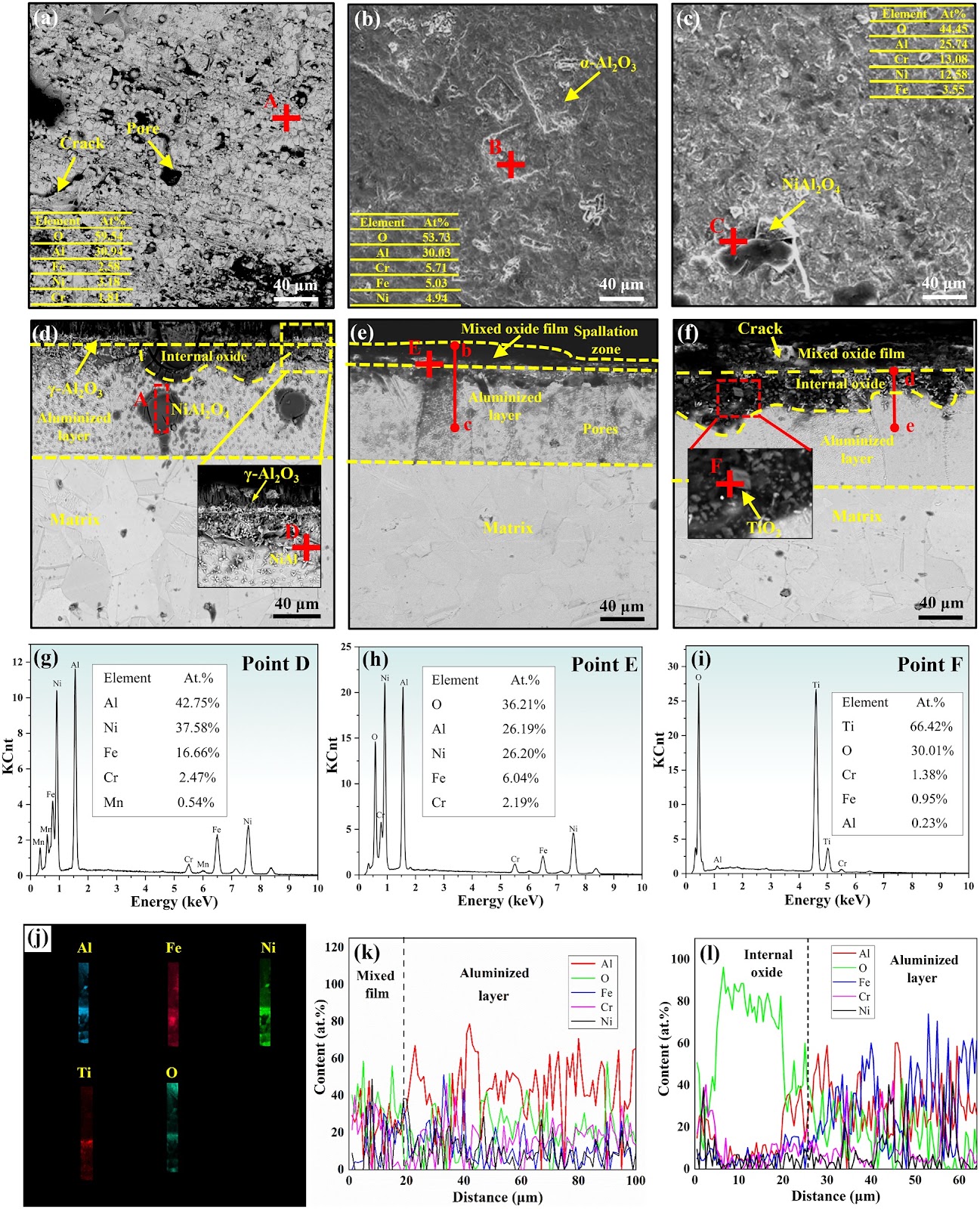
The high-temperature oxidation resistance of AISI 321 stainless steel used in solar thermal power heat exchangers determines its service life. In this study, aluminizing and subsequent laser shock peening (LSP) treatments were employed to improve the high-temperature oxidation resistance of AISI 321 stainless steel at 620 °C. These two treatments decreased the oxidation rate of AISI 321 steel. Specifically, the optimal oxidation resistance was observed in aluminized steel before oxidation for 144 h owing to the increased entropy of the LSP-treated specimen. After 144 h, LSP-treated steel achieved the best oxidation resistance because of the formation of a protective α-Al2O3 film. Moreover, the large amount of subgrain boundaries formed on the aluminized layer of the LSP-treated samples could act as short-circuit paths for the outward diffusion of Al, facilitating the rapid nucleation of α-Al2O3. Meanwhile, the aluminized layer could isolate the contact between the oxidation environment and matrix, thereby decreasing the oxidation rate. Furthermore, the minimum oxidation parabolic constant was calculated for LSP-treated steel (6.45787 × 10⁻¹⁴), which was 69.18% and 36.36% that of aluminized and 321 steel, respectively, during the entire oxidation process. Therefore, the combination of aluminizing and LSP treatments can improve the high-temperature oxidation resistance of 321 stainless steel, providing a new idea for its surface treatment to achieve a long service life at high temperatures.