A Motion-decoupled Pneumatic Rigid-Flexible Hybrid Joint with Independently-Controlled Variable Stiffness for Continuum Robot
Authors: Wenbiao Wang, Jiahao Shi, Ke Wu, Rui Chen, Zean Yuan, Shibo Cai, Guanjun Bao
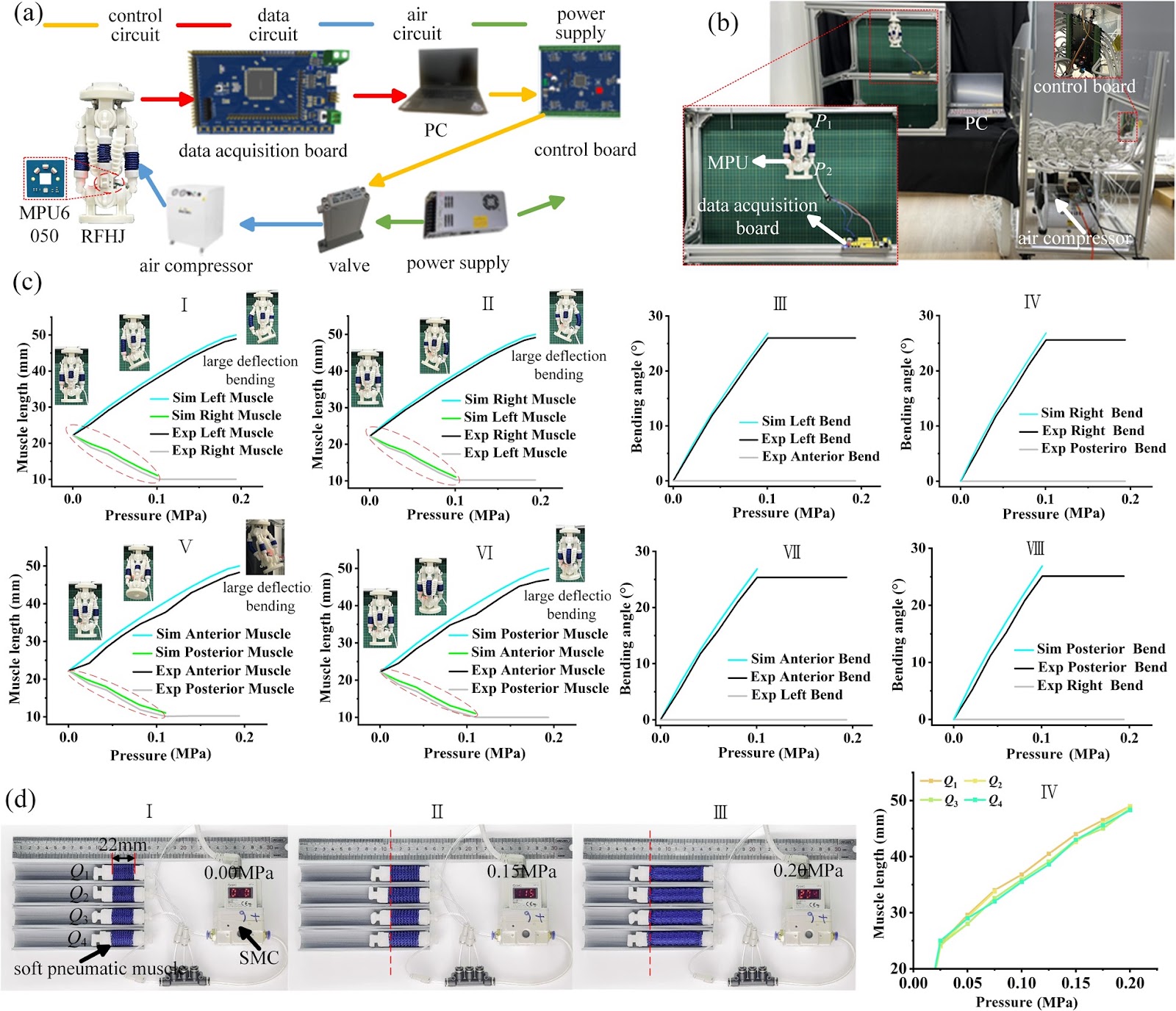
Continuum robots have been a hot topic in recent years due to their intrinsic features of agility, flexibility, and safety. To successfully deploy continuum robots in practical applications, further enhancements in variable stiffness, decoupled motion, and embedded sensing are highly desirable. Since continuum robots are usually composed of multiple joints assembled in series, their mechanical properties and performance will certainly rely on the connected joints. This paper proposes a motion-decoupled variable stiffness-decoupled pneumatic rigid-flexible hybrid joint (RFHJ), which is modular designed and integrated with a rigid hinge, a stiffness-tuning module, and soft actuators. The soft pneumatic muscle actuators are pre-stretched during assembly, ensuring the stable initial state of RFHJ. A novel musculature-mounting configuration is also presented, which enables RFHJs to achieve independent motions in two orthogonal planes. Furthermore, the variable stiffness module is embedded in the RFHJ’s structure to offer real-time and independent stiffness tunability across multiple scales in two perpendicular directions. The proposed RFHJ makes most of the advantages of soft continuum robots and conventional rigid serial robots by introducing a hybrid structure to provide both safe human-robot interaction (HRI), accurate control and reliable stiffness variation, presenting promising potentials for robotic systems, which have been theoretically proved and experimentally verified on the physical prototype. The experimental results also indicate that the developed RFHJ can work with variable stiffness ranging in [1.2, 49.9] N·m/rad. A variable stiffness rigid-flexible hybrid continuum arm (RFHA) is designed with three RFHJs in series. Primary tests on the developed RFHA prototype demonstrate that it has the characteristics of decoupled driving, bidirectional stiffness tunability and self-stability.