SinoTechIntel Academic Portal
🏛️ Indexed Academic JournalImpact Factor: 3.8

Chinese Journal of Energetic Materials (含能材料)

Authoritative peer-reviewed journal in materials science, metallurgy, chemistry and engineering technologies: Chinese Journal of Energetic Materials (含能材料)

Total Research Papers: 6
Access: 100% Free Open Access
Browse by Publication Year & VolumeReset All Filters ✕
Select Specific Issue:

Published Research PapersFiltered: Year 2026 • Vol 34 • 5

Showing 3 of 6 peer-reviewed papers with full Graphical Abstracts.

Original ResearchVol 34, Issue 5 • pp. 100-112DOI: 10.11943/CJEM2026001Jan 15, 2026

Blasting Failure Characteristics of Rock Specimens under In-Hole Layered Column Charge

Authors: CHENG Bing, YE Fu, WANG Quan, CHENG Yangfan, ZONG Qi, XU Ying, WANG Mengxiang, LI Junhao

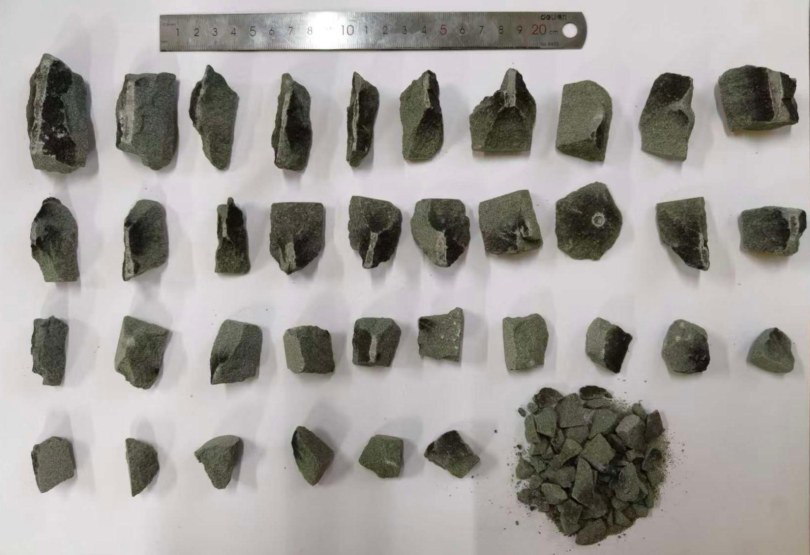
To improve rock fragmentation in open-pit deep-hole blasting, an in-hole layered column charge configuration was designed. Small-scale blasting tests on sandstone specimens were conducted under continuous and layered column charges to capture the failure process and final fragmentation. DEM-PBM coupled simulations visualized the dynamic fracture evolution and validated the experimental observations. Results show that under continuous charge, the top quarter of the specimen developed only a single blast-induced crack, splitting it into two parts, with horizontal fragment velocity of 2.0 m·s⁻¹ and a maximum block size of 9.0 cm. In contrast, layered charge produced multiple cracks in the top quarter, fragmenting it into smaller pieces, increasing horizontal velocity to 7.0 m·s⁻¹, and eliminating blocks larger than 5.0 cm. Simulations confirmed these trends, with maximum block size reduced from 8.8 cm to below 5.0 cm and velocity reaching 6.8 m·s⁻¹, closely matching experiments. Field trials in an open-pit coal mine overburden blasting demonstrated that layered charge reduced the boulder yield from 48.1% to 5.6%, significantly improving fragmentation. The findings confirm the practical effectiveness of in-hole layered column charge in enhancing rock breakage in deep-hole bench blasting.
Blasting Failure Characteristics of Rock Specimens under In-Hole Layered Column Charge
Graphical Abstract
Original ResearchVol 34, Issue 5 • pp. 100-112DOI: 10.11943/CJEM2026012Jan 15, 2026

Reaction-Growth Behavior of Energetic Materials under Mass-Inertial Confinement

Authors: ZHOU Fu-kang, YANG Xiao-yuan, SHANG Hai-lin, PAN Chuan-yu, LI Jin-he, LI Tao

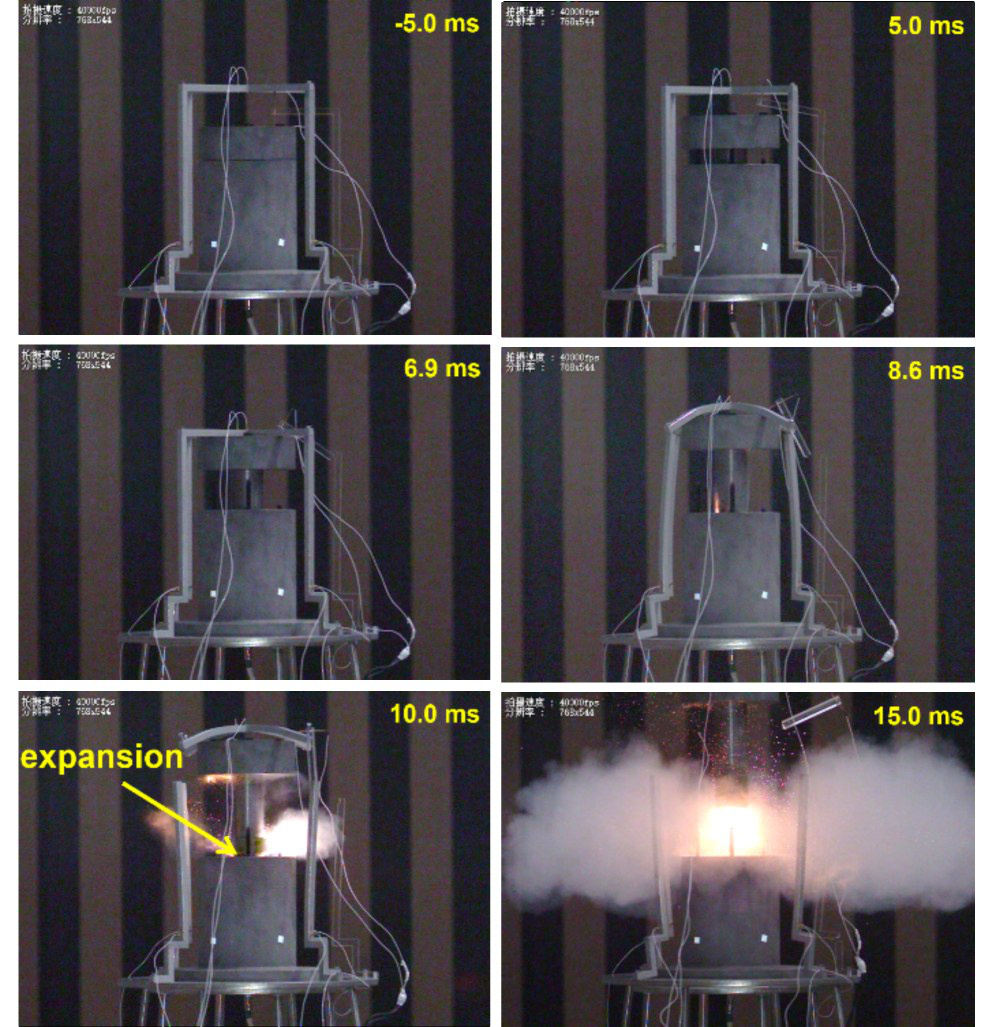
To investigate the reaction-growth behavior of propellants and polymer-bonded explosives (PBX) after non-shock ignition under mass-inertial confinement, a thick-walled cylinder experimental setup was constructed. The setup provided strong radial structural confinement and incorporated a large mass block with a mass ratio exceeding 45:1 relative to the energetic material. Laser ignition (250 W) was used to initiate reactions, and multiple photonic Doppler velocimetry (PDV) probes simultaneously measured radial expansion velocity of the cylinder and axial velocity of the mass block top. High-speed photography and recovered debris analysis were employed to compare reaction evolution processes. Results show that mass-inertial confinement enhances pressure buildup during the early reaction phase, but the type of energetic material determines reaction-growth characteristics and violence under identical confinement. For the composite propellant (containing AP, aluminum, RDX, and energetic binder), mass-inertial confinement dominated early pressurization; the system exhibited axial mass block acceleration without yielding of the thick-walled cylinder. Maximum reaction pressure was below 50 MPa, reaction fraction was less than 1%, and nearly all propellant was recovered, indicating a burning reaction. For the PBX (containing HMX and CL-20), early pressurization was jointly influenced by mass-inertial and structural confinement; the cylinder underwent yielding and radial expansion, and the mass block showed local upsetting deformation. Maximum reaction pressure reached 2 GPa, reaction fraction exceeded 50%, and no explosive was recovered, indicating a violent explosion. These findings provide insights into non-shock ignition reaction-growth mechanisms and safety design of structural charges.

Reaction-Growth Behavior of Energetic Materials under Mass-Inertial Confinement
Graphical Abstract
Original ResearchVol 34, Issue 5 • pp. 100-112DOI: 10.11943/CJEM2026054Jan 15, 2026

Solubility and Thermodynamic Properties of β-HMX in Dimethyl Sulfoxide–Alcohol Binary Solvent Mixtures

Authors: HE Yan, WU Hao, ZHAI Lian-jie, CAI Rong-bin, XU Cheng, HU Jian-jian, HUANG Jun-rui, ZHAO Xue

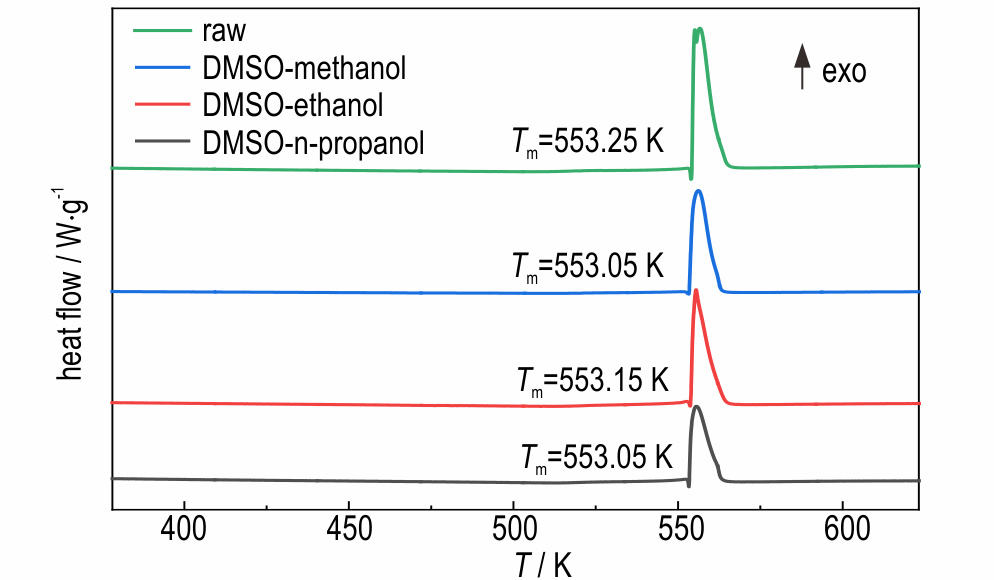
The solubility of β-octahydro-1,3,5,7-tetranitro-1,3,5,7-tetrazocine (β-HMX) in dimethyl sulfoxide (DMSO)–methanol, DMSO–ethanol, and DMSO–n-propanol binary solvent mixtures was measured using a static method over the temperature range of 293.15–343.15 K at atmospheric pressure. The mole fraction of alcohol in the mixed solvent was varied from 0 to 1. The experimental solubility data were correlated with the Apelblat, Jouyban–Acree, and NRTL models. The Apelblat model provided the best fit, with an average relative deviation (ARD) below 5% and a root-mean-square deviation (RMSD) below 0.11%. Thermodynamic properties, including Gibbs free energy, enthalpy, and entropy of dissolution, were derived from the NRTL model. The dissolution process was endothermic, entropy-driven, and spontaneous in all three solvent systems. Solid-phase characterization by PXRD and DSC confirmed that no polymorphic transition of β-HMX occurred under the experimental conditions. Solvent composition stability tests showed that the maximum relative change in solubility due to composition fluctuation was less than 6.3%, corresponding to an equivalent temperature variation of 1.4–2.7 K. These data provide a foundation for optimizing anti-solvent crystallization processes for β-HMX.

Solubility and Thermodynamic Properties of β-HMX in Dimethyl Sulfoxide–Alcohol Binary Solvent Mixtures
Graphical Abstract