SinoTechIntel Academic Portal
πŸ›οΈ Indexed Academic JournalImpact Factor: 3.8 (Q1 - Elsevier)Original: δΈ­ε›½εŒ–ε­¦ε·₯程学ζŠ₯ (θ‹±ζ–‡η‰ˆ)

Chinese Journal of Chemical Engineering

Access authentic peer-reviewed engineering methodologies, experimental datasets, and scientific literature published in this journal on SinoTechIntel.

Total Research Papers: 98
Access: 100% Free Open Access
Browse by Publication Year & VolumeReset All Filters βœ•

Published Research PapersFiltered: Year 2025 β€’ Vol. 32 β€’ Issue 4

Showing 3 of 98 peer-reviewed papers with full Graphical Abstracts.

Original ResearchVol. 32, Issue 4 β€’ pp. 499-511DOI: 10.1016/j_cjche_144876880β€’ Apr 17, 2023

Simultaneous removal of sulfur dioxide and nitrogen oxide from flue gas by phosphorus sludge: The performance and absorption mechanism

Authors: Yuanyuan Yin, Xujun Wang, Lei Xu, Binbin He, Yunxiang Nie, Yi Mei

Developing low-cost and green simultaneous desulfurization and denitrification technologies is of great significance for sulfur dioxide (SO2) and nitrogen oxide (NOx) emission control at low temperatures, especially for small and medium-sized coal-fired boilers and furnaces. Herein, phosphorus sludge, an industrial waste from the production process of yellow phosphorus, has been developed to simultaneously eliminate SO2 and NOx from coal-fired flue gas. The key factors affecting the experimental results indicate that desulfurization and denitrification efficiency of over 95% can be achieved at a low temperature of 55 Β°C. Further, the absorption mechanism was investigated by characterizing the solid and liquid phases of the phosphorus sludge during the absorption process. The efficient removal of SO2 is attributed to the abundance of iron (Fe3+) and manganese (Mn2+) in the absorbent. SO2 can be rapidly catalyzed and converted to SO4^2- by them. The key to NOx removal is the oxidation of NO toward water-soluble high-valent nitrogen oxides by oxidizing reactive substances induced via yellow phosphorus, which are then absorbed by water and converted to NO3-. Meanwhile, yellow phosphorus is oxidized to phosphoric acid (H3PO4). The spent absorption slurry can be reused through wet process phosphoric acid production, as it contains sulfuric acid (H2SO4), nitric acid (HNO3), and H3PO4. Accordingly, this is a technology with broad application prospects.
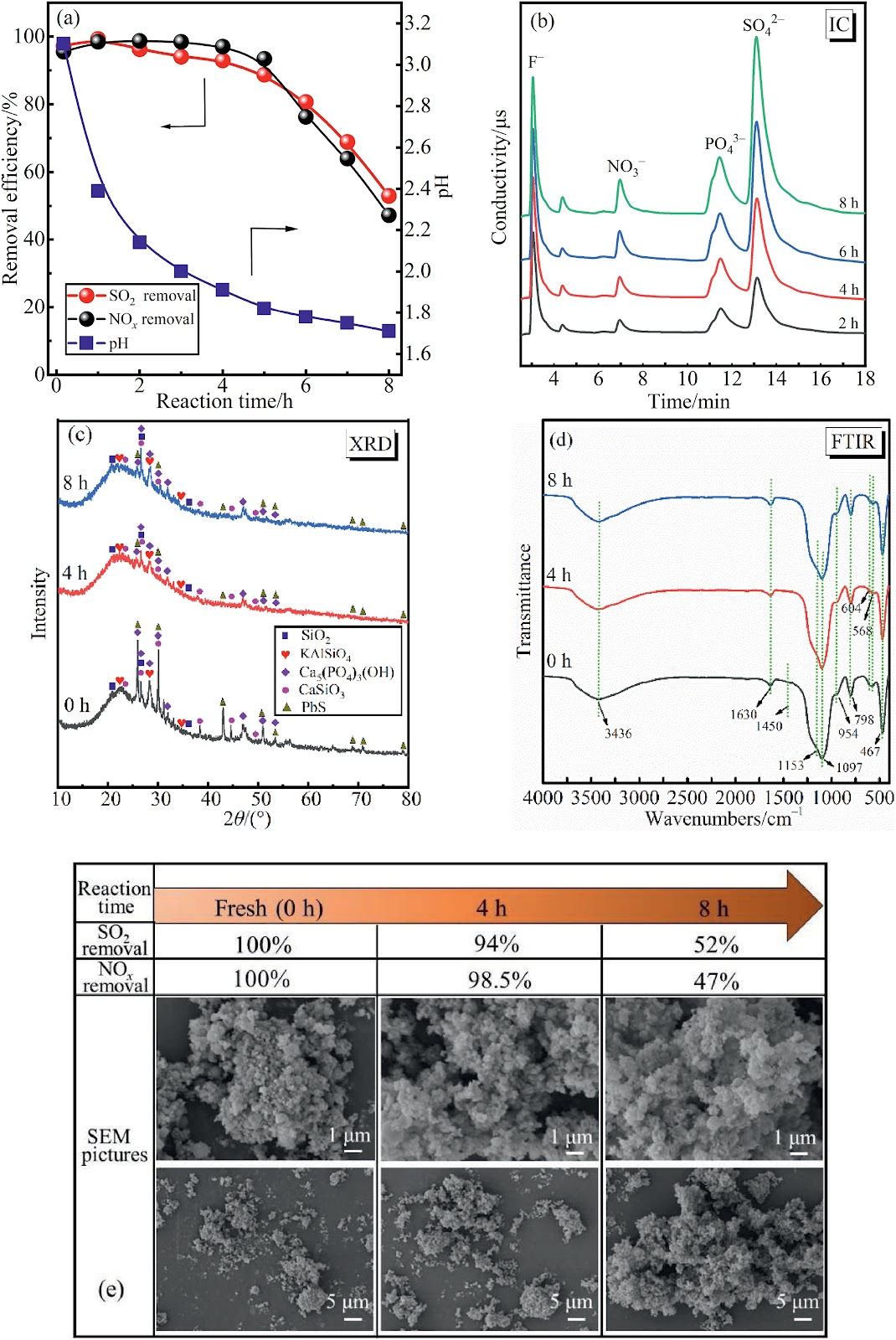
Simultaneous removal of sulfur dioxide and nitrogen oxide from flue gas by phosphorus sludge: The performance and absorption mechanism
Graphical Abstract
Original ResearchVol. 32, Issue 4 β€’ pp. 295-307DOI: 10.1016/j_cjche_144874680β€’ Apr 6, 2023

Facile synthesis of hierarchical NaX zeolite from natural kaolinite for efficient Knoevenagel condensation

Authors: Wen Xiao, Peng Dong, Chan Wang, Jingdong Xu, Tiesen Li, Haibo Zhu, Tinghai Wang, Renwei Xu, Yuanyuan Yue

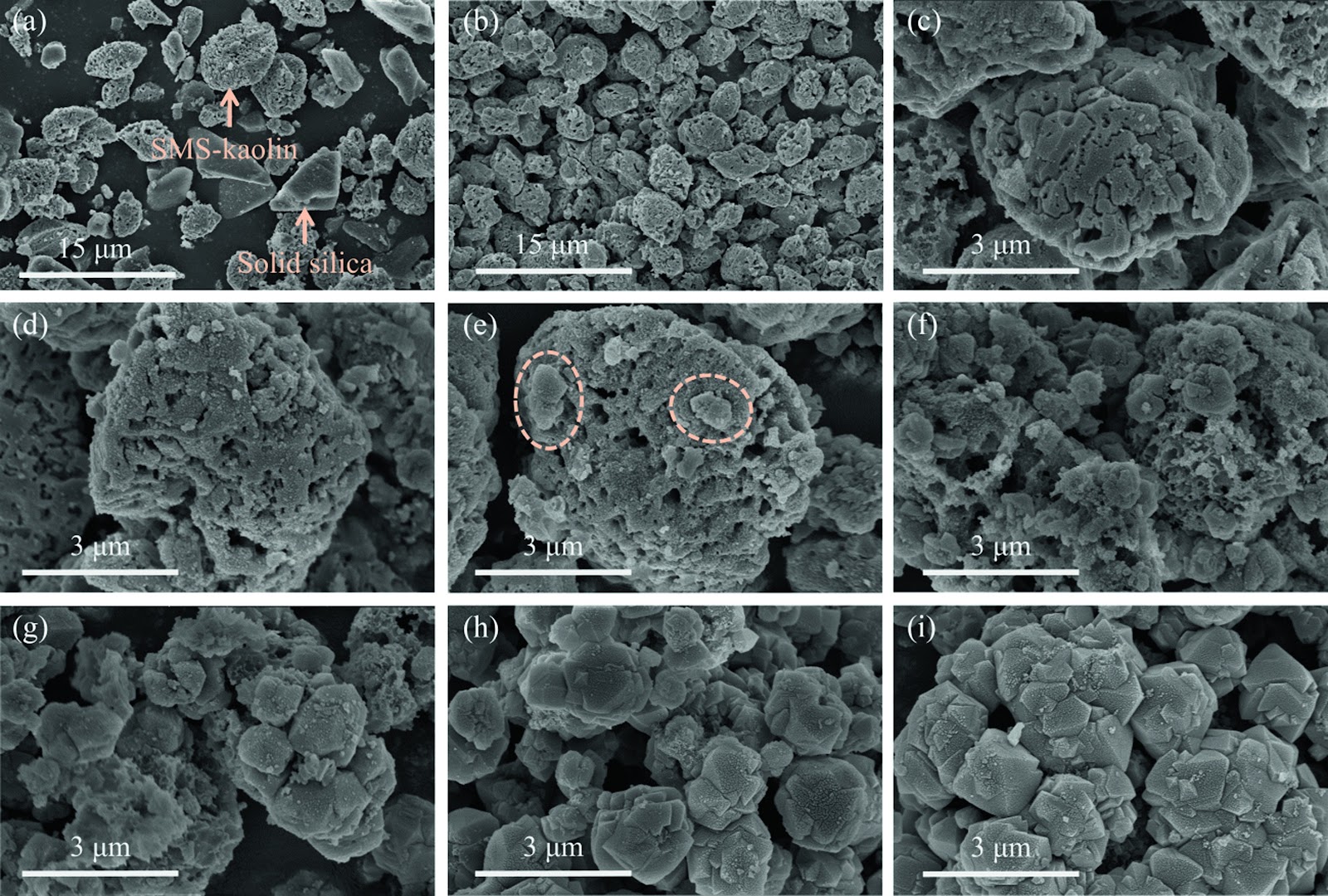
Zeolite catalysts have found extensive applications in the synthesis of various fine chemicals. However, the micropores of zeolites impose diffusion limitations on bulky molecules, greatly reducing the catalytic efficiency. Herein, we explore an economic and environmentally friendly method for synthesizing hierarchical NaX zeolite that exhibits improved catalytic performance in the Knoevenagel condensation reaction for producing the useful fine chemical 2-cyano-3-phenylacrylate. The synthesis was achieved via a low-temperature activation of kaolinite and subsequent in-situ transformation strategy without any template or seed. Systematic characterizations reveal that the synthesized NaX zeolite has both inter-crystalline and intra-crystalline mesopores, smaller crystal size, and larger external specific surface area compared to commercial NaX zeolite. Detailed mechanism investigations show that the inter-crystalline mesopores are generated by stacking smaller crystals formed from in-situ crystallization of the depolymerized kaolinite, and the intra-crystalline mesopores are inherited from the pores in the depolymerized kaolinite. This synthesis strategy provides an energy-saving and effective way to construct hierarchical zeolites, which may gain wide applications in fine chemical manufacturing.

Facile synthesis of hierarchical NaX zeolite from natural kaolinite for efficient Knoevenagel condensation
Graphical Abstract
Original ResearchVol. 32, Issue 4 β€’ pp. 703-715DOI: 10.1016/j_cjche_144878161β€’ Apr 3, 2023

Hyperbranched polymer hollow-fiber-composite membranes for pervaporation separation of aromatic/aliphatic hydrocarbon mixtures

Authors: Tong Liu, Hao Sun, Xiangqiong Wang, Jie Li, Zhanquan Zhang, Pei Wu, Naixin Wang, Quanfu An

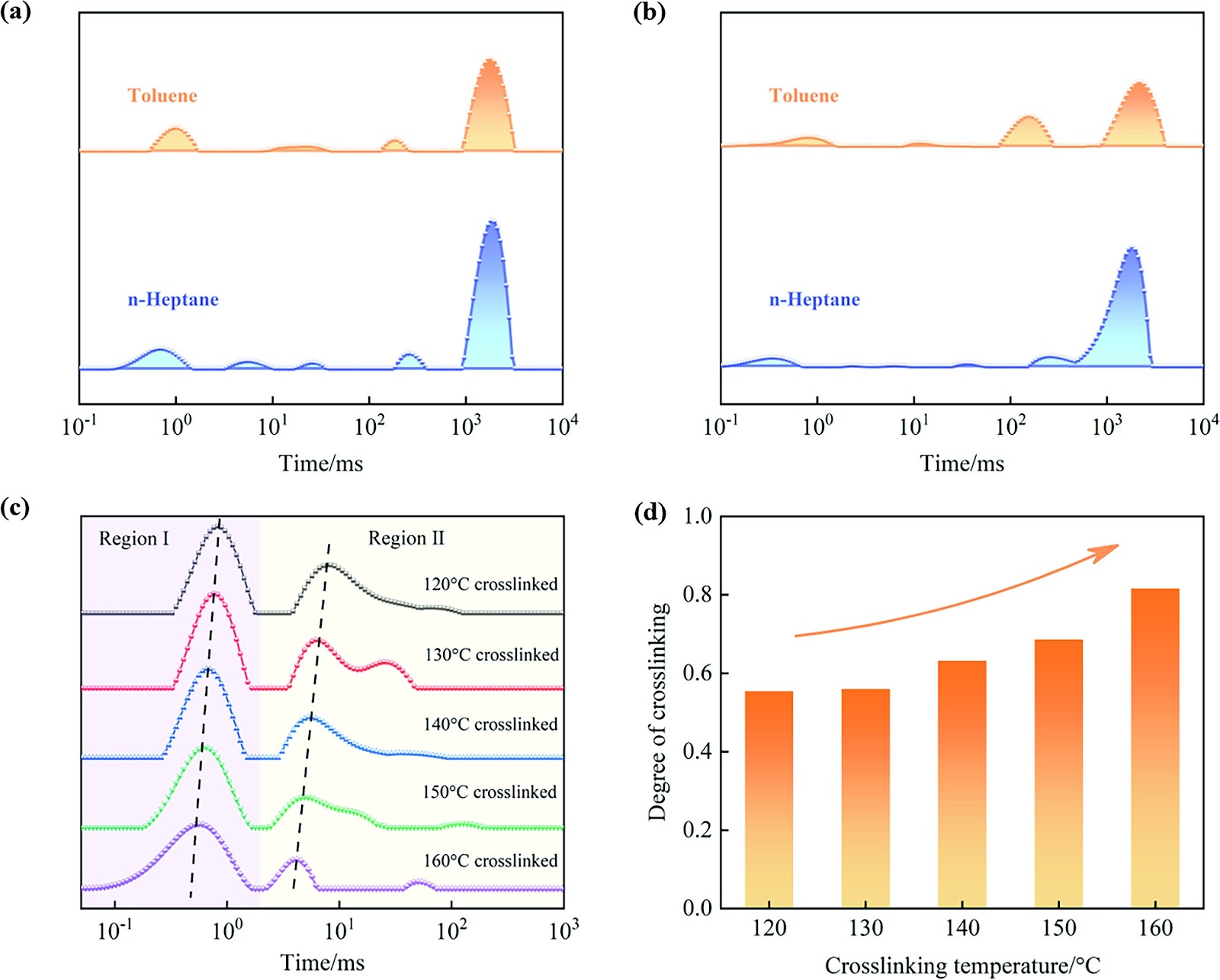
The separation of aromatic/aliphatic hydrocarbon mixtures is crucial in the petrochemical industry. Pervaporation is regarded as a promising approach for the separation of aromatic compounds from alkanes. Developing membrane materials with efficient separation performance is still the main task since the membrane should provide chemical stability, high permeation flux, and selectivity. In this study, the hyperbranched polymer (HBP) was deposited on the outer surface of a polyvinylidene fluoride (PVDF) hollow-fiber ultrafiltration membrane by a facile dip-coating method. The dip-coating rate, HBP concentration, and thermal cross-linking temperature were regulated to optimize the membrane structure. The obtained HBP/PVDF hollow-fiber-composite membrane had a good separation performance for aromatic/aliphatic hydrocarbon mixtures. For the 50%/50% (mass) toluene/n-heptane mixture, the permeation flux of optimized composite membranes could reach 1766 g·m⁻²·h⁻¹, with a separation factor of 4.1 at 60 °C. Therefore, the HBP/PVDF hollow-fiber-composite membrane has great application prospects in the pervaporation separation of aromatic/aliphatic hydrocarbon mixtures.

Hyperbranched polymer hollow-fiber-composite membranes for pervaporation separation of aromatic/aliphatic hydrocarbon mixtures
Graphical Abstract