Ligand Engineering Achieves Suppression of Temperature Quenching in Pure Green Perovskite Nanocrystals for Efficient and Thermostable Electroluminescence
Authors: Kaiwang Chen, Qing Du, Qiufen Cao, Chao Du, Shangwei Feng, Yutong Pan, Yue Liang, Lei Wang, Jiangshan Chen, Dongge Ma
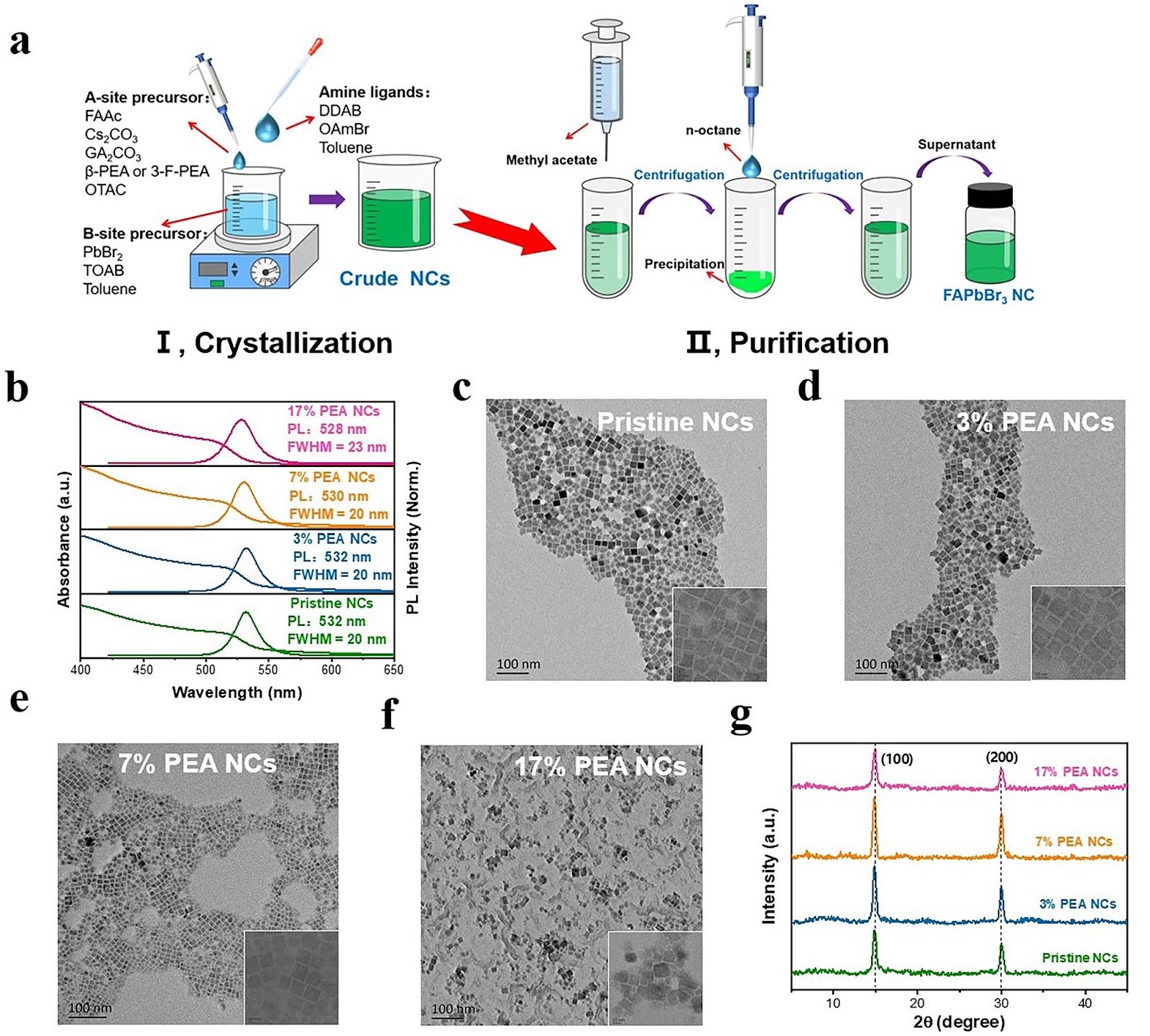
Formamidinium lead bromide (FAPbBr3) perovskite nanocrystals (NCs) are promising for display and lighting due to their ultra-pure green emission. However, the thermal quenching will exacerbate their performance degradation in practical applications, which is a common issue for halide perovskites. Here, we reported the heat-resistant FAPbBr3 NCs prepared by a ligand-engineered room-temperature synthesis strategy. An aromatic amine, specifically β-phenylethylamine (PEA) or 3-fluorophenylethylamine (3-F-PEA), was incorporated as the short-chain ligand to expedite the crystallization rate and control the size distribution of FAPbBr3 NCs. Employing this ligand engineering approach, we synthesized high quality FAPbBr3 NCs with uniform grain size and reduced long-chain alkyl ligands, resulting in substantially suppressed thermal quenching and enhanced carrier transportation in the perovskite NCs films. Most notably, more than 90% of the room temperature PL intensity in the 3-F-PEA modified FAPbBr3 NCs film was preserved at 380 K. Consequently, we fabricated ultra-pure green EL devices with a room temperature external quantum efficiency (EQE) as high as 21.9% at the luminance of above 1,000 cd m−2, and demonstrated less than 10% loss in EQE at 343 K. This study introduces a novel room temperature method to synthesize efficient FAPbBr3 NCs with exceptional thermal stability, paving the way for advanced optoelectronic device applications.