Vertical Interfacial Engineering in Two-Step-Processed Perovskite Films Enabled by Dual-Interface Modification for High-Efficiency p-i-n Solar Cells
Authors: Wenhao Zhou, Heng Liu, Haiyan Li, Weihai Zhang, Hui Li, Xia Zhou, Rouxi Chen, Wenjun Zhang, Tingting Shi, Antonio Abate, Hsing-Lin Wang
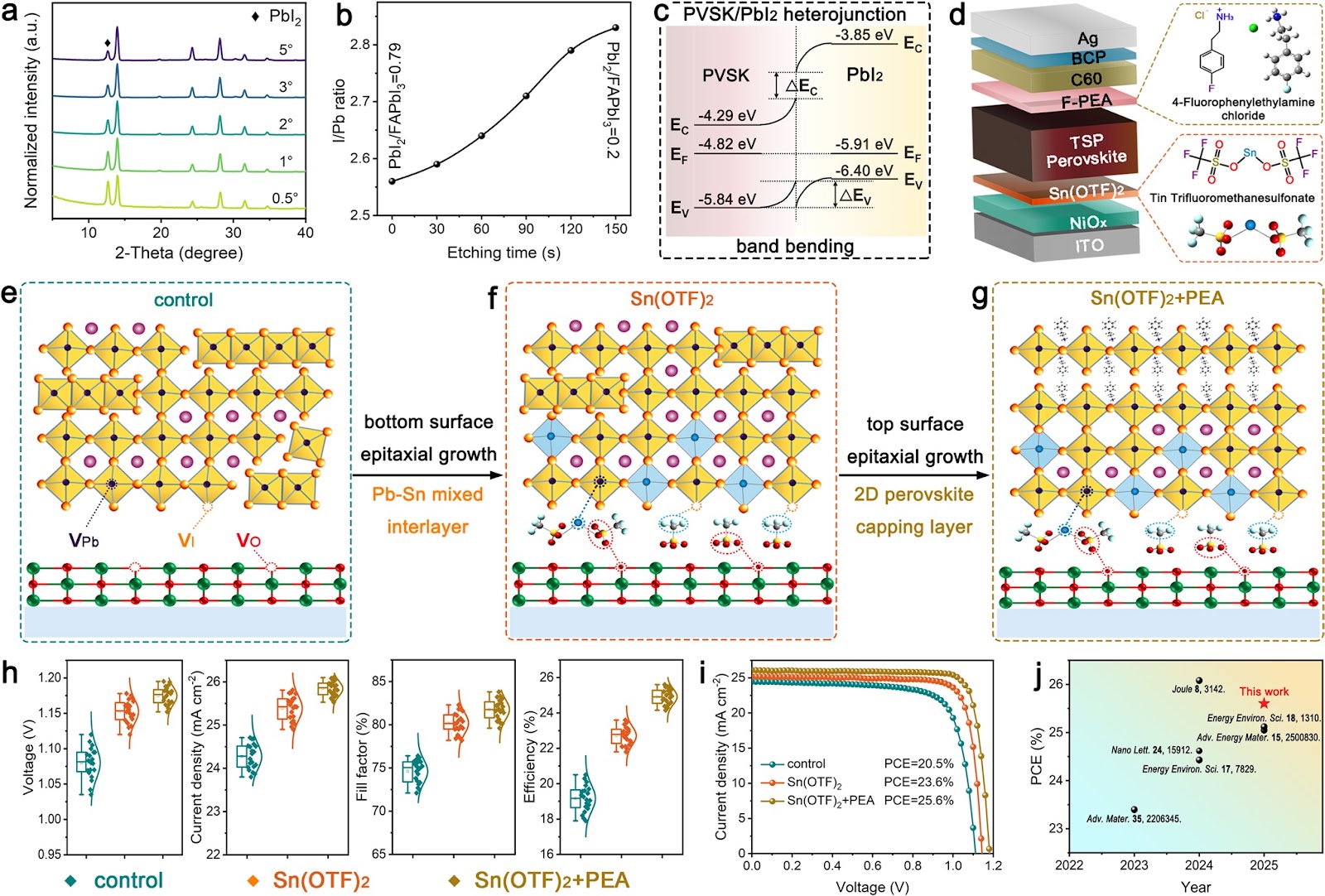
Two-step-processed (TSP) inverted p-i-n perovskite solar cells (PSCs) have demonstrated significant promise in tandem applications. However, the power conversion efficiency (PCE) of TSP p-i-n PSCs rarely exceeds 24%. Here, we demonstrate that TSP perovskite films exhibit a vertically gradient distribution of residual PbI2 clusters, which form Schottky heterojunctions with the perovskite, leading to substantial interfacial energy-level mismatches within NiOx-based TSP p-i-n PSCs. These limitations were effectively addressed via a vertical interfacial engineering enabled by dual-interface modification incorporating tin trifluoromethanesulfonate (Sn(OTF)2) and 4-Fluorophenylethylamine chloride (F-PEA) at the NiOx/perovskite and perovskite/C60 interfaces, respectively. The functional Sn(OTF)2 not only enhances the conductivity of NiOx films but also suppresses ion migration, while inducing the formation of a Pb-Sn mixed perovskite interlayer that precisely regulates the energy level at the NiOx/perovskite interface. Complementally, F-PEA post-treatment effectively converts surface residual PbI2 clusters into a 2D perovskite capping layer, which simultaneously passivates surface defects and enhances energy-level alignment at the perovskite/C60 interface. Consequently, the optimized NiOx-based TSP p-i-n PSCs achieve a notable PCE of 25.6% with superior operational stability. This study elucidates the underlying mechanisms limiting the efficiency of TSP p-i-n PSCs, while establishing design principles for these devices targeting 26% efficiency.