Key Takeaways & Executive Findings
- •• Unconfined compression tests on unsaturated completely weathered granite reveal diverse stress-strain behaviors (brittleness, softening, ductility) controlled by moisture content and dry density. • Unconfined compressive strength increases to an optimum at ~10.5% moisture content, then declines sharply beyond a critical value of 13.0%. • Shear failure dominates the deformation and fracture of CWG specimens, with ultimate failure modes governed primarily by moisture content rather than dry density. • A novel damage-based constitutive model accurately replicates the undrained mechanical behavior and quantitatively captures key mechanical indexes.
Abstract
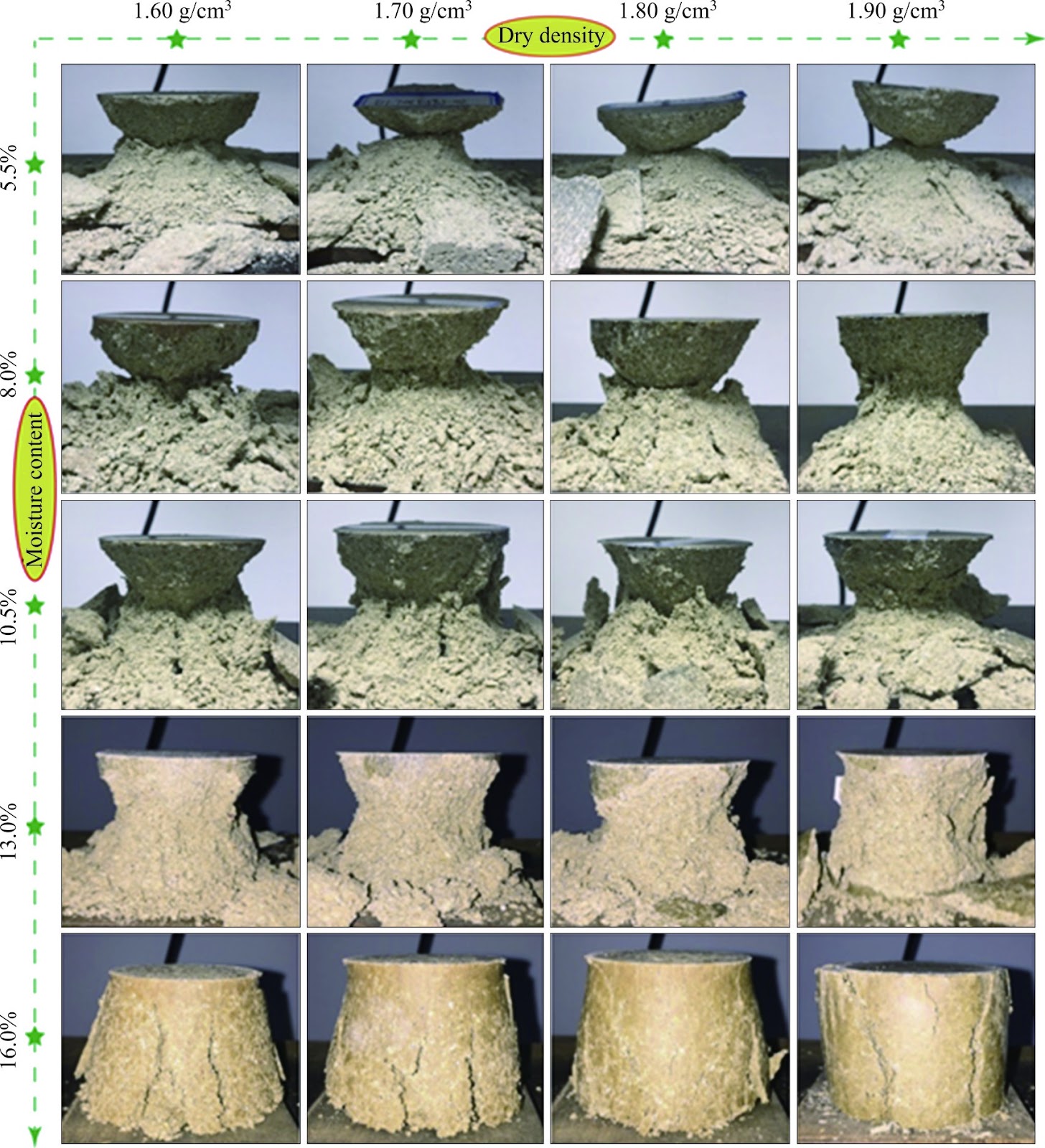
The undrained mechanical behavior of unsaturated completely weathered granite (CWG) is highly susceptible to alterations in the hydraulic environment, particularly under uniaxial loading conditions, due to the unique nature of this soil type. In this study, a series of unconfined compression tests were carried out on unsaturated CWG soil in an underground engineering site, and the effects of varying the environmental variables on the main undrained mechanical properties were analyzed. Based on the experimental results, a novel constitutive model was then established using the damage mechanics theory and the undetermined coefficient method. The results demonstrate that the curves of remolded CWG specimens with different moisture contents and dry densities exhibited diverse characteristics, including brittleness, significant softening, and ductility. As a typical indicator, the unconfined compression strength of soil specimens initially increased with an increase in moisture content and then decreased. Meanwhile, an optimal moisture content of approximately 10.5% could be observed, while a critical moisture content value of 13.0% was identified, beyond which the strength of the specimen decreases sharply. Moreover, the deformation and fracture of CWG specimens were predominantly caused by shear failure, and the ultimate failure modes were primarily influenced by moisture content rather than dry density. Furthermore, by comparing several similar models and the experimental data, the proposed model could accurately replicate the undrained mechanical characteristics of unsaturated CWG soil, and quantitatively describe the key mechanical indexes. These findings offer a valuable reference point for understanding the underlying mechanisms, anticipating potential risks, and implementing effective control measures in similar underground engineering projects.
1. Introduction
Granite is a kind of igneous rock widely distributed in the earth crust [1−3]. Under the joint action of weathering, erosion, and geological tectonic stress, etc., it will form rock and soil bodies with different weathering grades [4−8], such as residual soil (Grades Ⅳ and higher), completely weathered (Grade Ⅴ), highly weathered (Grade Ⅳ), moderately weathered (Grade Ⅲ), and slightly weathered (Grade Ⅱ). Among them, although the appearance of completely weathered granite (CWG) retains the structure of rock, the overall structure is loose and broken, and its particles consist mainly of powder and sand grains, often containing special minerals and chemical components, so it is a familiar unfavorable geological formation [9, 10]. In particular, CWG in different hydraulic environments show significant differences in physical and mechanical properties and engineering characteristics. And it is susceptible to construction disturbances and erosion of the natural environment during the construction, potentially increasing the technical difficulties of construction, thus resulting in frequent engineering accidents [11−14]. In general, CWG is extensively and deeply distributed in subtropical, tropical, and humid temperature zones, and is frequently exposed directly due to its geological location. As a result, it has become a prevalent primary geotechnical material in granite regional engineering construction.
In view of the mechanical peculiarities of the CWG formation and the technical difficulties of construction, several researchers and engineers have carried out valuable explorations under drained and undrained conditions. Considering the water inrush disasters originating from CWG, LIU et al [6] conducted a study on the mass transfer and flow properties of water inrush in CWG with varying particle size distributions, selected from a weathered granite with a depth of 100 m in Guangxi, China.
Loading authentic research manuscript (Pages 1–5)...
DU Shao-hua, MA Jin-yin, RUAN Bo, WU Gen-shui, ZHANG Rui-chao (2025). Undrained mechanical behavior of unsaturated completely weathered granite: Experimental investigation and constitutive modeling. Journal of Central South University. https://doi.org/10.1007/s11771-025-5986-3
Research & Educational Purpose Only:The translations, structured abstracts, analytical annotations, and data reports provided by SinoTechIntel are intended exclusively for academic research, internal corporate R&D, and educational benchmarking. They do not constitute formal engineering, chemical safety, legal, or professional advice.
Copyright & Intellectual Property Notice: Original copyright of the underlying source articles and experimental data remains with the respective authors, institutions, and original publishing journals. SinoTechIntel claims intellectual property only over its proprietary translations, analytical syntheses, and AEO structured enhancements in accordance with international fair use and academic citation principles.
Frequently Asked Questions
What is the optimal moisture content for maximum unconfined compression strength of completely weathered granite?
The optimal moisture content is approximately 10.5%, at which the unconfined compression strength of unsaturated completely weathered granite reaches its maximum.
At what moisture content does the strength of completely weathered granite decrease sharply?
A critical moisture content value of 13.0% was identified; beyond this value, the strength of the specimen decreases sharply.
What failure mode dominates in unsaturated completely weathered granite under unconfined compression?
Shear failure predominantly causes the deformation and fracture of completely weathered granite specimens under unconfined compression.
What factors influence the ultimate failure modes of CWG specimens?
The ultimate failure modes are primarily influenced by moisture content rather than dry density.
What method was used to establish the constitutive model for unsaturated completely weathered granite?
The constitutive model was established using damage mechanics theory and the undetermined coefficient method.
Related Technical Papers & Translations

Design and optimization of a high-efficiency distillation process for cellulosic fuel ethanol integrated with thermal coupling and molecular sieve adsorption
To address the challenges of high energy consumption and prominent costs in the traditional three-columns distillation process for cellulosic fuel ethanol, a distillation—molecular sieve coupling separation process is proposed. This process integrates a three-column (crude distillation column, first distillation column, second distillation column) system with a 3A molecular sieve adsorption deep dehydration unit. A thermal coupling network is constructed via differential pressure design (steam from medium/high-pressure columns as mutual heat sources, reboiler liquid waste heat for feed preheating), and molecular sieve adsorption conditions are optimized. The study first performs a thermodynamic consistency test on the ethanol—water system, determines optimal non-random two-liquid (NRTL) model binary interaction parameters via experimental data regression for Aspen Plus simulation. Aiming at minimum total annual cost (TAC), Aspen Plus is used to optimize process parameters (theoretical tray number, feed location, reflux ratio, side-draw position, etc.). Economic analysis shows this process reduces CO2 emission costs by 27.56%, TAC by 15.58% (to 5.123 × 10⁶ USD·a-1), and increases ethanol purity to >99.6%, providing an effective solution for green, efficient separation.

A cohesion loss model for determining residual strength of deep bedded sandstone
Rock residual strength, as an important input parameter, plays an indispensable role in proposing the reasonable and scientific scheme about stope design, underground tunnel excavation and stability evaluation of deep chambers. Therefore, previous residual strength models of rocks established were reviewed. And corresponding related problems were stated. Subsequently, starting from the effects of bedding and whole life-cycle evolution process, series of triaxial mechanical tests of deep bedded s

Federated model with contrastive learning and adaptive control variates for human activity recognition
Recent attention to privacy issues demands a communication-safe method for training human activity recognition (HAR) models on client activity data. Federated learning (FL) has become a compelling technique to facilitate model training between the server and clients while preserving data privacy. However, classical FL methods often assume independent and identically distributed (IID) data among clients. This assumption does not hold true in practical scenarios. Human activity in real-world scena