Key Takeaways & Executive Findings
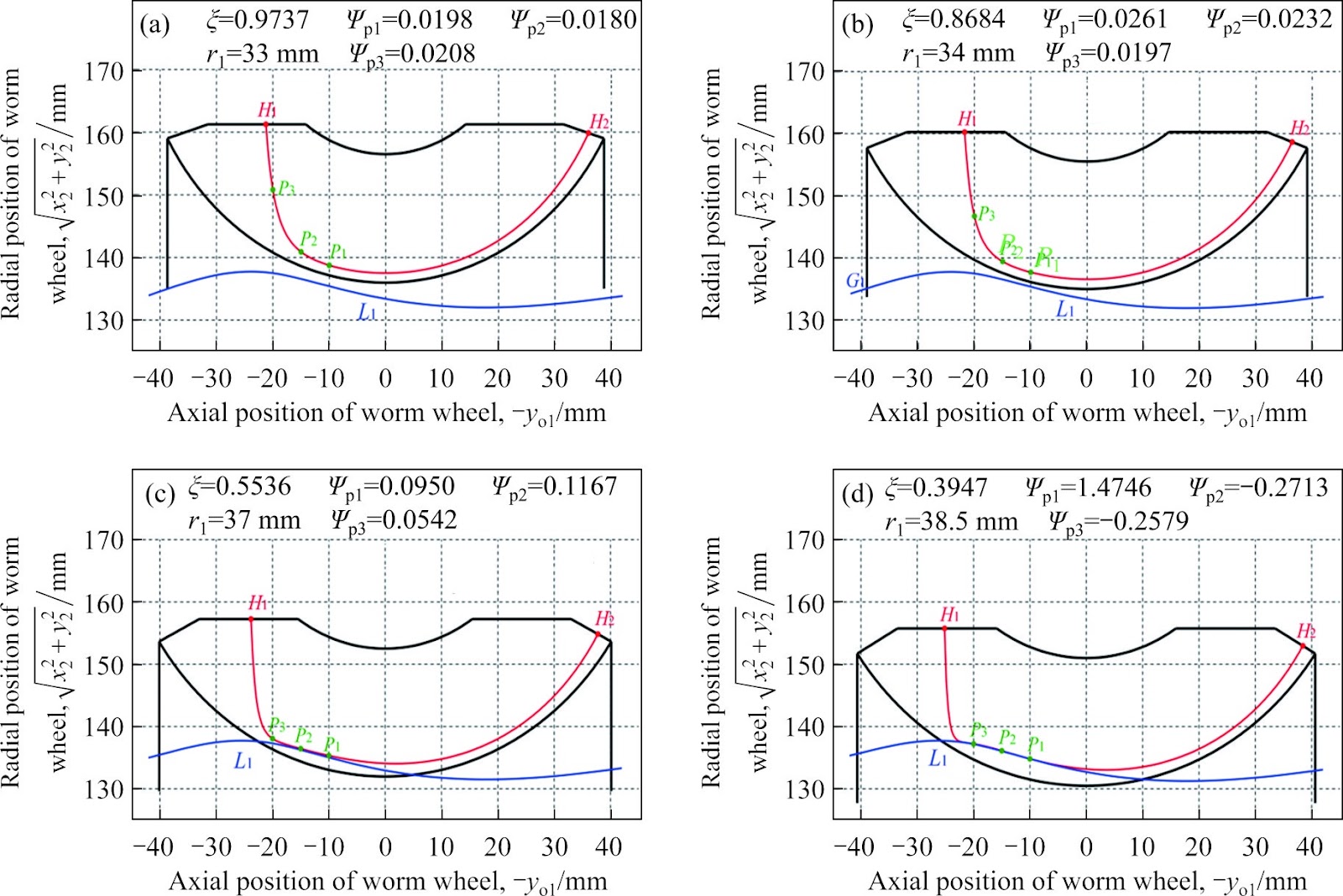
- •• A first-type limit line exists on the worm wheel tooth surface and is normally located out of the meshing zone, indicating the undercutting boundary. • The undercutting mechanism occurs when part of the meshing zone near the conjugated line of the worm tooth crest enters the undercutting area and is cut off during machining. • Only one intersection point exists between the first- and second-type limit lines, which is identified as a lubrication weak point. • A convenient characteristic quantity based on first-type limit function values on the worm tooth crest is proposed to judge whether undercutting exists across the whole meshing zone.
Abstract
The worm wheel whose undercutting characteristic is researched is a member of offsetting normal arc-toothed cylindrical worm drive. The tooth profile of the worm in its offsetting normal section is a circular arc. The normal vector used to calculate the first-type limit function is determined in the natural frame without the aid of the curvature parameter of worm helicoid. The first-type limit line is ascertained via solving the nonlinear equations iteratively. It is discovered that one first-type limit line exists on the tooth surface of worm wheel by numerical simulation, and such a line is normally located out of the meshing zone. Only one intersection point exists between the first and second-types of limit lines, and this point is a lubrication weak point. The undercutting mechanism is essentially that a part of the meshing zone near the conjugated line of worm tooth crest will come into the undercutting area and will be cut off during machining the worm wheel. The machining simulation verifies the correctness of undercutting mechanism. Moreover, a convenient and practical characteristic quantity is proposed to judge whether the undercutting exists in the whole meshing zone via computing the first-type limit function values on the worm tooth crest.
1. Introduction
The offsetting normal arc-toothed cylindrical worm drive, which is meshed by concave and convex teeth, is a kind of ZC worm gearing [1−6]. The worm helicoid is turned by a lathe tool with the convex arc blade and this arc blade is located in the offsetting normal plane of the worm, so that the worm helicoid is a track surface and its tooth profile is a circular arc in the offsetting normal plane [7]. The worm wheel is produced using a cylindrical hobbing cutter with the same generating surface as the worm helical surface, and therefore the working meshing of the worm drive and the cutting meshing of the worm wheel are identical.
Meshing theory for gearing [8] introduces the concept of the first-type limit line, also known as the path of singular points, the curvature interference limit line, or the spine curve of the enveloped surface [3, 6, 9 −12]. This limit line generally exists on the enveloped surface and separates it into non-undercutting and undercutting areas. During the cutting meshing of the worm wheel, the enveloped surface is the worm wheel tooth surface, and therefore the first-type limit line must be located out of the meshing zone to avoid undercutting. Although the values of induced principal curvature of worm drives [7, 13−16] can judge whether the undercutting exists in the meshing zone, the relative location between the first-type limit line and the meshing zone cannot be reflected. Not only that, the computation of the induced principal curvature in preceding literature was only implemented at some meshing points, and this may lead the meshing points having undercutting to be missed. In order to avoid the above possible inaccurate situations, it is necessary to determine the relative location between the first-type limit line and the meshing zone of the worm drive. In consequence, ascertaining the first-type limit line for the worm drive has great significance to investigate the undercutting characteristic of the worm wheel.
On the worm wheel tooth surface, the so-called first-type limit line can be regarded as a combination of the meshing points where the values of the first-type limit function equal to 0. From this, the authors computed the curvature interference limit lines for the conical worm wheel and ZC1 worm wheel [17, 18]. The generating surfaces of hobs used for machining the preceding two kinds of worm wheels are envelope surfaces. The normal vectors of contact line of the preceding worm pairs were determined in the unit orthogonal frames and the curvature paramet
Loading authentic research manuscript (Pages 1–5)...
MENG Qing-xiang, JIAO Yu-ge, ZHAO Ya-ping, MU Shi-bo, CUI Jian, ZHANG Ming-hua (2025). Undercutting mechanism of worm wheel in offsetting normal arc-toothed cylindrical worm drive. Journal of Central South University. https://doi.org/10.1007/s11771-025-5878-6
Research & Educational Purpose Only:The translations, structured abstracts, analytical annotations, and data reports provided by SinoTechIntel are intended exclusively for academic research, internal corporate R&D, and educational benchmarking. They do not constitute formal engineering, chemical safety, legal, or professional advice.
Copyright & Intellectual Property Notice: Original copyright of the underlying source articles and experimental data remains with the respective authors, institutions, and original publishing journals. SinoTechIntel claims intellectual property only over its proprietary translations, analytical syntheses, and AEO structured enhancements in accordance with international fair use and academic citation principles.
Frequently Asked Questions
What is the first-type limit line?
It is also known as the path of singular points, curvature interference limit line, or spine curve of the enveloped surface. It separates the worm wheel tooth surface into non-undercutting and undercutting areas.
Why is it important to locate the first-type limit line?
To avoid undercutting, the first-type limit line must be located out of the meshing zone. Its relative position helps determine whether the worm wheel will be properly machined without undercutting.
What causes undercutting in this worm drive?
A part of the meshing zone near the conjugated line of the worm tooth crest comes into the undercutting area and is cut off during machining, which is the essential undercutting mechanism.
How was the first-type limit line computed?
The first-type limit line was ascertained by solving nonlinear equations iteratively, with the normal vector determined in the natural frame without using the curvature parameter of the worm helicoid.
How can one judge whether undercutting exists in the meshing zone?
By computing the values of the first-type limit function on the worm tooth crest, a convenient characteristic quantity can be used to judge whether undercutting exists in the whole meshing zone.
Related Technical Papers & Translations
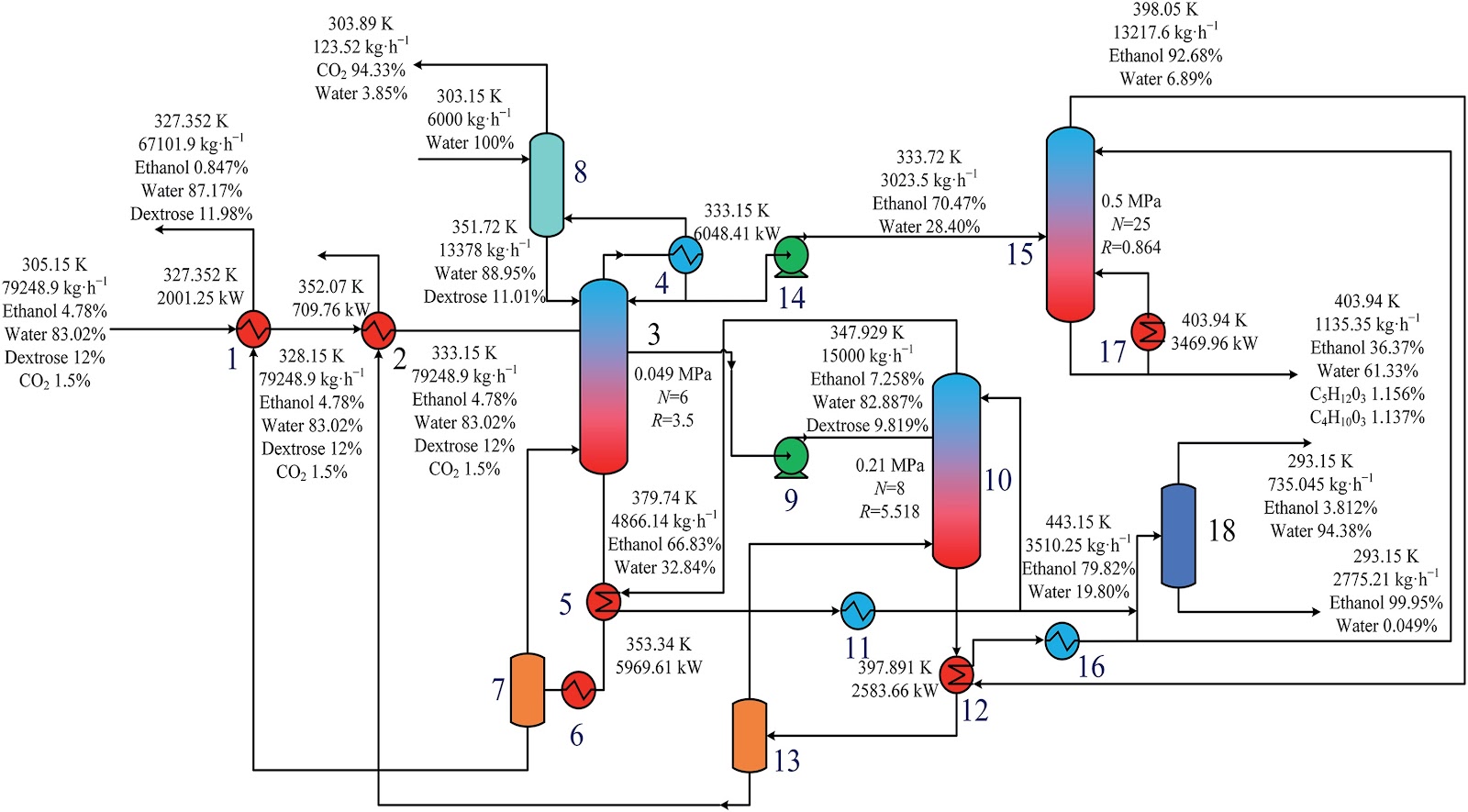
Design and optimization of a high-efficiency distillation process for cellulosic fuel ethanol integrated with thermal coupling and molecular sieve adsorption
To address the challenges of high energy consumption and prominent costs in the traditional three-columns distillation process for cellulosic fuel ethanol, a distillation—molecular sieve coupling separation process is proposed. This process integrates a three-column (crude distillation column, first distillation column, second distillation column) system with a 3A molecular sieve adsorption deep dehydration unit. A thermal coupling network is constructed via differential pressure design (steam from medium/high-pressure columns as mutual heat sources, reboiler liquid waste heat for feed preheating), and molecular sieve adsorption conditions are optimized. The study first performs a thermodynamic consistency test on the ethanol—water system, determines optimal non-random two-liquid (NRTL) model binary interaction parameters via experimental data regression for Aspen Plus simulation. Aiming at minimum total annual cost (TAC), Aspen Plus is used to optimize process parameters (theoretical tray number, feed location, reflux ratio, side-draw position, etc.). Economic analysis shows this process reduces CO2 emission costs by 27.56%, TAC by 15.58% (to 5.123 × 10⁶ USD·a-1), and increases ethanol purity to >99.6%, providing an effective solution for green, efficient separation.
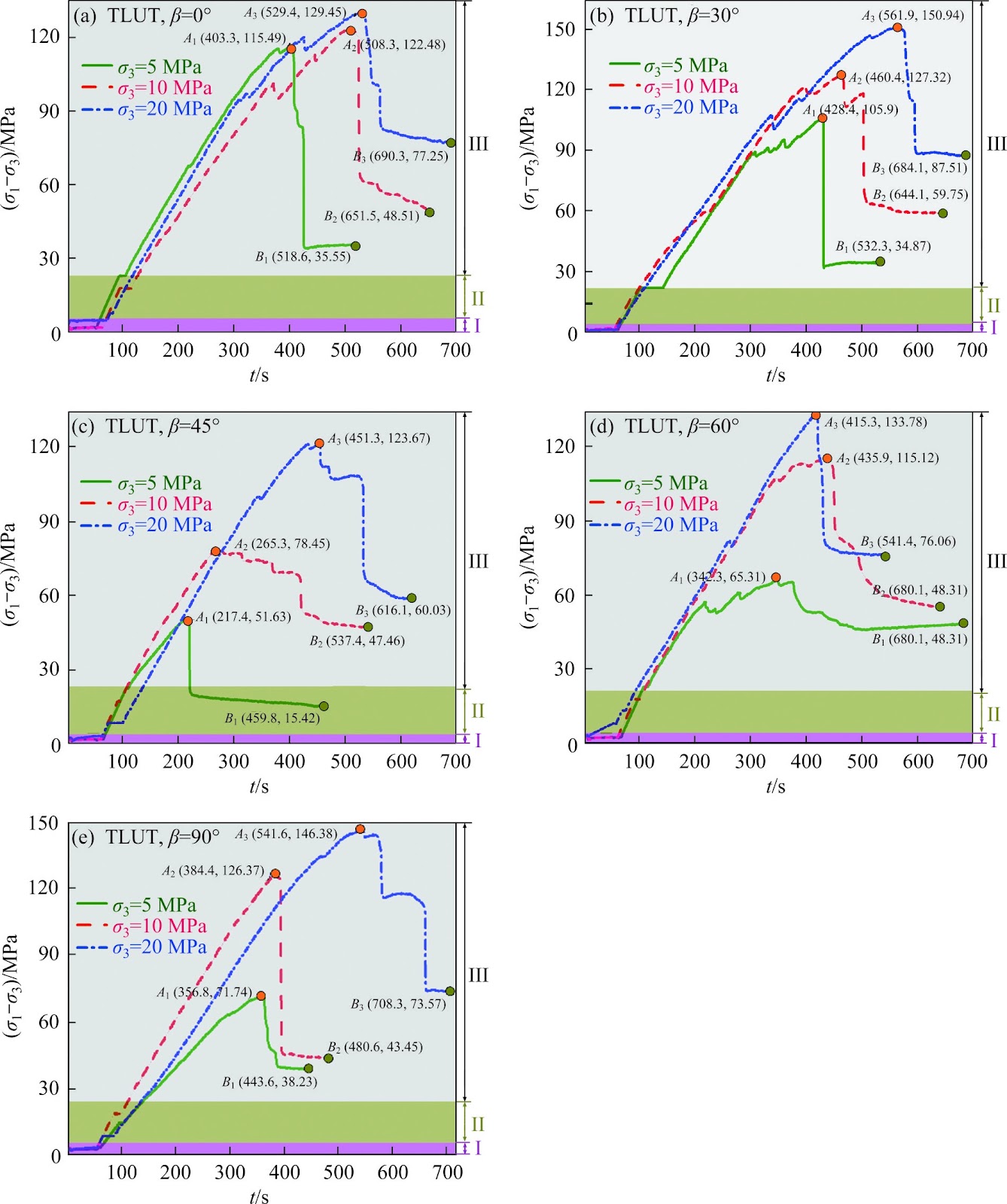
A cohesion loss model for determining residual strength of deep bedded sandstone
Rock residual strength, as an important input parameter, plays an indispensable role in proposing the reasonable and scientific scheme about stope design, underground tunnel excavation and stability evaluation of deep chambers. Therefore, previous residual strength models of rocks established were reviewed. And corresponding related problems were stated. Subsequently, starting from the effects of bedding and whole life-cycle evolution process, series of triaxial mechanical tests of deep bedded s
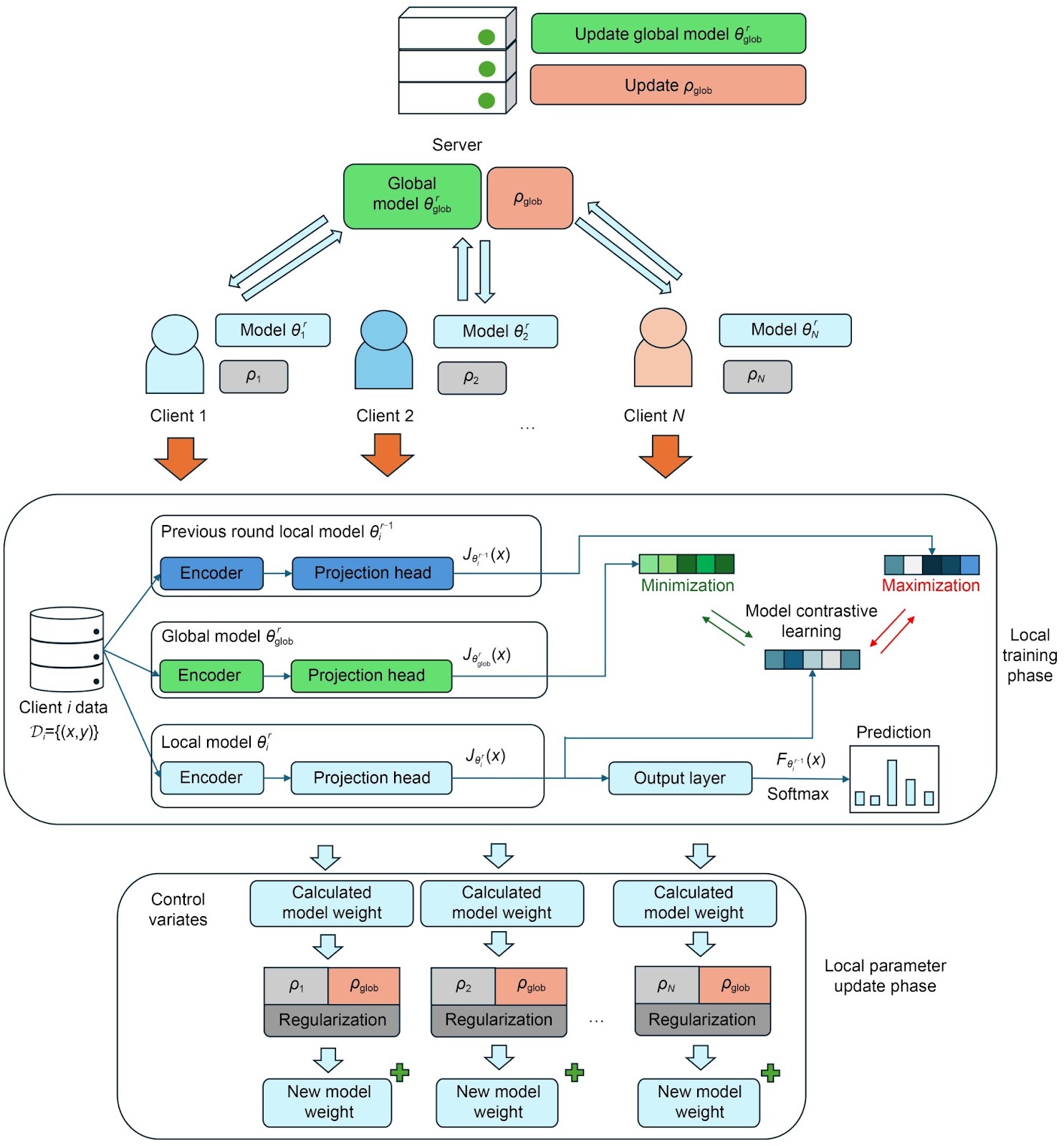
Federated model with contrastive learning and adaptive control variates for human activity recognition
Recent attention to privacy issues demands a communication-safe method for training human activity recognition (HAR) models on client activity data. Federated learning (FL) has become a compelling technique to facilitate model training between the server and clients while preserving data privacy. However, classical FL methods often assume independent and identically distributed (IID) data among clients. This assumption does not hold true in practical scenarios. Human activity in real-world scena