Key Takeaways & Executive Findings
- •• 3D rotational wedge failure mechanism yields higher safety factors than 2D analyses, providing more realistic stability predictions for constrained slopes. • The presence of open and vertical cracks significantly reduces slope stability, highlighting the importance of crack modeling in engineering practice. • Temperature-dependent shear strength assessment reveals unique response curves for different unsaturated soils, underscoring the need for soil-specific thermal design. • Integration of particle swarm optimization with limit analysis enables accurate and efficient safety factor computation for complex slope scenarios.
Abstract
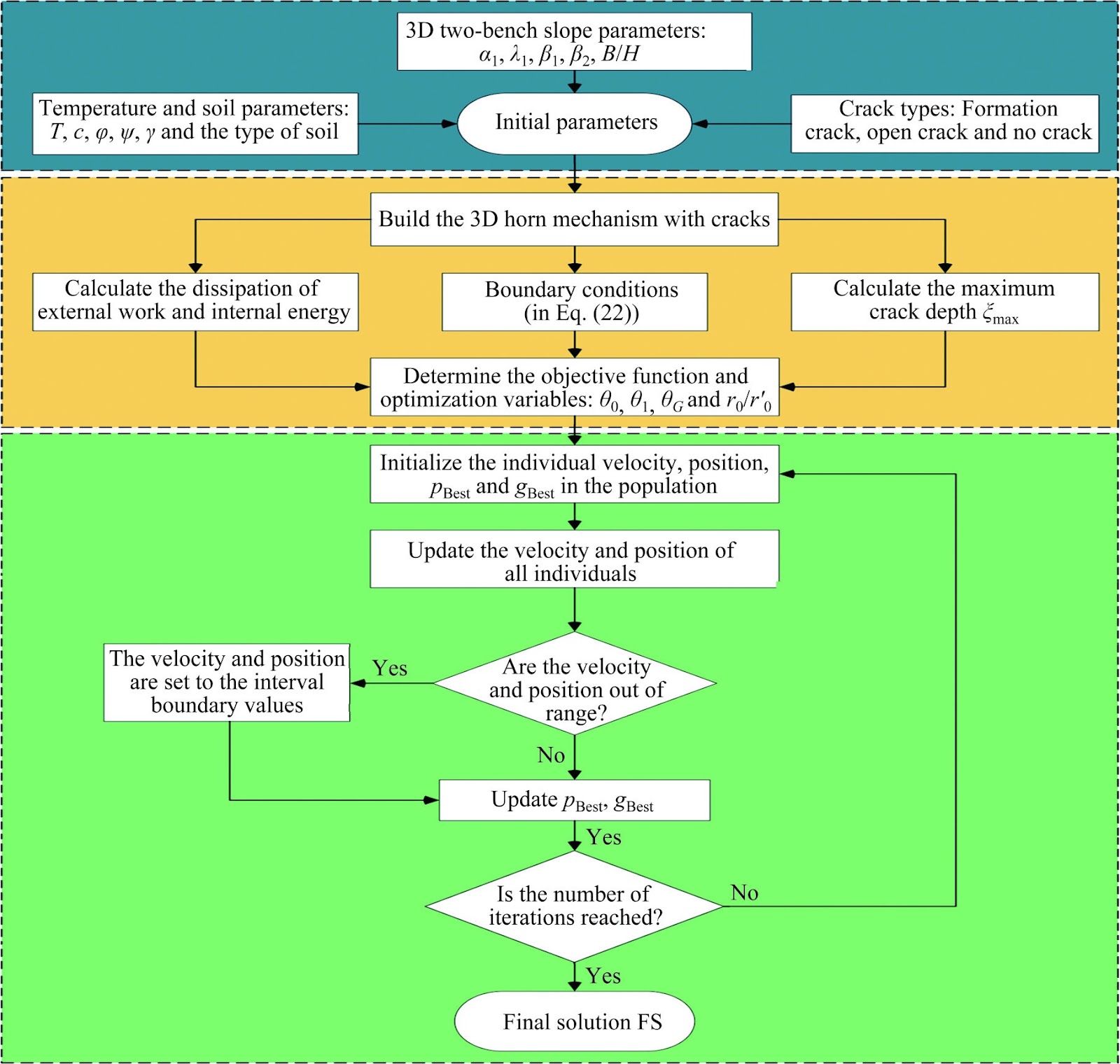
In existing studies, most slope stability analyses concentrate on conditions with constant temperature, assuming the slope is intact, and employ the Mohr-Coulomb (M-C) failure criterion for saturated soil to characterize the strength of the backfill. However, the actual working temperature of slopes varies, and natural phenomena such as rainfall and groundwater infiltration commonly result in unsaturated soil conditions, with cracks typically present in cohesive slopes. This study introduces a novel approach for assessing the stability of unsaturated soil stepped slopes under varying temperatures, incorporating the effects of open and vertical cracks. Utilizing the kinematic approach and gravity increase method, we developed a three-dimensional (3D) rotational wedge failure mechanism to simulate slope collapse, enhancing the traditional two-dimensional analyses. We integrated temperature-dependent functions and nonlinear shear strength equations to evaluate the impact of temperature on four typical unsaturated soil types. A particle swarm optimization algorithm was employed to calculate the safety factor, ensuring our method’s accuracy by comparing it with existing studies. The results indicate that considering 3D effects yields a higher safety factor, while cracks reduce slope stability. Each unsaturated soil exhibits a distinctive temperature response curve, highlighting the importance of understanding soil types in the design phase.
1. Introduction
The stability assessment of slopes is a classic topic within the field of geotechnical engineering. In the realm of slope and excavation engineering, the stability of stepped slopes exhibits a certain degree of improvement compared to their single-level counterparts. In the past, the majority of research on slope stability has primarily focused on failure mechanisms within a two-dimensional (2D) framework [1]. However, the failure of the slope usually exhibits three-dimensional (3D) characteristics when the width of a slope is constrained, indicating the necessity of considering a 3D model in the analysis. As of now, a considerable amount of research has been dedicated to evaluating the stability of slopes under 3D failure modes. These approaches can generally be categorized into three types: (a) limit analysis methods [2−4], (b) limit equilibrium methods [5−8], and (c) numerical analysis methods [9−12]. Limit analysis method circumvents the prolonged computational time and diverse parameter settings in numerical analysis as well as the various complex stress assumptions in the limit equilibrium method, which can cleverly analyze the stability of slopes and yield the required safety factor. Over the past few decades, the limit analysis method has proven to be effective, progressively evolving into one of the most efficient and powerful tools in the assessment of slope stability.
As is widely recognized, owing to the impact of human activities, the occurrence of extreme weather events on earth has been progressively increasing in recent years, with frequent and anomalous fluctuations in atmospheric temperatures. Slope engineering is highly susceptible to the influence of temperature changes due to the majority being exposed to the external environment. Meteorological data indicate that the likelihood of future occurrences of extreme events such as droughts and high temperatures is increasing in certain regions. ZHAN et al [13] conducted an analysis of soil temperature using daily temperature data from the Nanchang Meteorological Station spanning from 1961 to 2018. They found that over the past 58 years, the annual average temperature, seasonal average temperatures, and soil temperature primarily exhibited a significant upward trend. Based on daily measurements from 1970 to 2017 in Jiangsu Province, China, SHI et al [14] found that soil temperatures at most observation stations generally exhibited a warming trend, with these trends being more pronounced during the cold seasons than the warm seasons. MAZDIYASNI and AGHAKOUCHAK [15] mentioned in their study that the occurrences of drought and heatwaves have shifted towards more frequent and simultaneously more extreme events. From these facts, it is not difficult for us to recognize that considering temperature effects is pressing for slope stability analysis.
Loading authentic research manuscript (Pages 1–5)...
SHAN Jun-tao, WU Yi-min, YANG Xiao-li (2025). Three-dimensional stability of two-step slope with crack considering temperature effect on unsaturated soil. Journal of Central South University. https://doi.org/10.1007/s11771-025-5914-6
Research & Educational Purpose Only:The translations, structured abstracts, analytical annotations, and data reports provided by SinoTechIntel are intended exclusively for academic research, internal corporate R&D, and educational benchmarking. They do not constitute formal engineering, chemical safety, legal, or professional advice.
Copyright & Intellectual Property Notice: Original copyright of the underlying source articles and experimental data remains with the respective authors, institutions, and original publishing journals. SinoTechIntel claims intellectual property only over its proprietary translations, analytical syntheses, and AEO structured enhancements in accordance with international fair use and academic citation principles.
Frequently Asked Questions
What is the primary focus of this study?
The study focuses on evaluating the three-dimensional stability of two-step slopes with cracks in unsaturated soils, considering the effect of temperature variations using the limit analysis method.
How does temperature influence the stability of unsaturated slopes?
Temperature changes affect the shear strength of unsaturated soils. The study found that each soil type exhibits a distinctive temperature response curve, meaning different soils react differently to thermal variations, which is crucial for slope design.
Why is a three-dimensional (3D) analysis preferred over two-dimensional (2D) analysis in this study?
3D analysis provides a more realistic safety factor when the slope width is constrained. The results show that considering 3D effects yields a higher safety factor, preventing underestimation of slope stability.
What role do cracks play in the stability assessment?
The presence of open and vertical cracks reduces slope stability. The study incorporates crack effects into the failure mechanism, highlighting the need to account for cracks in stability assessments.
Which optimization algorithm was used to calculate the safety factor?
A particle swarm optimization (PSO) algorithm was employed to calculate the safety factor, and the method's accuracy was verified by comparison with existing studies.
Related Technical Papers & Translations

Design and optimization of a high-efficiency distillation process for cellulosic fuel ethanol integrated with thermal coupling and molecular sieve adsorption
To address the challenges of high energy consumption and prominent costs in the traditional three-columns distillation process for cellulosic fuel ethanol, a distillation—molecular sieve coupling separation process is proposed. This process integrates a three-column (crude distillation column, first distillation column, second distillation column) system with a 3A molecular sieve adsorption deep dehydration unit. A thermal coupling network is constructed via differential pressure design (steam from medium/high-pressure columns as mutual heat sources, reboiler liquid waste heat for feed preheating), and molecular sieve adsorption conditions are optimized. The study first performs a thermodynamic consistency test on the ethanol—water system, determines optimal non-random two-liquid (NRTL) model binary interaction parameters via experimental data regression for Aspen Plus simulation. Aiming at minimum total annual cost (TAC), Aspen Plus is used to optimize process parameters (theoretical tray number, feed location, reflux ratio, side-draw position, etc.). Economic analysis shows this process reduces CO2 emission costs by 27.56%, TAC by 15.58% (to 5.123 × 10⁶ USD·a-1), and increases ethanol purity to >99.6%, providing an effective solution for green, efficient separation.

A cohesion loss model for determining residual strength of deep bedded sandstone
Rock residual strength, as an important input parameter, plays an indispensable role in proposing the reasonable and scientific scheme about stope design, underground tunnel excavation and stability evaluation of deep chambers. Therefore, previous residual strength models of rocks established were reviewed. And corresponding related problems were stated. Subsequently, starting from the effects of bedding and whole life-cycle evolution process, series of triaxial mechanical tests of deep bedded s

Federated model with contrastive learning and adaptive control variates for human activity recognition
Recent attention to privacy issues demands a communication-safe method for training human activity recognition (HAR) models on client activity data. Federated learning (FL) has become a compelling technique to facilitate model training between the server and clients while preserving data privacy. However, classical FL methods often assume independent and identically distributed (IID) data among clients. This assumption does not hold true in practical scenarios. Human activity in real-world scena