Key Takeaways & Executive Findings
- •• SnS2@NxC composite with eggshell-like nitrogen-doped carbon coating effectively mitigates volumetric expansion, maintaining structural integrity over 1000 cycles. • The electrode delivers a high specific capacity of 701.8 mA·h·g−1 at 0.5 A·g−1 after 1000 cycles, demonstrating exceptional long-term cycling stability. • Nitrogen doping enhances electrical conductivity and promotes a robust SEI layer, contributing to improved rate performance and durability. • The scalable synthesis using sucrose and dopamine offers a promising strategy for high-performance lithium-ion battery anodes.
Abstract
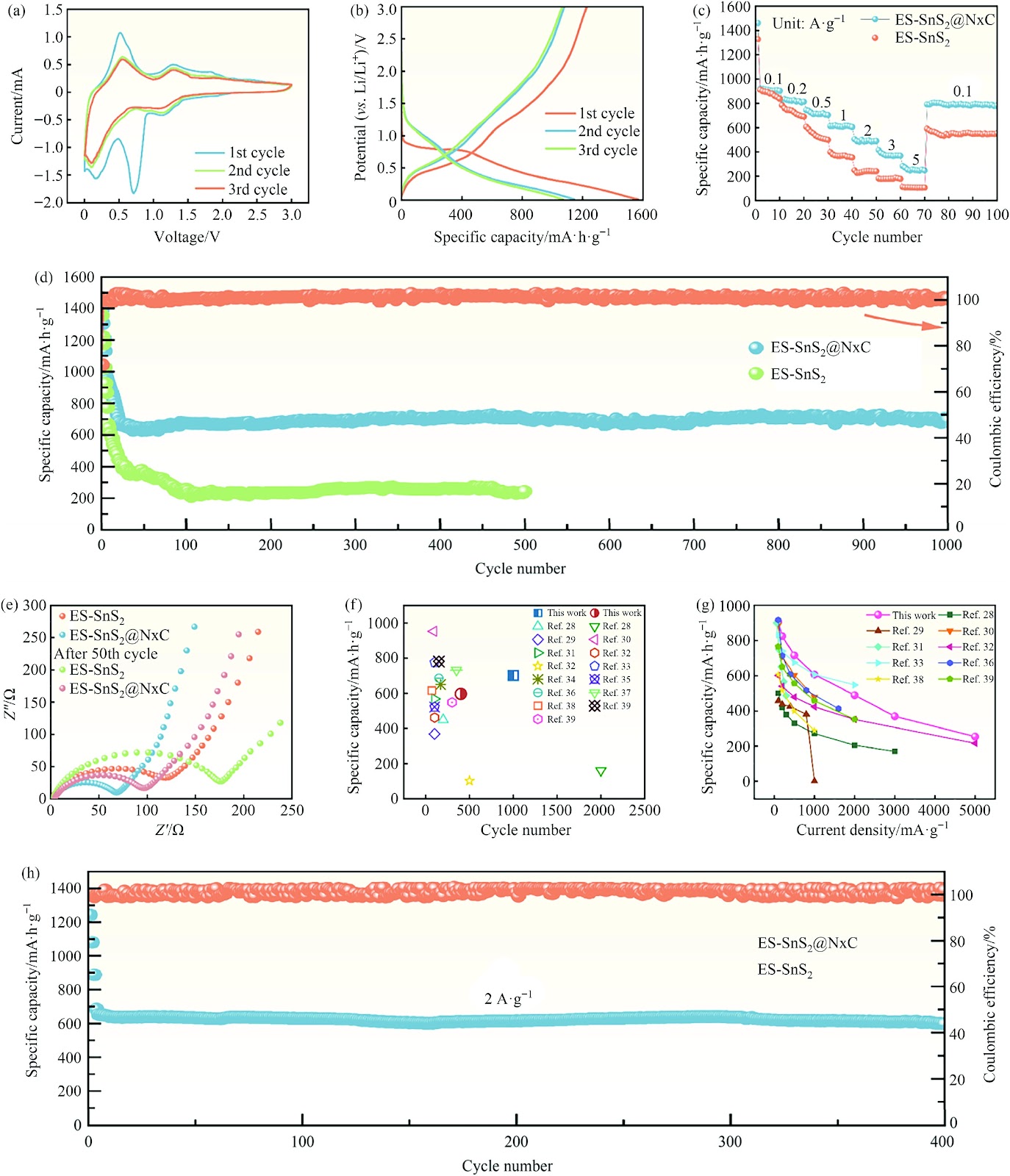
Tin sulfide (SnS2) anodes have garnered significant attention within emerging energy storage technologies. However, the application of SnS2 is curtailed due to its inherent limitations, including poor cyclic stability and inevitable volumetric expansion upon cycling. This study reports the successful fabrication of an innovative SnS2-based composite, featuring an eggshell-like structured nitrogen-doped carbon coating, referred to as SnS2@NxC. This novel architecture, wherein SnS2 acts as the core encapsulated by a nitrogen-doped carbon shell, characterized by a void space between the shell and core, is crucial in mitigating volumetric expansion. This configuration contributes to maintaining the structural integrity of the composite materials, even under the stresses of continuous cycling. Nitrogen within the carbon matrix enhances conductivity and promotes the formation of a more robust and stable solid electrolyte interphase (SEI) layer. Experimental investigations have substantiated the electrochemical superiority of the SnS2@NxC electrode, demonstrating a specific capacity of 701.8 mA·h·g−1 after 1000 cycles at 0.5 A·g−1 and maintaining a capacity of 597.2 mA·h·g−1 after 400 cycles at a heightened current density of 2 A·g−1. These findings underscore the exceptional cyclic performance and durability of the SnS2@NxC electrode.
1. Introduction
Technological advancements in energy storage devices, ranging from portable smart gadgets to electric vehicles, have featured the urgency of upgrading traditional energy storage materials. This urgent need is primarily driven by the quest for enhanced efficiency and performance in energy storage solutions, which is vital for supporting the growing reliance on renewable energy sources and the transition towards more sustainable forms of energy consumption. Yet, the low capacity of the traditional graphite anode hinders the high-capacity necessitated by lithium-ion batteries (LIBs), thereby impeding their broader application spectrum [1e4].
Tin-based materials, including Sn [5], SnO2 [6], SnS2 [7,8], and Sn4P3 [9], have gained widespread attention because of their remarkable theoretical capacities and low cost. Tin disulfide (SnS2), a layered metallic sulfide with a CdI2 lattice structure, stands out in this regard [10]. SnS2 is characterized by its relatively expansive interlayer spacing of 0.59 nm, which facilitates rapid ion diffusion in contrast to the widely reported graphite anode materials with a narrower interlayer space of approximately 0.34 nm. Moreover, SnS2 boasts a considerably higher theoretical capacity (z1231 mA·h·g−1) compared to graphite anodes. It exhibits many properties conducive to energy storage systems, such as non-toxicity, high lithium storage capability, and affordability. However, challenges related to its inferior conductivity and significant volume changes have notably diminished its reversible capacity and rate performance, indicating a need for further research and development to leverage its potential in the related applications [11e13].
Loading authentic research manuscript (Pages 1–5)...
Zhen He, Yuqian Wei, Yunfei Song, Jiaming Liu, Yuxin Wang, Muhammad D. Hayat (2024). The preparation of SnS2@NxC electrodes and its exceptional performance in energy storage usages. Chinese Journal of Chemical Engineering. https://doi.org/10.1016/j_cjche_1448
Research & Educational Purpose Only:The translations, structured abstracts, analytical annotations, and data reports provided by SinoTechIntel are intended exclusively for academic research, internal corporate R&D, and educational benchmarking. They do not constitute formal engineering, chemical safety, legal, or professional advice.
Copyright & Intellectual Property Notice: Original copyright of the underlying source articles and experimental data remains with the respective authors, institutions, and original publishing journals. SinoTechIntel claims intellectual property only over its proprietary translations, analytical syntheses, and AEO structured enhancements in accordance with international fair use and academic citation principles.
Frequently Asked Questions
What is the SnS2@NxC composite material?
SnS2@NxC is a composite material consisting of tin sulfide (SnS2) nanoparticles encapsulated in a nitrogen-doped carbon shell with an eggshell-like structure, featuring a void space between the core and shell to accommodate volume changes during cycling.
How does the nitrogen-doped carbon coating improve battery performance?
The nitrogen doping enhances the electrical conductivity of the carbon shell and promotes the formation of a stable solid electrolyte interphase (SEI) layer, which improves cycling stability and rate capability.
What specific capacity does the SnS2@NxC electrode achieve?
The SnS2@NxC electrode achieves a specific capacity of 701.8 mA·h·g−1 after 1000 cycles at 0.5 A·g−1, and maintains 597.2 mA·h·g−1 after 400 cycles at 2 A·g−1.
What are the main advantages of SnS2 as an anode material?
SnS2 offers a high theoretical capacity (about 1231 mA·h·g−1), large interlayer spacing for fast ion diffusion, non-toxicity, and low cost, making it a promising alternative to graphite anodes.
How is the SnS2@NxC composite synthesized?
The composite is synthesized using sucrose as a carbon source and dopamine hydrochloride as a nitrogen source, followed by a solvothermal process to create the eggshell-like structure.
Related Technical Papers & Translations

Design and optimization of a high-efficiency distillation process for cellulosic fuel ethanol integrated with thermal coupling and molecular sieve adsorption
To address the challenges of high energy consumption and prominent costs in the traditional three-columns distillation process for cellulosic fuel ethanol, a distillation—molecular sieve coupling separation process is proposed. This process integrates a three-column (crude distillation column, first distillation column, second distillation column) system with a 3A molecular sieve adsorption deep dehydration unit. A thermal coupling network is constructed via differential pressure design (steam from medium/high-pressure columns as mutual heat sources, reboiler liquid waste heat for feed preheating), and molecular sieve adsorption conditions are optimized. The study first performs a thermodynamic consistency test on the ethanol—water system, determines optimal non-random two-liquid (NRTL) model binary interaction parameters via experimental data regression for Aspen Plus simulation. Aiming at minimum total annual cost (TAC), Aspen Plus is used to optimize process parameters (theoretical tray number, feed location, reflux ratio, side-draw position, etc.). Economic analysis shows this process reduces CO2 emission costs by 27.56%, TAC by 15.58% (to 5.123 × 10⁶ USD·a-1), and increases ethanol purity to >99.6%, providing an effective solution for green, efficient separation.

A cohesion loss model for determining residual strength of deep bedded sandstone
Rock residual strength, as an important input parameter, plays an indispensable role in proposing the reasonable and scientific scheme about stope design, underground tunnel excavation and stability evaluation of deep chambers. Therefore, previous residual strength models of rocks established were reviewed. And corresponding related problems were stated. Subsequently, starting from the effects of bedding and whole life-cycle evolution process, series of triaxial mechanical tests of deep bedded s

Federated model with contrastive learning and adaptive control variates for human activity recognition
Recent attention to privacy issues demands a communication-safe method for training human activity recognition (HAR) models on client activity data. Federated learning (FL) has become a compelling technique to facilitate model training between the server and clients while preserving data privacy. However, classical FL methods often assume independent and identically distributed (IID) data among clients. This assumption does not hold true in practical scenarios. Human activity in real-world scena