Key Takeaways & Executive Findings
- •• Molecular dynamics simulations reveal that EVA disrupts ordered wax crystallization by adopting a curly conformation due to polar VA side chains, delaying wax solidification. • EVA exhibits a dual effect on hydrate formation: its nonpolar backbone enhances methane diffusion to wax surfaces (inhibiting hydrates), while VA chains repel methane, increasing local methane concentration and promoting hydrate nucleation. • The net impact of EVA on hydrate formation depends on wax crystal size: inhibition dominates for small crystals, promotion for larger crystals. • EVA effectively mitigates both wax and hydrate deposition in low-wax-content multiphase systems, offering a promising strategy for deep-sea flow assurance.
Abstract
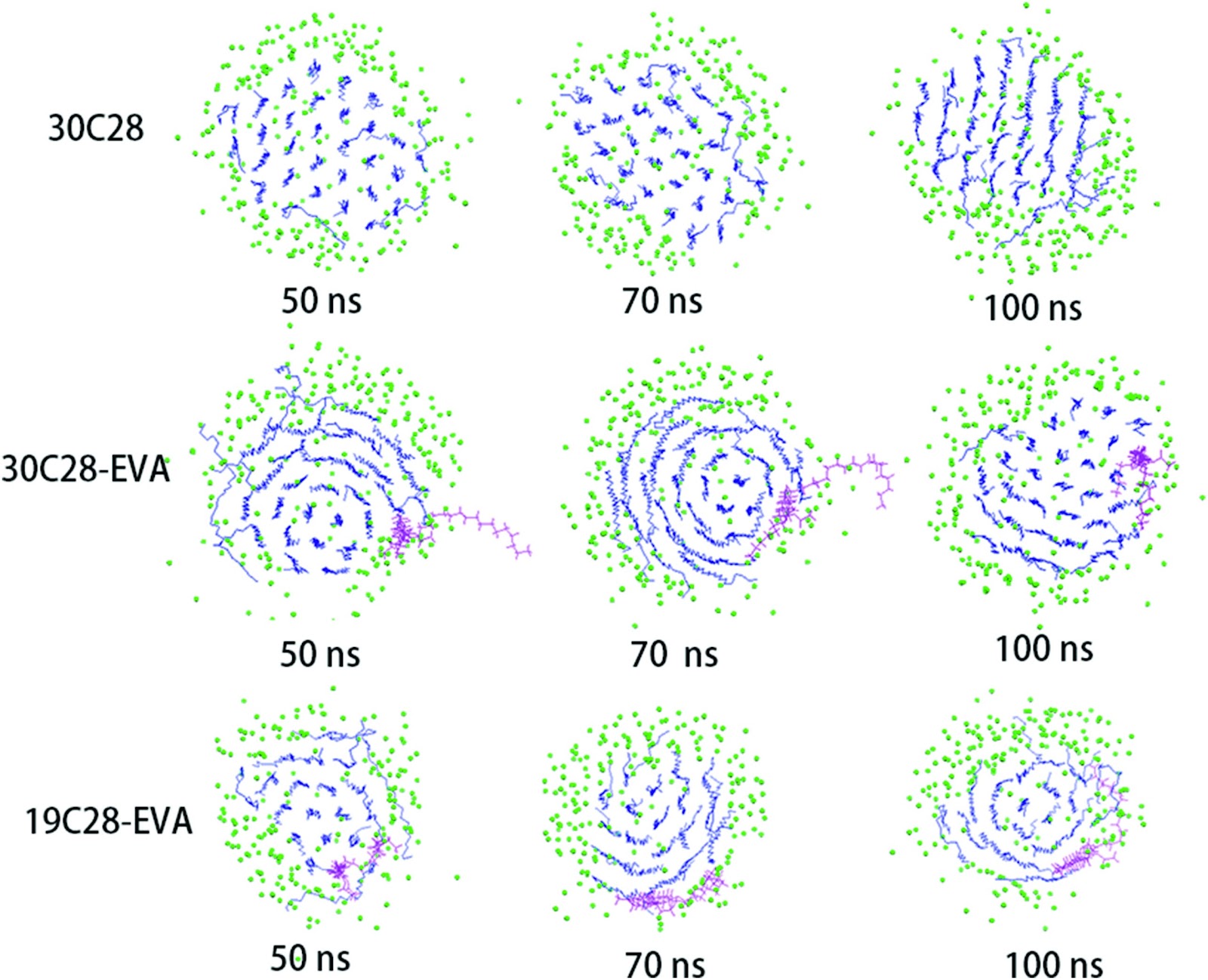
Ethylene-vinyl acetate copolymer (EVA) as a kind of effective polymeric pour point depressant has been extensively used in the pipeline transportation of crude oil to inhibit wax deposition and improve the low temperature fluidity of crude oil. In this work, molecular dynamics simulations were performed to investigate the effect of EVA on wax-hydrate coexistence system to evaluate the application potentiality of EVA to the flow assurance of deep-sea oilegasewater multiphase flow system. Our simulation results reveal that wax molecules gradually stretched and stacked from random coiling to a directional and ordered crystalline state during the process of wax solidification. The strong affinity of polar vinyl acetate side chains of EVA to neighboring water molecules made the EVA molecule prefer being in a curly state, which disrupted the ordered crystallization of surrounding wax molecules and delayed the solidification rate of wax cluster. In addition, it is found that EVA cocrystallized with wax molecules to form eutectic when the wax was fully solidified. The simulation results of hydrate nucleation and growth show that the EVA molecule displayed a two-sided effect on gas adsorption of wax crystals, which was the key factor that affected the nucleation and growth of hydrates in the methane-water system. The nonpolar hydrocarbon backbone of EVA increased the diffusion rate of methane and water, allowing more methane to diffuse to the surface of wax crystals, reducing the methane concentration in aqueous solutions and inhibiting the hydrate formation. On the other hand, the nonpolar vinyl acetate chains had a repulsive effect on methane, which reduced the adsorption area of methane on the eutectic surface and decreased the adsorption threshold value of the wax crystal. The excluded methane molecules would continue dissociating in the aqueous phase and participating in the nucleation and growth process of hydrates. Therefore, the probability of hydrate formation would be increased. It was worth noting that the inhibition performance of EVA on hydrate formation mainly played a significant role in the system with small wax crystal, while its hydrate promotion effect played a dominant role in the system with lager wax crystal. In summary, EVA could significantly inhibit both of the wax and hydrate deposition for the wax-gas-water multiphase system with low wax content. When the wax content in the system was high, the role of EVA was mainly played in the alleviation of wax crystallization rather than the gas hydrates. The results of the present work can contribute to a better understanding of EVA on wax deposition and hydrate formation, and provide theoretical support of the potential industrial applications of EVA.
1. Introduction
With the exploration and exploitation of the onshore and deep-sea oil and gas resources, the products gradually change from single-phase to multiphase (oil, gas, and water) flows. During the multiphase transportation process, wax deposition and hydrate formation can easily occur under appropriate thermodynamic conditions, leading to pipeline blockage, potentially significant financial losses, and safety issues [1e4].
Currently, for the crude oil single-phase flow systems, the most widely employed approach to alleviate the wax deposition problem involves incorporating pour point depressants (PPDs), which could improve the low-temperature flowability of waxy crude oil with a small dosage (tens to hundreds parts per million) [5e7]. Representative PPDs comprise polymethacrylate, ethylene-vinyl acetate copolymer (EVA), maleic anhydride copolymer, poly-α-olefin copolymers, and their derivatives [8e14]. Among them, EVA as a kind of effective polymeric PPDs has been extensively studied [15]. The EVA molecule is composed of polar vinyl acetate (VA) and nonpolar alkyl long chains of different lengths, in which the VA content directly affects the crystallization ability of EVA copolymers [16,17]. The main chain of the EVA molecule preferred to be adsorbed in parallel with the wax surface involving the polar VA group staying upside of the surface to interfere with their crystallization.
Loading authentic research manuscript (Pages 1–5)...
Limin Wang, Jinrong Duan, Bei Liu, Zhi Li, Guangjin Chen (2024). The effect of ethylene-vinyl acetate copolymer on the formation process of wax crystals and hydrates. Chinese Journal of Chemical Engineering. https://doi.org/10.1016/j_cjche_1448
Research & Educational Purpose Only:The translations, structured abstracts, analytical annotations, and data reports provided by SinoTechIntel are intended exclusively for academic research, internal corporate R&D, and educational benchmarking. They do not constitute formal engineering, chemical safety, legal, or professional advice.
Copyright & Intellectual Property Notice: Original copyright of the underlying source articles and experimental data remains with the respective authors, institutions, and original publishing journals. SinoTechIntel claims intellectual property only over its proprietary translations, analytical syntheses, and AEO structured enhancements in accordance with international fair use and academic citation principles.
Frequently Asked Questions
What is the main purpose of this study?
The study investigates the effect of ethylene-vinyl acetate copolymer (EVA) on the formation process of wax crystals and hydrates using molecular dynamics simulations, aiming to evaluate its potential for flow assurance in deep-sea oil-gas-water multiphase systems.
How does EVA affect wax crystallization?
EVA disrupts the ordered crystallization of wax molecules by adopting a curly conformation due to the strong affinity of its polar vinyl acetate side chains to water, thereby delaying wax solidification and improving low-temperature fluidity.
What is the dual effect of EVA on hydrate formation?
EVA has a two-sided effect: its nonpolar hydrocarbon backbone increases methane diffusion to wax surfaces, reducing methane concentration in water and inhibiting hydrate formation; conversely, its vinyl acetate chains repel methane, increasing local methane concentration and promoting hydrate nucleation.
How does wax crystal size influence EVA's performance?
EVA's inhibition of hydrate formation is significant in systems with small wax crystals, while its promotion effect dominates in systems with larger wax crystals.
What are the practical implications of this research?
The findings suggest that EVA can effectively inhibit both wax and hydrate deposition in low-wax-content multiphase systems, providing theoretical support for its industrial application in deep-sea flow assurance.
Related Technical Papers & Translations

Design and optimization of a high-efficiency distillation process for cellulosic fuel ethanol integrated with thermal coupling and molecular sieve adsorption
To address the challenges of high energy consumption and prominent costs in the traditional three-columns distillation process for cellulosic fuel ethanol, a distillation—molecular sieve coupling separation process is proposed. This process integrates a three-column (crude distillation column, first distillation column, second distillation column) system with a 3A molecular sieve adsorption deep dehydration unit. A thermal coupling network is constructed via differential pressure design (steam from medium/high-pressure columns as mutual heat sources, reboiler liquid waste heat for feed preheating), and molecular sieve adsorption conditions are optimized. The study first performs a thermodynamic consistency test on the ethanol—water system, determines optimal non-random two-liquid (NRTL) model binary interaction parameters via experimental data regression for Aspen Plus simulation. Aiming at minimum total annual cost (TAC), Aspen Plus is used to optimize process parameters (theoretical tray number, feed location, reflux ratio, side-draw position, etc.). Economic analysis shows this process reduces CO2 emission costs by 27.56%, TAC by 15.58% (to 5.123 × 10⁶ USD·a-1), and increases ethanol purity to >99.6%, providing an effective solution for green, efficient separation.

A cohesion loss model for determining residual strength of deep bedded sandstone
Rock residual strength, as an important input parameter, plays an indispensable role in proposing the reasonable and scientific scheme about stope design, underground tunnel excavation and stability evaluation of deep chambers. Therefore, previous residual strength models of rocks established were reviewed. And corresponding related problems were stated. Subsequently, starting from the effects of bedding and whole life-cycle evolution process, series of triaxial mechanical tests of deep bedded s

Federated model with contrastive learning and adaptive control variates for human activity recognition
Recent attention to privacy issues demands a communication-safe method for training human activity recognition (HAR) models on client activity data. Federated learning (FL) has become a compelling technique to facilitate model training between the server and clients while preserving data privacy. However, classical FL methods often assume independent and identically distributed (IID) data among clients. This assumption does not hold true in practical scenarios. Human activity in real-world scena