Key Takeaways & Executive Findings
- •• Adding N2 to CO2 hydrate formation retards nucleation and growth, leading to larger crystals and rougher morphology, which enhances mass transfer. • N2 delays secondary nucleation on the hydrate film, preserving pore-throat structure and improving gas exchange efficiency. • Hydrate film vertical growth rate is primarily controlled by supercooling and gas composition, not absolute temperature or pressure. • Optimal CO2+N2 composition for maximum mass transfer coefficient is 60% CO2 + 40% N2, with a value of 3.98 × 10^-8 mol·cm^-2·s^-1·MPa^-1.
Abstract
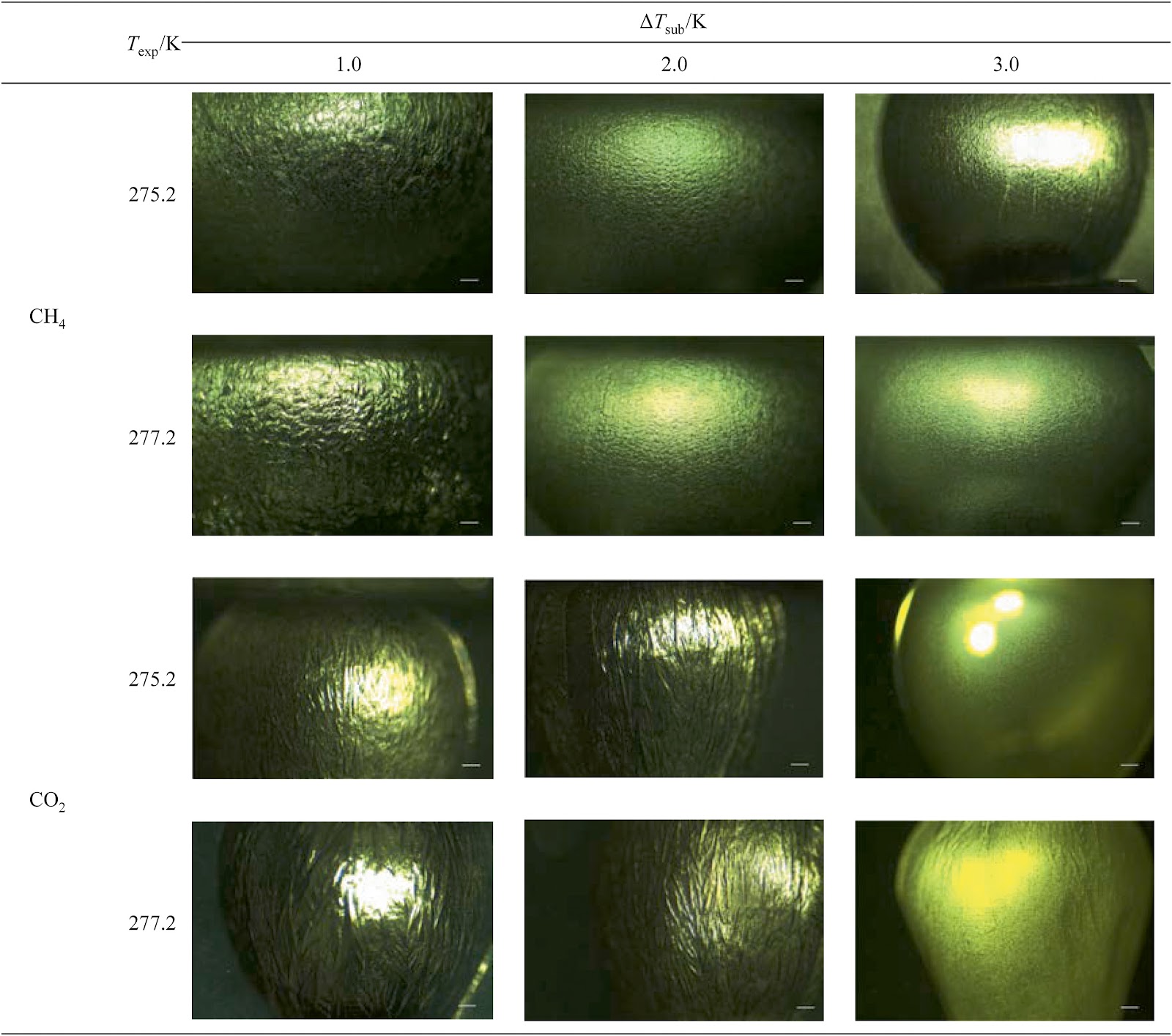
The morphology characteristics of CH4, CO2, and CO2+N2 hydrate film forming on the suspending gas bubbles are studied using microscopic visual method at supercooling conditions from 1.0 to 3.0 K. The hydrate film vertical growth rate and thickness along the planar gas-water interface are measured to study the hydrate formation kinetics and mass transfer process. Adding N2 in the gas mixture plays the same role as lowering the supercooling conditions, both retarding the crystal nucleation and growth rates, which results in larger single crystal size and rough hydrate morphology. N2 in the gas mixture helps to delay the secondary nucleation on the hydrate film, which is beneficial to maintain the pore-throat structure and enhance the mass transfer. The vertical growth rate of hydrate film mainly depends on the supercooling conditions and gas compositions but has weak dependence on the experimental temperature and pressure. Under the same gas composition condition, the final film thickness shows a linear relationship with the supercooling conditions. The mass transfer coefficient of CH4 molecules in hydrates ranges from 4.54 × 10^-8 to 7.54 × 10^-8 mol·cm^-2·s^-1·MPa^-1. The maximum mass transfer coefficient for CO2 + N2 hydrate occurs at the composition of 60% CO2 + 40% N2, which is 3.98 × 10^-8 mol·cm^-2·s^-1·MPa^-1.
1. Introduction
Gas hydrate is a non-stoichiometric crystalline compound consisting of polygonal cage structures, where the guest molecules such as small molecule hydrocarbons trapped in Ref. [1]. Natural gas hydrate is considered as an important global backup energy resource due to its vast reserves, which occurs in a wide variety of geologic settings including continental slopes and permafrost regions [2]. Conservative estimates suggest that the amount of CH4 in natural gas hydrate is ~200000 trillion cubic feet (TCF) [3], which is at least twice as much as the energy contained in the known fossil fuel reserves [4]. The proposed exploitation methods include thermal stimulation [5,6], thermodynamic inhibitor injection [7], depressurization [8], and CO2-CH4 replacement [9,10]. The CO2-CH4 replacement method is injecting CO2 into natural gas hydrate reservoir, since CO2 hydrate is thermodynamically more stable than CH4 hydrate at relevant temperature-pressure condition, it can achieve the dual goals of carbon sequestration and methane hydrate exploitation [11]. From an environmental perspective, the gas replacement is one of the most promising hydrate recovery methods due to its advantages of low energy consumption and non-destructive characteristic. Despite these advantages, its further application is still hampered by the low replacement rate [12]. Several microscopic studies using GC [13], Raman [14,15], and NMR [16,17] have been carried out to investigate the CO2-CH4 replacement process. Although these studies vary in terms of experimental procedures and replacement conditions, they reach consensus that the replacement process can be divided into two stages [18-20]. In the first stage, CH4 hydrate on the surface can be easily replaced by CO2 with relatively high rate and form a dense mixed hydrate shell. Heat-transfer limited surface reaction rate is the controlling factor in this stage. In the latter stage, the mass transfer rate is the controlling factor, which is hindered by the mixed hydrate shell, resulting in low replacement rate. Therefore, overcoming mass transfer limitation is the key to enhance the gas replacement rate [21].
In this work, we mainly focus on the effect of small molecular gas N2 on reforming the CO2 hydrate film, which is seen as the mass transfer obstruction in natural gas hydrate exploitation. Adding small molecule gas N2 into CO2 to improve CH4 recovery rate was initiated by Park et al. [14], the recovery rate showed a great improvement from 64% to 85%. Then the mixture of CO2-N2/H2 replacing CH4 hydrate has been studied at both the laboratory-scale [22-24] and the pilot-scale in the field [25,26]. A series of studies have been conducted to understand the role of N2 in the replacement process, but the underlying mechanism remains unclear. This study aims to elucidate the dual action of N2 on morphology regulation and mass-transfer acceleration of CO2 hydrate film, providing insights for optimizing gas replacement processes.
Loading authentic research manuscript (Pages 1–5)...
Jinrong Zhong, Yu Tian, Yifei Sun, Li Wan, Yan Xie, Yujie Zhu, Changyu Sun, Guangjin Chen, Yuefei Zhang (2024). The dual action of N2 on morphology regulation and mass-transfer acceleration of CO2 hydrate film. Chinese Journal of Chemical Engineering. https://doi.org/10.1016/j_cjche_1448
Research & Educational Purpose Only:The translations, structured abstracts, analytical annotations, and data reports provided by SinoTechIntel are intended exclusively for academic research, internal corporate R&D, and educational benchmarking. They do not constitute formal engineering, chemical safety, legal, or professional advice.
Copyright & Intellectual Property Notice: Original copyright of the underlying source articles and experimental data remains with the respective authors, institutions, and original publishing journals. SinoTechIntel claims intellectual property only over its proprietary translations, analytical syntheses, and AEO structured enhancements in accordance with international fair use and academic citation principles.
Frequently Asked Questions
What is the dual action of N2 on CO2 hydrate film?
N2 plays a dual role: it regulates the morphology of the hydrate film by retarding nucleation and growth, leading to larger crystals and a rougher surface, and it accelerates mass transfer by delaying secondary nucleation, which preserves the pore-throat structure and enhances gas exchange.
How does N2 affect the growth rate of CO2 hydrate film?
Adding N2 to the gas mixture retards the crystal nucleation and growth rates, similar to lowering supercooling conditions. The vertical growth rate of the hydrate film depends mainly on supercooling and gas composition, with weak dependence on absolute temperature and pressure.
What is the optimal CO2/N2 composition for maximum mass transfer coefficient?
The maximum mass transfer coefficient for CO2 + N2 hydrate occurs at a composition of 60% CO2 + 40% N2, with a value of 3.98 × 10^-8 mol·cm^-2·s^-1·MPa^-1.
Why is mass transfer important in CO2-CH4 replacement?
Mass transfer is the controlling factor in the latter stage of CO2-CH4 replacement, where a dense mixed hydrate shell hinders gas exchange, leading to low replacement rates. Enhancing mass transfer is key to improving the efficiency of this method.
What methods were used to study the hydrate film?
The study used a microscopic visual method to observe hydrate film morphology on suspending gas bubbles at supercooling conditions from 1.0 to 3.0 K. The vertical growth rate and thickness along the planar gas-water interface were measured to analyze formation kinetics and mass transfer.
Related Technical Papers & Translations

Design and optimization of a high-efficiency distillation process for cellulosic fuel ethanol integrated with thermal coupling and molecular sieve adsorption
To address the challenges of high energy consumption and prominent costs in the traditional three-columns distillation process for cellulosic fuel ethanol, a distillation—molecular sieve coupling separation process is proposed. This process integrates a three-column (crude distillation column, first distillation column, second distillation column) system with a 3A molecular sieve adsorption deep dehydration unit. A thermal coupling network is constructed via differential pressure design (steam from medium/high-pressure columns as mutual heat sources, reboiler liquid waste heat for feed preheating), and molecular sieve adsorption conditions are optimized. The study first performs a thermodynamic consistency test on the ethanol—water system, determines optimal non-random two-liquid (NRTL) model binary interaction parameters via experimental data regression for Aspen Plus simulation. Aiming at minimum total annual cost (TAC), Aspen Plus is used to optimize process parameters (theoretical tray number, feed location, reflux ratio, side-draw position, etc.). Economic analysis shows this process reduces CO2 emission costs by 27.56%, TAC by 15.58% (to 5.123 × 10⁶ USD·a-1), and increases ethanol purity to >99.6%, providing an effective solution for green, efficient separation.

A cohesion loss model for determining residual strength of deep bedded sandstone
Rock residual strength, as an important input parameter, plays an indispensable role in proposing the reasonable and scientific scheme about stope design, underground tunnel excavation and stability evaluation of deep chambers. Therefore, previous residual strength models of rocks established were reviewed. And corresponding related problems were stated. Subsequently, starting from the effects of bedding and whole life-cycle evolution process, series of triaxial mechanical tests of deep bedded s

Federated model with contrastive learning and adaptive control variates for human activity recognition
Recent attention to privacy issues demands a communication-safe method for training human activity recognition (HAR) models on client activity data. Federated learning (FL) has become a compelling technique to facilitate model training between the server and clients while preserving data privacy. However, classical FL methods often assume independent and identically distributed (IID) data among clients. This assumption does not hold true in practical scenarios. Human activity in real-world scena