Key Takeaways & Executive Findings
- •• Tensile stresses yield higher creep strains than compressive stresses in pre-treated Al-Zn-Mg-Cu alloy, with asymmetry becoming more pronounced at higher applied stresses. • Compressive stress creep aging results in superior mechanical properties compared to tensile stress, despite exhibiting lower creep strain. • Dislocation density, dislocation moving velocity, and precipitate proportions are the primary microstructural factors governing tension-compression asymmetry. • Incorporating tension/compression stress asymmetry into creep constitutive models can significantly improve the forming accuracy of creep age forming components for civil aviation.
Abstract
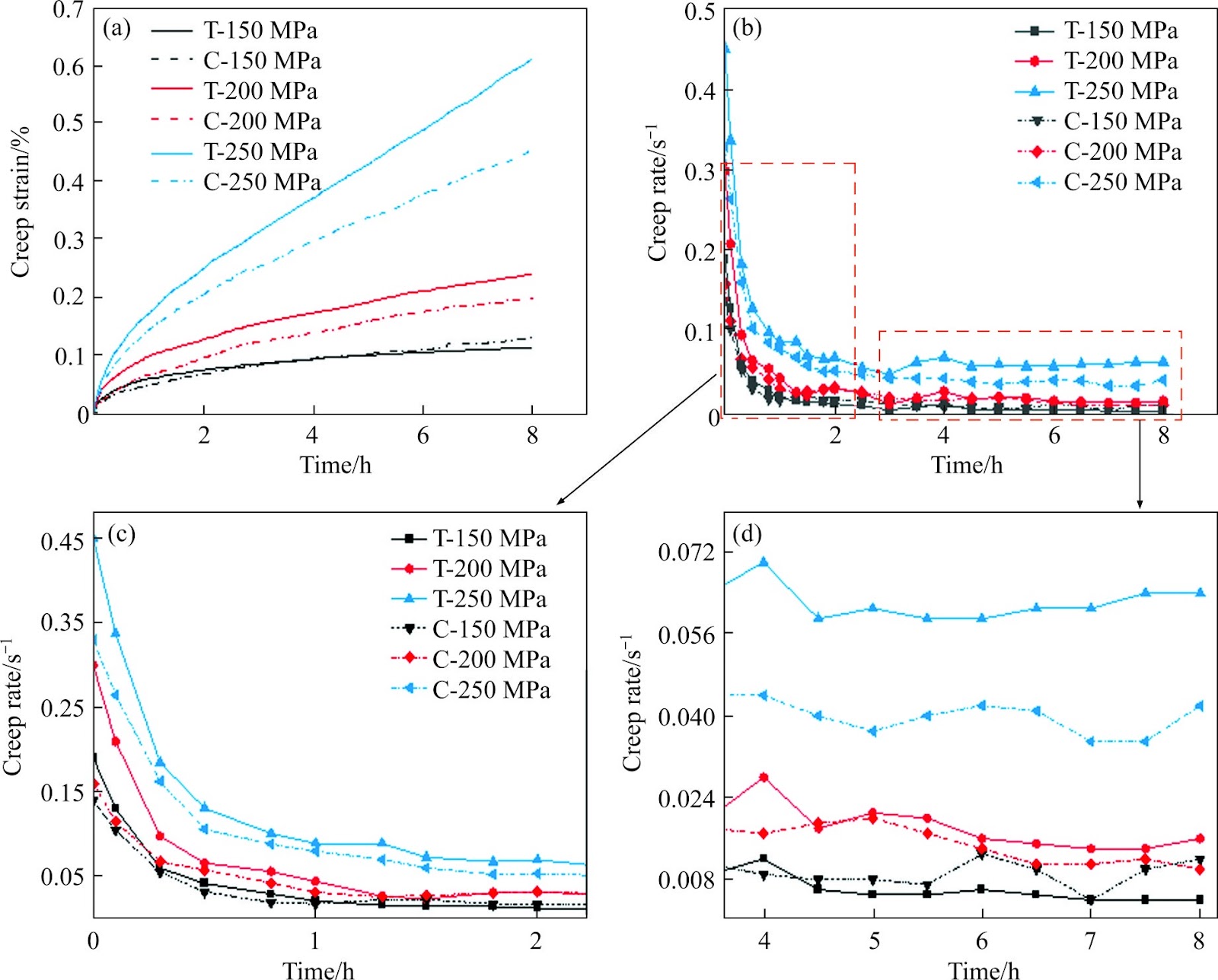
The asymmetric creep aging behaviors of a pre-treated Al-Zn-Mg-Cu alloy under high and low stresses have been investigated for high precision creep age forming application of aluminum integral panels. With the increase of applied stress, the creep strains under the tensile stresses are higher than those of compressive stresses and the asymmetry of creep strain is more obvious. However, the mechanical properties of tensile stress creep aged samples are lower than those of compressive stress creep aged samples. Dislocation density, dislocation moving velocity and the proportion of precipitates directly lead to the asymmetry of creep strain and mechanical properties after tensile-compressive creep aging process. In addition, the tensile and compressive stresses have little effect on the width of the precipitate-free zone (PFZ). It indicates that in the high stress creep age forming process of the pretreated Al-Zn-Mg-Cu alloy, the tensile stress promotes the dislocation motion to obtain a better creep strain but weakens its mechanical properties compared with the compressive stress. In the field of civil aviation aircraft component manufacturing, the introduction of tension and compression stress asymmetry into the creep constitutive model may improve the accuracy of creep age forming components.
1. Introduction
Al-Zn-Mg-Cu (7xxx) alloys with outstanding comprehensive properties are widely used in spacecraft integral panels and other components [1, 2]. The creep age forming (CAF) process is a technology that completes age hardening and forming at the same time. Some of integral panels and aircraft components are manufactured with this technology [3]. The corrosion performance of T7451 state is higher than that of T7751 and T6 state, and its strength is higher than that of T73 state. From the comprehensive evaluation of strength and corrosion performance, the T7451 state not only maintains a certain strength but also retains a certain corrosion performance. Therefore, many civil aircraft integral panel adopts T7451 state [4, 5]. Aircraft integral panel structure will become more and more complex in order to meet the requirements of aerodynamics [6]. In the manufacture of complex shape components in civil aviation, it not only maintains the comprehensive performance of creep age forming parts but also ensures the forming accuracy, which is the challenge of creep age forming technology.
In recent years, a great deal of researches have been conducted on the causes of tensile-compressive creep asymmetry in aluminum alloys. LI et al [7] found that the tensile and compressive creep of T34, T84 and quenched AA2050 alloys shows asymmetry, and the difference in the change of precipitated phases in different initial states leads to the asymmetry of tensile and compressive creep. XU et al [3] discovered that the compressive stress hinders the coarsening rate of S phase, and the less precipitation phase at grain boundary leads to higher mechanical properties after creep aging under compressive stress than that under tensile stress. LI et al [8] showed that the asymmetric change of yield strength (YS) after tension-compression creep is because the dislocation density under tensile stress creep is higher than that under compressive stress, which obviously promotes the growth of T1 and θ' phases. From the above research progress, it has been found that there is an asymmetric phenomenon of tensile and compressive creep in aluminum alloys, and different initial states, precipitates, and dislocations are important reasons for this phenomenon.
However, there is limited research on the asymmetry of tensile and compressive creep of 7xxx aluminum alloys.
Loading authentic research manuscript (Pages 1–5)...
LAO Shan-feng, XU Ke-ren, WANG Tao, ZHAN Li-hua, XU Yong-qian, HUANG Ming-hui, MA Bo-lin, YANG You-liang, GUO Wen-xing (2025). Tension and compression creep aging asymmetry of a pre-treated Al-Zn-Mg-Cu alloy. Journal of Central South University. https://doi.org/10.1007/s11771-025-5851-4
Research & Educational Purpose Only:The translations, structured abstracts, analytical annotations, and data reports provided by SinoTechIntel are intended exclusively for academic research, internal corporate R&D, and educational benchmarking. They do not constitute formal engineering, chemical safety, legal, or professional advice.
Copyright & Intellectual Property Notice: Original copyright of the underlying source articles and experimental data remains with the respective authors, institutions, and original publishing journals. SinoTechIntel claims intellectual property only over its proprietary translations, analytical syntheses, and AEO structured enhancements in accordance with international fair use and academic citation principles.
Frequently Asked Questions
What is the main finding of the study on Al-Zn-Mg-Cu alloy?
The study reveals that tensile stresses produce higher creep strains but lower mechanical properties compared to compressive stresses during creep aging of a pre-treated Al-Zn-Mg-Cu alloy. The asymmetry intensifies with increasing applied stress.
Why does tensile stress lead to lower mechanical properties despite higher creep strain?
Tensile stress promotes higher dislocation density and dislocation mobility, which accelerates precipitate coarsening and reduces strengthening contributions. In contrast, compressive stress limits dislocation activity, resulting in finer precipitates and better mechanical properties.
What microstructural factors cause tension-compression creep asymmetry?
The primary factors are dislocation density, dislocation moving velocity, and the proportion of precipitates. These directly influence the creep strain and mechanical property evolution under different stress states.
How does the precipitate-free zone (PFZ) width respond to stress direction?
The width of the precipitate-free zone is minimally affected by the direction of applied stress, indicating that tensile and compressive stresses do not significantly alter PFZ characteristics in the tested alloy.
How can these findings improve creep age forming in aviation manufacturing?
By incorporating tension-compression stress asymmetry into creep constitutive models, manufacturers can more accurately predict component shape and properties during creep age forming, which is critical for producing high-precision aircraft integral panels.
Related Technical Papers & Translations

Design and optimization of a high-efficiency distillation process for cellulosic fuel ethanol integrated with thermal coupling and molecular sieve adsorption
To address the challenges of high energy consumption and prominent costs in the traditional three-columns distillation process for cellulosic fuel ethanol, a distillation—molecular sieve coupling separation process is proposed. This process integrates a three-column (crude distillation column, first distillation column, second distillation column) system with a 3A molecular sieve adsorption deep dehydration unit. A thermal coupling network is constructed via differential pressure design (steam from medium/high-pressure columns as mutual heat sources, reboiler liquid waste heat for feed preheating), and molecular sieve adsorption conditions are optimized. The study first performs a thermodynamic consistency test on the ethanol—water system, determines optimal non-random two-liquid (NRTL) model binary interaction parameters via experimental data regression for Aspen Plus simulation. Aiming at minimum total annual cost (TAC), Aspen Plus is used to optimize process parameters (theoretical tray number, feed location, reflux ratio, side-draw position, etc.). Economic analysis shows this process reduces CO2 emission costs by 27.56%, TAC by 15.58% (to 5.123 × 10⁶ USD·a-1), and increases ethanol purity to >99.6%, providing an effective solution for green, efficient separation.

A cohesion loss model for determining residual strength of deep bedded sandstone
Rock residual strength, as an important input parameter, plays an indispensable role in proposing the reasonable and scientific scheme about stope design, underground tunnel excavation and stability evaluation of deep chambers. Therefore, previous residual strength models of rocks established were reviewed. And corresponding related problems were stated. Subsequently, starting from the effects of bedding and whole life-cycle evolution process, series of triaxial mechanical tests of deep bedded s

Federated model with contrastive learning and adaptive control variates for human activity recognition
Recent attention to privacy issues demands a communication-safe method for training human activity recognition (HAR) models on client activity data. Federated learning (FL) has become a compelling technique to facilitate model training between the server and clients while preserving data privacy. However, classical FL methods often assume independent and identically distributed (IID) data among clients. This assumption does not hold true in practical scenarios. Human activity in real-world scena