Key Takeaways & Executive Findings
- •• Directionally solidified pure Mg with columnar crystals achieves a high elongation of 53% at room temperature, demonstrating exceptional tensile plasticity. • The growth orientation concentrated in <022ˉ5> ensures high Schmid factors (>0.43) for basal <a> slip, enhancing deformation capability. • A geometric compatibility factor greater than 0.7 across grain boundaries indicates outstanding strain coordination and reduced boundary cracking. • This work provides a strategy to overcome the inherent low plasticity of cast Mg by optimizing grain morphology and orientation via directional solidification.
Abstract
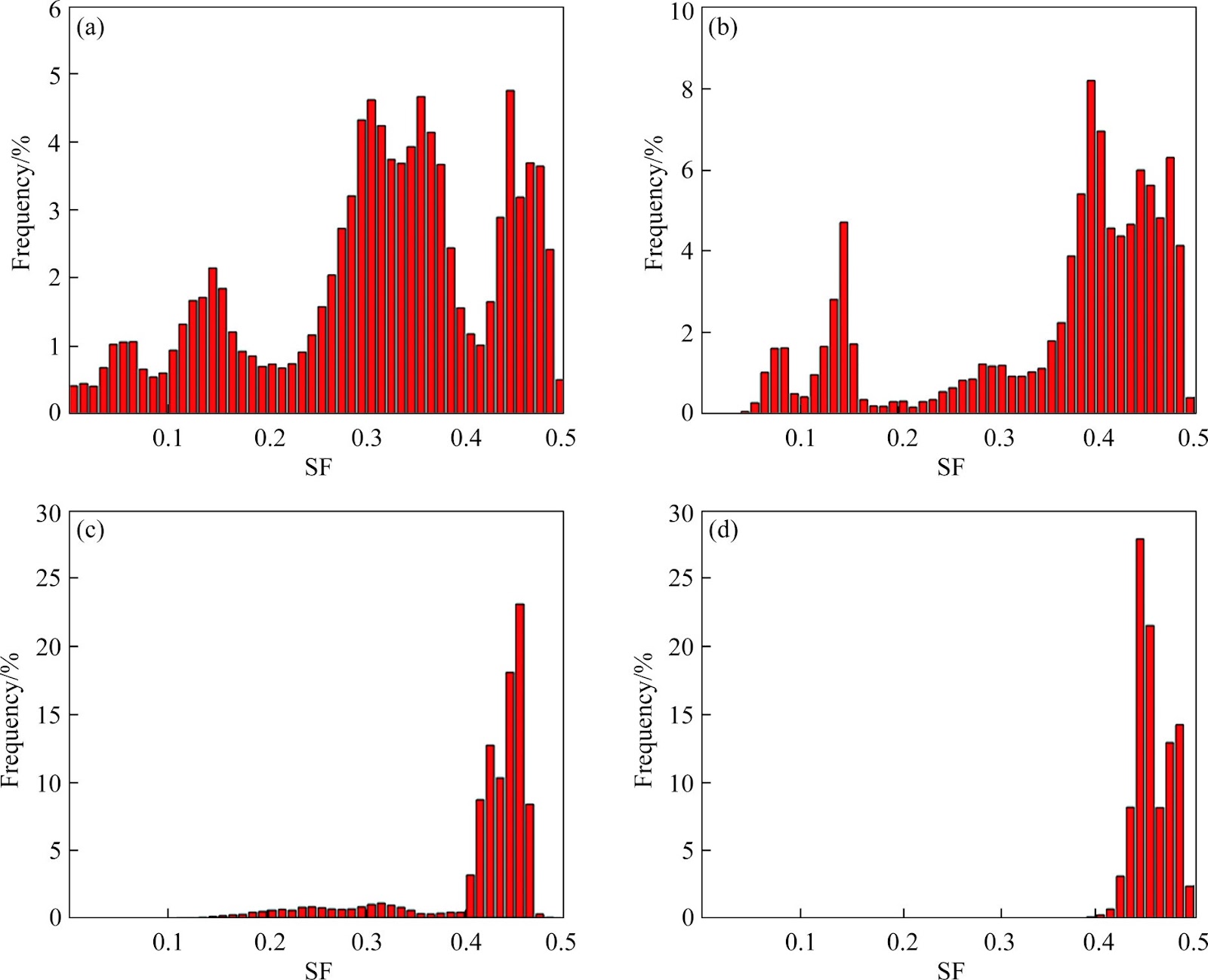
The pure Mg with columnar crystals was prepared by directional solidification, and the effect of process parameters on the crystal orientation and tensile properties was studied. Moreover, the microstructure evolution during tensile deformation was analyzed by electron backscatter diffraction (EBSD) technology. Furthermore, the slip within adjacent grains and grain boundary strain were discussed using the bicrystal model theory. The results show that the microstructure of the pure Mg at a pulling rate of 200 μm/s is columnar polycrystal with growth orientation concentrated in < 022ˉ5 >, and no transverse grain boundaries can be seen. In addition, the Schmid factors (SFs) of basal slips in columnar crystals are higher than 0.43 under tensile stress. Moreover, the geometric compatibility factor of slip systems on both sides of grain boundaries is greater than 0.7, showing good strain coordination ability of grain boundaries. Therefore, the elongation of the directionally solidified pure Mg is as high as 53% at room temperature.
1. Introduction
Casting magnesium alloys often show poor strain compatibility of grain boundaries and low plasticity because there are only two independent basal slip systems at room temperature, while at least 5 independent slip systems are required to coordinate grain boundary strain during deformation of equiaxed crystals. Therefore, it is very important to optimize the grain morphology and crystal orientation, and to improve strain compatibility of grain boundaries for developing high-performance Mg alloys.
Directional solidification is a technology making metals grow along the required direction during solidification to form columnar grains with preferred orientation. LIAN et al prepared Mg-6.3Gd alloy with growth orientation concentrated in <21ˉ1ˉ0> and Mg-8.2Gd alloy with growth orientation concentrated in <32ˉ1ˉ4> by directional solidification, and found that the Mg-6.3Gd alloy had high yield strength (176 MPa), and the Mg-8.2Gd alloy had good plasticity (elongation of 22%). ZHANG et al investigated the tensile properties of the directionally solidified Mg-0.8Ca alloy, and the results showed that the mechanical properties of the alloy were significantly improved, especially for the elongation (over 20%). CHAI et al studied the directionally solidified Mg-Gd-Y alloy and found that the alloy had excellent tensile plasticity (elongation of 32.8%) and good strain hardening ability. ZHAO et al reported that the elongation of the directionally solidified Mg-4.5Zn-0.5Y-0.1Zr alloy was as high as 30% at room temperature, and the yield strength was up to 178 MPa simultaneously. Furthermore, the researches on Mg-4.0Zn, Mg-3.0Nd-1.5Gd, Mg-2.35Gd, and Mg-1.5Mn-Al also indicated that the mechanical properties of the alloys can be improved by directional solidification. WANG et al, WANG et al, YANG et al, and LUO et al found that the grain morphology and the primary dendrite arm spacing of columnar crystals can be adjusted by controlling temperature gradient (GL) and pulling rate (R), thereby improving the mechanical properties of the Mg-Gd alloys. GENG et al studied directionally solidified Mg-xGd (x=4 wt.% − 12 wt.%) alloys, and found that the Gd content influenced the mechanical properties by changing the growth orientation of the columnar crystals. Similarly, FANG et al stated that the growth orientation of the columnar crystals in the directionally solidified Mg-Gd-Y-Zr alloy greatly affected deformation mode and strain compatibility of grain boundaries.
At present, there are few reports on the relationship of the growth orientation of columnar crystals, deformation mode, and strain compatibility of grain boundaries. In this study, pure Mg with columnar crystals was prepared by directional solidification. One of the aims is to study the effect of process parameters on the growth orientation of columnar crystals. Another aim is to investigate the relationship of the crystal orientation, strain compatibility of grain boundaries and mechanical properties. On this basis, it is expected to reveal the mechanism improving the plasticity.
Loading authentic research manuscript (Pages 1–5)...
ZHANG Hang, FANG Da-ran, ZHAO Sheng-shi, LIN Xiao-ping, LIAN Yong-qiang, ZHANG Xu-zhao, GAO Qiu-zhi (2025). Tensile deformation characteristics and high-plasticity mechanism of directionally solidified pure magnesium. Journal of Central South University. https://doi.org/10.1007/s11771-025-5960-0
Research & Educational Purpose Only:The translations, structured abstracts, analytical annotations, and data reports provided by SinoTechIntel are intended exclusively for academic research, internal corporate R&D, and educational benchmarking. They do not constitute formal engineering, chemical safety, legal, or professional advice.
Copyright & Intellectual Property Notice: Original copyright of the underlying source articles and experimental data remains with the respective authors, institutions, and original publishing journals. SinoTechIntel claims intellectual property only over its proprietary translations, analytical syntheses, and AEO structured enhancements in accordance with international fair use and academic citation principles.
Frequently Asked Questions
What is the maximum tensile elongation achieved in this study?
The directionally solidified pure Mg exhibits a high elongation of 53% at room temperature.
How does directional solidification improve the plasticity of pure magnesium?
It optimizes the grain morphology and crystal orientation, forming columnar grains with preferred <022ˉ5> orientation. This increases the Schmid factors for basal slip and enhances the geometric compatibility factor across grain boundaries, improving strain coordination and delaying fracture.
What was the role of the geometric compatibility factor in this research?
The geometric compatibility factor quantifies the strain coordination ability of slip systems across grain boundaries. Values greater than 0.7 indicate excellent compatibility, contributing to the high tensile ductility observed in the directionally solidified Mg.
Which experimental techniques were used to analyze the deformation mechanisms?
Electron backscatter diffraction (EBSD) was used to analyze microstructure evolution, and the bicrystal model theory was applied to discuss slip behavior within adjacent grains and grain boundary strain.
What are the potential applications of this high-plasticity pure magnesium?
This high-plasticity magnesium can be used in lightweight structural components, biomedical implants, and other applications requiring good formability and biocompatibility.
Related Technical Papers & Translations
Design and optimization of a high-efficiency distillation process for cellulosic fuel ethanol integrated with thermal coupling and molecular sieve adsorption
To address the challenges of high energy consumption and prominent costs in the traditional three-columns distillation process for cellulosic fuel ethanol, a distillation—molecular sieve coupling separation process is proposed. This process integrates a three-column (crude distillation column, first distillation column, second distillation column) system with a 3A molecular sieve adsorption deep dehydration unit. A thermal coupling network is constructed via differential pressure design (steam from medium/high-pressure columns as mutual heat sources, reboiler liquid waste heat for feed preheating), and molecular sieve adsorption conditions are optimized. The study first performs a thermodynamic consistency test on the ethanol—water system, determines optimal non-random two-liquid (NRTL) model binary interaction parameters via experimental data regression for Aspen Plus simulation. Aiming at minimum total annual cost (TAC), Aspen Plus is used to optimize process parameters (theoretical tray number, feed location, reflux ratio, side-draw position, etc.). Economic analysis shows this process reduces CO2 emission costs by 27.56%, TAC by 15.58% (to 5.123 × 10⁶ USD·a-1), and increases ethanol purity to >99.6%, providing an effective solution for green, efficient separation.
A cohesion loss model for determining residual strength of deep bedded sandstone
Rock residual strength, as an important input parameter, plays an indispensable role in proposing the reasonable and scientific scheme about stope design, underground tunnel excavation and stability evaluation of deep chambers. Therefore, previous residual strength models of rocks established were reviewed. And corresponding related problems were stated. Subsequently, starting from the effects of bedding and whole life-cycle evolution process, series of triaxial mechanical tests of deep bedded s
Federated model with contrastive learning and adaptive control variates for human activity recognition
Recent attention to privacy issues demands a communication-safe method for training human activity recognition (HAR) models on client activity data. Federated learning (FL) has become a compelling technique to facilitate model training between the server and clients while preserving data privacy. However, classical FL methods often assume independent and identically distributed (IID) data among clients. This assumption does not hold true in practical scenarios. Human activity in real-world scena