Key Takeaways & Executive Findings
- •• Proposes TFE, a competitive learning paradigm based on DisenIB theory to enhance temporal fidelity in video action recognition without fine-grained supervision. • Decouples action-relevant semantics from spurious correlations via adversarial feature disentanglement, improving attention alignment. • Achieves significant accuracy improvements on UCF101, HMDB-51, and Charades benchmarks. • Addresses the gap between coarse video-level labels and fine-grained temporal dynamics, reducing attention noise in complex scenarios.
Abstract
Temporal attention mechanisms are essential for video action recognition, enabling models to focus on semantically informative moments. However, these models frequently exhibit temporal infidelity—misaligned attention weights caused by limited training diversity and the absence of fine-grained temporal supervision. While video-level labels provide coarse-grained action guidance, the lack of detailed constraints allows attention noise to persist, especially in complex scenarios with distracting spatial elements. To address this issue, we propose temporal fidelity enhancement (TFE), a competitive learning paradigm based on the disentangled information bottleneck (DisenIB) theory. TFE mitigates temporal infidelity by decoupling action-relevant semantics from spurious correlations through adversarial feature disentanglement. Using pre-trained representations for initialization, TFE establishes an adversarial process in which segments with elevated temporal attention compete against contexts with diminished action relevance. This mechanism ensures temporal consistency and enhances the fidelity of attention patterns without requiring explicit fine-grained supervision. Extensive studies on UCF101, HMDB-51, and Charades benchmarks validate the effectiveness of our method, with significant improvements in action recognition accuracy.
1. Introduction
Learning paradigms based on physical systems and neural mechanisms have advanced video-based action recognition by enhancing temporal dependency modeling and discriminative motion pattern extraction (Jiao LC et al., 2024, 2025). While traditional three-dimensional (3D) convolutional networks and two-stream architectures (Liu ZY et al., 2021; Liu Y et al., 2024) have established the foundation for temporal modeling, their reliance on predefined hierarchies limits the adaptability to long-term dynamics. Multi-scale temporal dependency methods (Yu et al., 2020; Zhou JM et al., 2021; Zhang et al., 2025) partially alleviate this, but remain constrained by fixed parameterization. This has driven the use of temporal attention mechanisms, which dynamically prioritize critical temporal segments and improve motion feature extraction (Wu CY et al., 2022; Jiao JY et al., 2023; Yamazaki et al., 2023; Gao et al., 2024; Zhou JM et al., 2024).
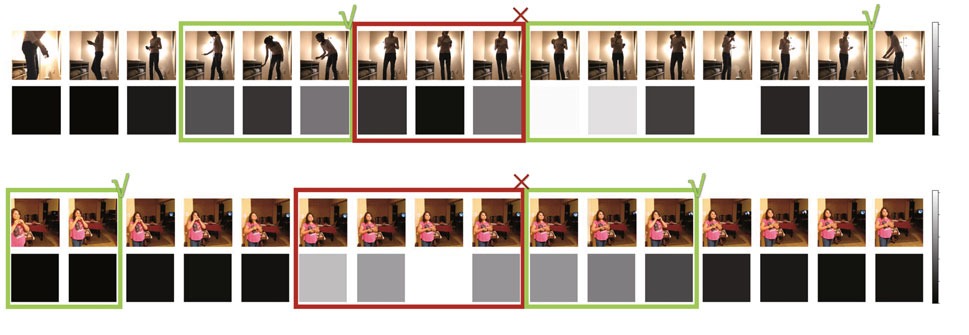
However, these attention-based models for video action recognition (Mondal et al., 2023; Wang H et al., 2024; Wu WH et al., 2024) primarily depend on video-level supervision, providing only coarse-grained supervision despite the inherent fine-grained temporal variations in action videos (e.g., eating speed differences or utensil usage patterns). This discrepancy causes temporal infidelity (Liang et al., 2020; Aghaeipoor et al., 2023)—a misalignment between attention distributions and action-relevant temporal segments. For instance, as shown in Fig. 1, for actions such as “eating a sandwich,” a model may mistakenly pay significant attention to adjacent segments that are irrelevant while overlooking key discriminative moments in unseen scenarios. This limitation arises from the training paradigm which depends solely on coarse video-level supervision, and fails to capture the fine-grained temporal dynamics intrinsic to action semantics.
To address this challenge, we propose a novel temporal fidelity enhancement (TFE) framework based on the disentangled information bottleneck (DisenIB) theory (Pan et al., 2021). TFE explicitly optimizes temporal attention fidelity by decoupling the latent video embedding into the action-relevant and semantically redundant components. Unlike conventional attention refinement methods, TFE resolves infidelity through adversarial disentanglement, which maximizes the sufficiency of critical temporal features while suppressing spurious correlations from noisy contexts. The framework first encodes video segments into temporally discriminative embeddings using pre-trained models, followed by an adversarial process to approximate the DisenIB objective. A disentangler separates embeddings into temporal fidelity-preserving and fidelity-deviating ones, while dual approximators compete to retain action-relevant semantics.
Loading authentic research manuscript (Pages 1–5)...
Shaowu XU, Xibin JIA, Qianmei SUN, Jing CHANG (2025). Temporal fidelity enhancement for video action recognition. Frontiers of Information Technology & Electronic Engineering. https://doi.org/10.1631/FITEE_2500164
Research & Educational Purpose Only:The translations, structured abstracts, analytical annotations, and data reports provided by SinoTechIntel are intended exclusively for academic research, internal corporate R&D, and educational benchmarking. They do not constitute formal engineering, chemical safety, legal, or professional advice.
Copyright & Intellectual Property Notice: Original copyright of the underlying source articles and experimental data remains with the respective authors, institutions, and original publishing journals. SinoTechIntel claims intellectual property only over its proprietary translations, analytical syntheses, and AEO structured enhancements in accordance with international fair use and academic citation principles.
Frequently Asked Questions
What is temporal infidelity in video action recognition?
Temporal infidelity refers to misalignment between attention distributions and action-relevant temporal segments, where models focus on irrelevant moments and overlook discriminative ones due to coarse supervision.
How does Temporal Fidelity Enhancement (TFE) work?
TFE uses disentangled information bottleneck theory to decouple video embeddings into action-relevant and redundant components through adversarial disentanglement, ensuring attention focuses on critical temporal segments.
Does TFE require fine-grained annotations?
No, TFE enhances temporal fidelity without explicit fine-grained supervision, making it cost-effective and applicable to large-scale video datasets.
What benchmarks were used to validate TFE?
Extensive experiments were conducted on UCF101, HMDB-51, and Charades benchmarks, demonstrating significant improvements in action recognition accuracy.
What is the main contribution of this research?
The main contribution is a novel framework that improves temporal attention fidelity by adversarial feature disentanglement, bridging the gap between action semantics and temporal dynamics.
Related Technical Papers & Translations

Design and optimization of a high-efficiency distillation process for cellulosic fuel ethanol integrated with thermal coupling and molecular sieve adsorption
To address the challenges of high energy consumption and prominent costs in the traditional three-columns distillation process for cellulosic fuel ethanol, a distillation—molecular sieve coupling separation process is proposed. This process integrates a three-column (crude distillation column, first distillation column, second distillation column) system with a 3A molecular sieve adsorption deep dehydration unit. A thermal coupling network is constructed via differential pressure design (steam from medium/high-pressure columns as mutual heat sources, reboiler liquid waste heat for feed preheating), and molecular sieve adsorption conditions are optimized. The study first performs a thermodynamic consistency test on the ethanol—water system, determines optimal non-random two-liquid (NRTL) model binary interaction parameters via experimental data regression for Aspen Plus simulation. Aiming at minimum total annual cost (TAC), Aspen Plus is used to optimize process parameters (theoretical tray number, feed location, reflux ratio, side-draw position, etc.). Economic analysis shows this process reduces CO2 emission costs by 27.56%, TAC by 15.58% (to 5.123 × 10⁶ USD·a-1), and increases ethanol purity to >99.6%, providing an effective solution for green, efficient separation.

A cohesion loss model for determining residual strength of deep bedded sandstone
Rock residual strength, as an important input parameter, plays an indispensable role in proposing the reasonable and scientific scheme about stope design, underground tunnel excavation and stability evaluation of deep chambers. Therefore, previous residual strength models of rocks established were reviewed. And corresponding related problems were stated. Subsequently, starting from the effects of bedding and whole life-cycle evolution process, series of triaxial mechanical tests of deep bedded s

Federated model with contrastive learning and adaptive control variates for human activity recognition
Recent attention to privacy issues demands a communication-safe method for training human activity recognition (HAR) models on client activity data. Federated learning (FL) has become a compelling technique to facilitate model training between the server and clients while preserving data privacy. However, classical FL methods often assume independent and identically distributed (IID) data among clients. This assumption does not hold true in practical scenarios. Human activity in real-world scena