Key Takeaways & Executive Findings
- •• A universal brine quenching strategy constructs a dual-layer surface structure (Y-doped layered inner layer + disordered rock-salt outer layer) on lithium-rich layered oxides. • Y-doping strengthens Y–O bonds, raises the oxygen evolution energy barrier, and stabilizes lattice oxygen. • The engineered surface reduces oxygen release, suppresses structural degradation, and enhances Li+ diffusion kinetics. • Y-quenched LLO delivers high capacity (283 mAh/g at 0.1C, 223 mAh/g at 1C), 91.2% capacity retention after 300 cycles, and reduced voltage decay (0.76 mV/cycle vs 1.16 mV/cycle).
Abstract
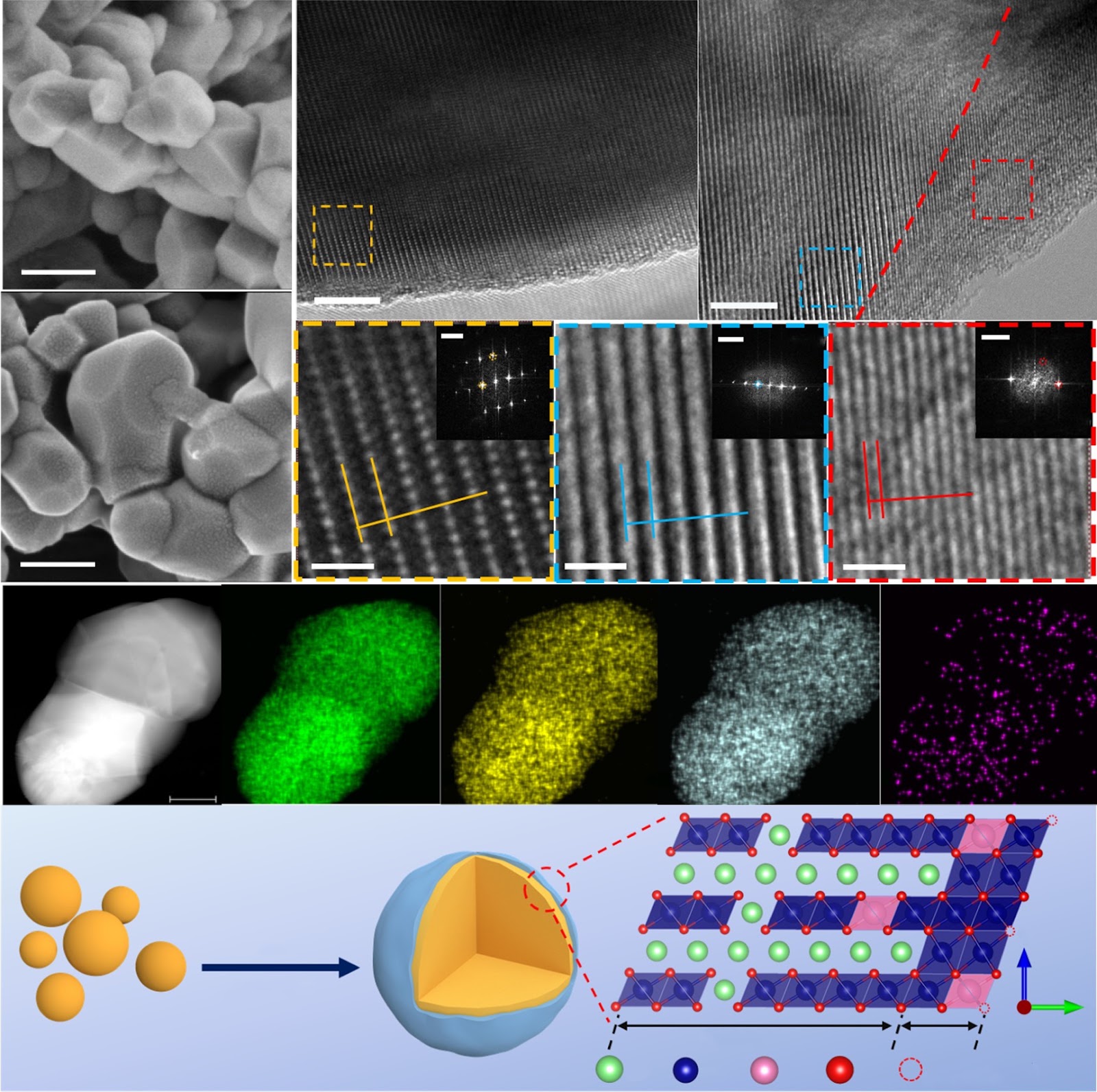
Lithium-rich layered oxides are prospective materials for future-generation cathodes attributable to their high specific capacity. However, significant surface instability, particularly under high-voltage operating conditions, leads to substantial voltage decay and dramatic capacity degradation during long-term cycling, severely limiting their widespread application. In this study, we developed a universal brine quenching strategy to construct a stabilized composite surface structure for lithium-rich layered oxides. This structure comprises an inner surface layer with a Y-doped layered structure and an outermost layer featuring a disordered rock-salt structure. Doping in the layered structure strengthens the Y–O bonds, raises the energy barrier for oxygen evolution, and significantly increases the stability of the lattice oxygen. Additionally, the disordered rock-salt surface structure reduces oxygen release during the charge and discharge cycles. Consequently, this well-designed surface structure significantly boosts the structural stability of the lithium-rich layered oxide surface, suppresses structural degradation during long-term cycling, and facilitates Li+ diffusion kinetics. The improved redox activity, combined with superior structural stability, contributes to an outstanding electrochemical performance. For instance, the Y-quenched Li1.2Mn0.54Ni0.13Co0.13O2 (LLO) cathode exhibited an improved discharge capacity of 283 mAh·g−1 at 0.1 C and 223 mAh·g−1 at 1 C, along with remarkable cyclic stability retaining 91.2% of its capacity after 300 cycles at 1 C, and a reduced voltage decay of 0.76 mV per cycle (compared to 1.16 mV per cycle for pristine LLO). This research provides valuable insights into the design and synthesis of high-energy-density lithium-rich layered oxides through a simple and cost-effective strategy.
1. Introduction
Lithium-ion batteries (LIBs) are primarily used in portable electronics, electric vehicles (EVs), and grid-scale energy storage systems owing to their high energy density, cost-effectiveness, and sustained cycling lifespan [1–3]. As the industry advances, there is an increasing demand for LIBs with significantly higher energy densities to optimize energy storage within constrained spaces, a goal that critically depends on cathode performance [4–6]. However, current commercial cathodes (e.g., LiCoO2, LiFePO4, and LiMn1/3Co1/3Ni1/3O2) face inherent limitations in energy density due to their heavy reliance on transition metal (TM) cationic redox chemistry, which does not meet the requirements for next-generation LIBs aiming for energy densities exceeding 350 Wh·kg−1 [7–8].
Lithium-rich layered oxides, represented as xLi2MnO3·(1−x)LiTMO2 (TM = Mn, Ni, and Co, etc.), have emerged as one of the most potential front-runners for high-capacity cathodes owing to their exceptional specific capacity (>250 mAh·g−1) and ultrahigh energy density (>1000 Wh·kg−1) [9–10]. The ultra-high specific capacity of lithium-rich layered oxides originates from TM cationic redox reactions and anionic oxygen redox activity under high-voltage conditions. The oxygen redox mechanism contributes additional capacity through reversible bulk redox processes (O2−/Ox−, x < 2) and irreversible oxygen evolution (O2−/O2) at the surface [11–12].
Unfortunately, the unique anionic oxygen redox also imposes significant challenges to the structural stability of lithium-rich layered oxides [13–14]. During high-voltage operation (i.e., >4.5 V vs. Li+/Li), irreversible oxygen evolution at the surface triggers the migration of TMs from octahedral sites in the TM layer to octahedral sites in the Li layer [15–17]. This migration progressively degrades the layered structure, resulting in irreversible phase transformations, such as transitions from layered structures to spinel or rock-salt phases [18–19]. O2 released from the surface, along with unstable TM ions, synergistically exacerbate the electrolyte decomposition. This promotes the parasitic side reactions and leads to the formation of an unstable cathode electrolyte interphase (CEI) film [20–22]. Consequently, the poor surface stability of lithium-rich layered oxides under high-voltage conditions triggers reduced initial Coulombic efficiency (ICE), significant capacity degradation, and rapid voltage decay [23–24]. To date, enhancing surface stability and suppressing irreversible oxygen release at the cathode surface remain the primary challenges for the sustainable development of lithium-rich layered oxides [25–26].
Loading authentic research manuscript (Pages 1–5)...
Hailiang Chu, Jiaxiao Meng, Longde Duan, Shujun Qiu, Errui Wang, Fen Xu, and Lixian Sun (2025). Surface reconstruction via rapid solution quenching to enhance structural stability of lithium-rich layered cathodes. Journal of Mineral Metallurgy and Materials Science. https://doi.org/10.1007/s12613-025-3303-7
Research & Educational Purpose Only:The translations, structured abstracts, analytical annotations, and data reports provided by SinoTechIntel are intended exclusively for academic research, internal corporate R&D, and educational benchmarking. They do not constitute formal engineering, chemical safety, legal, or professional advice.
Copyright & Intellectual Property Notice: Original copyright of the underlying source articles and experimental data remains with the respective authors, institutions, and original publishing journals. SinoTechIntel claims intellectual property only over its proprietary translations, analytical syntheses, and AEO structured enhancements in accordance with international fair use and academic citation principles.
Frequently Asked Questions
What is the main challenge for lithium-rich layered oxide cathodes?
Significant surface instability under high-voltage conditions leads to voltage decay and dramatic capacity degradation during long-term cycling, limiting their widespread application.
What method do the authors propose to stabilize the surface?
They developed a universal brine quenching strategy to construct a composite surface structure featuring an inner Y-doped layered layer and an outermost disordered rock-salt layer.
What electrochemical performance does the Y-quenched LLO cathode achieve?
It delivers a discharge capacity of 283 mAh·g−1 at 0.1 C and 223 mAh·g−1 at 1 C, with 91.2% capacity retention after 300 cycles at 1 C and a voltage decay of 0.76 mV per cycle (vs 1.16 mV for pristine LLO).
How does Y-doping improve structural stability?
Y-doping strengthens Y–O bonds, raises the energy barrier for oxygen evolution, and significantly increases the stability of lattice oxygen.
What is the significance of the disordered rock-salt surface structure?
The disordered rock-salt structure reduces oxygen release during charge and discharge cycles, suppressing structural degradation and improving long-term cycling stability.
Related Technical Papers & Translations

Design and optimization of a high-efficiency distillation process for cellulosic fuel ethanol integrated with thermal coupling and molecular sieve adsorption
To address the challenges of high energy consumption and prominent costs in the traditional three-columns distillation process for cellulosic fuel ethanol, a distillation—molecular sieve coupling separation process is proposed. This process integrates a three-column (crude distillation column, first distillation column, second distillation column) system with a 3A molecular sieve adsorption deep dehydration unit. A thermal coupling network is constructed via differential pressure design (steam from medium/high-pressure columns as mutual heat sources, reboiler liquid waste heat for feed preheating), and molecular sieve adsorption conditions are optimized. The study first performs a thermodynamic consistency test on the ethanol—water system, determines optimal non-random two-liquid (NRTL) model binary interaction parameters via experimental data regression for Aspen Plus simulation. Aiming at minimum total annual cost (TAC), Aspen Plus is used to optimize process parameters (theoretical tray number, feed location, reflux ratio, side-draw position, etc.). Economic analysis shows this process reduces CO2 emission costs by 27.56%, TAC by 15.58% (to 5.123 × 10⁶ USD·a-1), and increases ethanol purity to >99.6%, providing an effective solution for green, efficient separation.

A cohesion loss model for determining residual strength of deep bedded sandstone
Rock residual strength, as an important input parameter, plays an indispensable role in proposing the reasonable and scientific scheme about stope design, underground tunnel excavation and stability evaluation of deep chambers. Therefore, previous residual strength models of rocks established were reviewed. And corresponding related problems were stated. Subsequently, starting from the effects of bedding and whole life-cycle evolution process, series of triaxial mechanical tests of deep bedded s

Federated model with contrastive learning and adaptive control variates for human activity recognition
Recent attention to privacy issues demands a communication-safe method for training human activity recognition (HAR) models on client activity data. Federated learning (FL) has become a compelling technique to facilitate model training between the server and clients while preserving data privacy. However, classical FL methods often assume independent and identically distributed (IID) data among clients. This assumption does not hold true in practical scenarios. Human activity in real-world scena