Key Takeaways & Executive Findings
- •• The one-step rapid activation method under flue gas atmosphere for powdered activated coke preparation is divided into three distinct reaction stages based on reaction time. • Stage I (0–0.5 s) involves rapid volatile release and O2 consumption; Stage II (0.5–2.0/3.0 s) couples carbonization and activation; Stage III (2.0/3.0–4.0 s) focuses on CO2 and H2O(g) activation. • The first two stages create diffusion channels and activation sites essential for the final activation stage, enhancing SO2 adsorption capability. • Understanding the reaction mechanism provides critical guidance for reactor design, sizing, and optimal activator nozzle placement in industrial PAC production.
Abstract
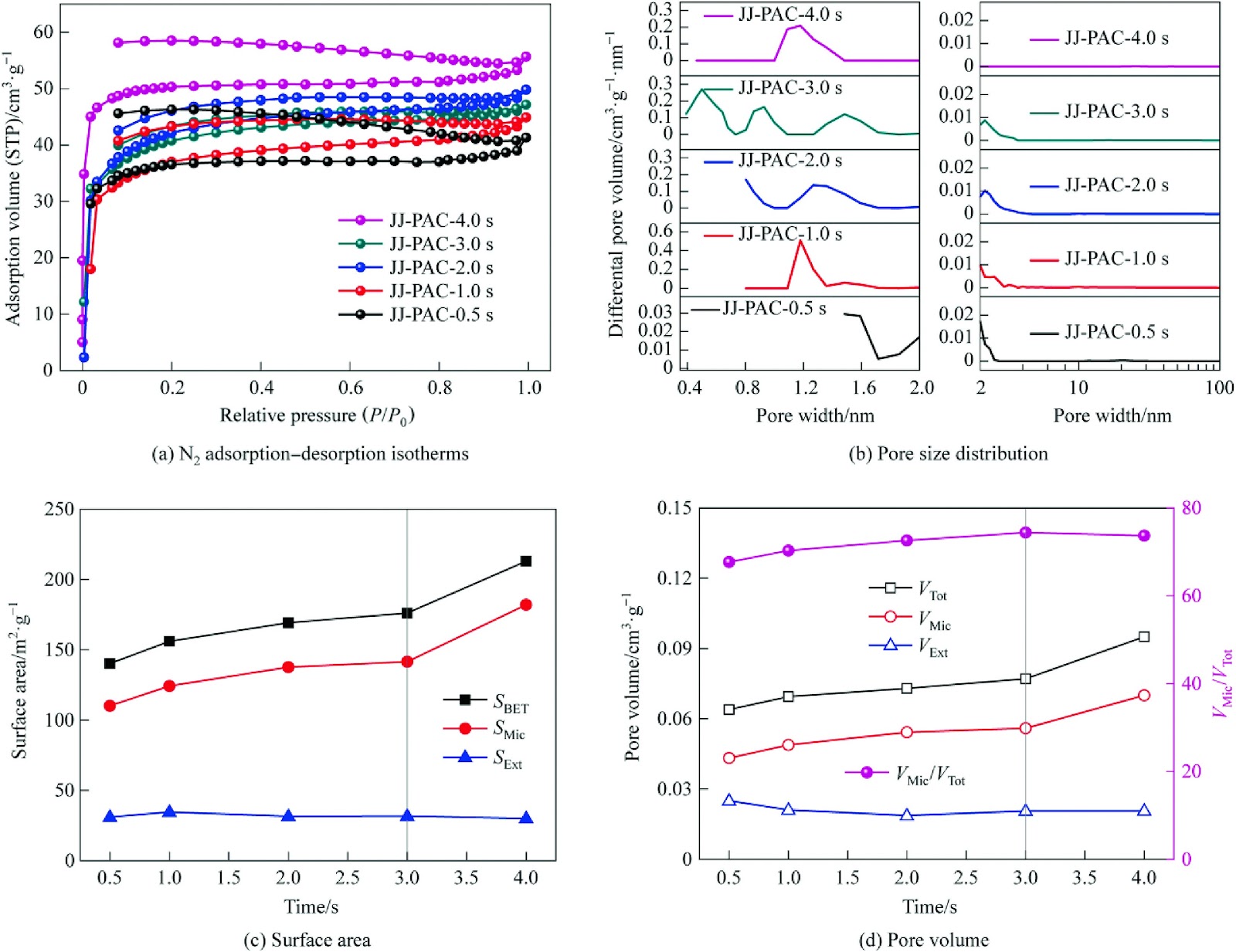
In this study, the impact of different reaction times on the preparation of powdered activated carbon (PAC) using a one-step rapid activation method under flue gas atmosphere is investigated, and the underlying reaction mechanism is summarized. Results indicate that the reaction process of this method can be divided into three stages: stage I is the rapid release of volatiles and the rapid consumption of O2, primarily occurring within a reaction time range of 0–0.5 s; stage II is mainly the continuous release and diffusion of volatiles, which is the carbonization and activation coupling reaction stage, and the carbonization process is the main in this stage. This stage mainly occurs at the reaction time range of 0.5–2.0 s when SL-coal is used as material, and that is 0.5–3.0 s when JJ-coal is used as material; stage III is mainly the activation stage, during which activated components diffuse to both the surface and interior of particles. This stage mainly involves the reaction stage of CO2 and H2O (g) activation, and it mainly occurs at the reaction time range of 2.0–4.0 s when SL-coal is used as material, and that is 3.0–4.0 s when JJ-coal is used as material. Besides, the main function of the first two stages is to provide more diffusion channels and contact surfaces/activation sites for the diffusion and activation of the activated components in the third stage. Mastering the reaction mechanism would serve as a crucial reference and foundation for designing the structure, size of the reactor, and optimal positioning of the activator nozzle in PAC preparation.
1. Introduction
The combustion of S-containing fuel results in the emission of SO2, which poses a serious threat to both the environment and health [1–3]. At present, the wet flue gas desulfurization (WFGD) is the most popular method for SO2 removal, while this technology is facing challenges due to many problems in its running process, such as high consumption of Ca-based absorbents and water, high operating costs, resulting CO2 leakage and secondary pollution [4–6]. Alternatively, the use of carbon-based adsorbents [7–13] for SO2 adsorption technology has been considered a promising updating technology due to its advantages in sulfur recovery, water conservation and multi-pollutant removal. The aforementioned technology has been employed in Europe and Japan for the purpose of flue gas purification, specifically targeting emissions resulting from the combustion of coal and waste [14].
For the AC-FGD technology, the primary obstacle to its industrial implementation is the exorbitant cost of preparation for the AC adsorbent. In general, there are two methods for the preparation of AC, namely physical and chemical methods. The utilization of the latter is restricted owing to the application of chemical reagents [15,16], while the former is extensively utilized due to its relative environmental friendliness and ease of industrial application [17,18]. Physical activation method generally consists of two steps: carbonization process and activation process. Generally, the carbonization process followed by activation process, and there is an AC forming process between the two processes [19]. At present, the prevailing method for SO2 adsorption involves the use of columnar AC (CAC) with a size of 6 mm × 9 mm, which is typically prepared in this manner. Specifically, the materials are initially carbonized in an inert atmosphere at a temperature below 800 °C, followed by cooling, screening and forming. Finally, they are activated in an activating atmosphere at a temperature of approximately 700–1000 °C. This method is a complex process and its operation cost is high, which leads to the high price of CAC; besides, the activation process is after molding, which is bound to lead to internal and external activation is not uniform, and when the CAC are used for adsorption, the utilization rate of its inner surface is also low. In addition, the CAC products necessitate high levels of hardness to prevent wear and tear.
The activators commonly used in the physical activation method are CO2, H2O (g), O2 or their mixtures, and different activation components have different activation effects. Among them, CO2 can promote the formation of micropores [20,21]; H2O (g) can promote the expansion of micropores, thus increasing the proportion of mesoporous [20,22]; and the mixture of the two has a mutual...
Loading authentic research manuscript (Pages 1–5)...
Binxuan Zhou, Jingcai Chang, Jun Li, Jinglan Hong, Tao Wang, Liqiang Zhang, Ping Zhou, Chunyuan Ma (2023). Study of the reaction mechanism for preparing powdered activated coke with SO2 adsorption capability via one-step rapid activation method under flue gas atmosphere. Chinese Journal of Chemical Engineering. https://doi.org/10.1016/j_cjche_144875979
Research & Educational Purpose Only:The translations, structured abstracts, analytical annotations, and data reports provided by SinoTechIntel are intended exclusively for academic research, internal corporate R&D, and educational benchmarking. They do not constitute formal engineering, chemical safety, legal, or professional advice.
Copyright & Intellectual Property Notice: Original copyright of the underlying source articles and experimental data remains with the respective authors, institutions, and original publishing journals. SinoTechIntel claims intellectual property only over its proprietary translations, analytical syntheses, and AEO structured enhancements in accordance with international fair use and academic citation principles.
Frequently Asked Questions
What is the one-step rapid activation method for preparing powdered activated coke?
The one-step rapid activation method is a novel technique that combines carbonization and activation in a single step under a flue gas atmosphere, significantly reducing preparation time and cost compared to traditional two-step physical activation methods.
How does the reaction time affect the preparation of powdered activated coke?
The reaction process is divided into three stages based on reaction time: Stage I (0–0.5 s) involves rapid volatile release and O2 consumption; Stage II (0.5–2.0/3.0 s) couples carbonization and activation; Stage III (2.0/3.0–4.0 s) focuses on CO2 and H2O(g) activation. Optimal SO2 adsorption is achieved by controlling the duration of each stage.
What is the significance of the reaction mechanism for industrial applications?
Understanding the reaction mechanism provides crucial guidance for designing the reactor structure, sizing, and optimal positioning of activator nozzles, thereby improving the efficiency and cost-effectiveness of powdered activated coke production for SO2 adsorption.
What are the advantages of using flue gas atmosphere in the activation process?
Using flue gas atmosphere (containing CO2, H2O, O2) as the activating agent eliminates the need for separate inert gas and activating gas supplies, simplifying the process and reducing operational costs while achieving effective activation.
How does the one-step rapid activation method compare to traditional methods?
Compared to traditional two-step physical activation (carbonization followed by activation), the one-step rapid activation method is faster, more energy-efficient, and produces powdered activated coke with uniform activation and enhanced SO2 adsorption capacity, while avoiding the need for forming and high hardness requirements.
Related Technical Papers & Translations

Design and optimization of a high-efficiency distillation process for cellulosic fuel ethanol integrated with thermal coupling and molecular sieve adsorption
To address the challenges of high energy consumption and prominent costs in the traditional three-columns distillation process for cellulosic fuel ethanol, a distillation—molecular sieve coupling separation process is proposed. This process integrates a three-column (crude distillation column, first distillation column, second distillation column) system with a 3A molecular sieve adsorption deep dehydration unit. A thermal coupling network is constructed via differential pressure design (steam from medium/high-pressure columns as mutual heat sources, reboiler liquid waste heat for feed preheating), and molecular sieve adsorption conditions are optimized. The study first performs a thermodynamic consistency test on the ethanol—water system, determines optimal non-random two-liquid (NRTL) model binary interaction parameters via experimental data regression for Aspen Plus simulation. Aiming at minimum total annual cost (TAC), Aspen Plus is used to optimize process parameters (theoretical tray number, feed location, reflux ratio, side-draw position, etc.). Economic analysis shows this process reduces CO2 emission costs by 27.56%, TAC by 15.58% (to 5.123 × 10⁶ USD·a-1), and increases ethanol purity to >99.6%, providing an effective solution for green, efficient separation.

A cohesion loss model for determining residual strength of deep bedded sandstone
Rock residual strength, as an important input parameter, plays an indispensable role in proposing the reasonable and scientific scheme about stope design, underground tunnel excavation and stability evaluation of deep chambers. Therefore, previous residual strength models of rocks established were reviewed. And corresponding related problems were stated. Subsequently, starting from the effects of bedding and whole life-cycle evolution process, series of triaxial mechanical tests of deep bedded s

Federated model with contrastive learning and adaptive control variates for human activity recognition
Recent attention to privacy issues demands a communication-safe method for training human activity recognition (HAR) models on client activity data. Federated learning (FL) has become a compelling technique to facilitate model training between the server and clients while preserving data privacy. However, classical FL methods often assume independent and identically distributed (IID) data among clients. This assumption does not hold true in practical scenarios. Human activity in real-world scena