Key Takeaways & Executive Findings
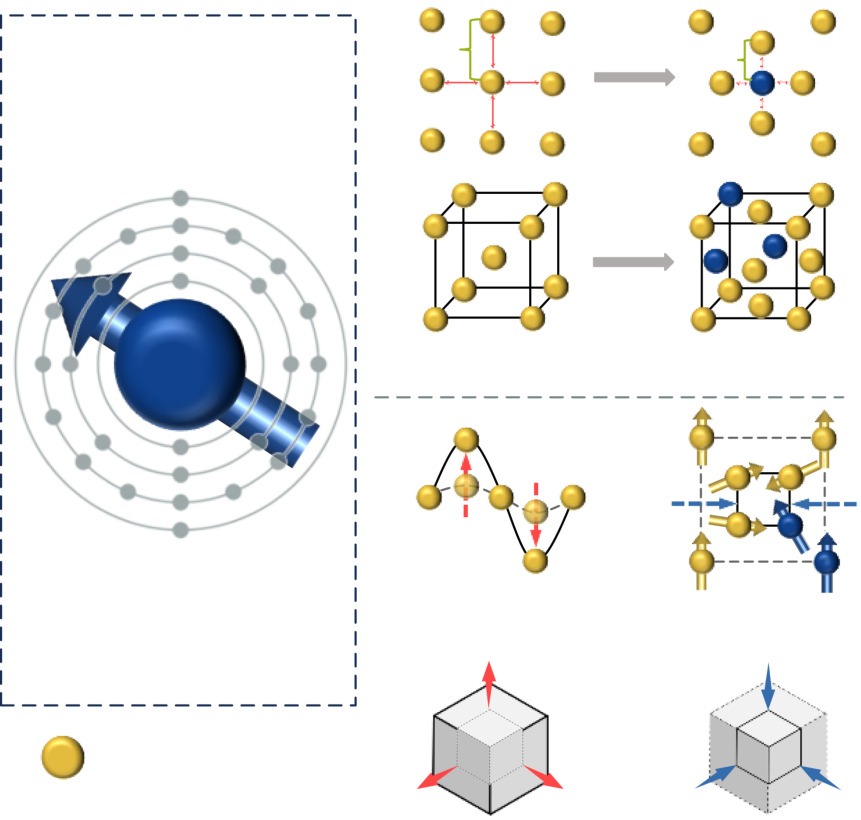
- •• A new multi-principal-element alloy achieves an ultralow coefficient of thermal expansion (αl = 1.00 × 10⁻⁶ K−1) over 100–400 K alongside exceptional tensile strength (560 MPa) and ductility (53% elongation). • The alloy uniquely combines transformation-induced plasticity (TRIP) and the Invar effect at room temperature, defining a new class of TRIP-Invar alloys. • In situ magnetic analysis shows that ferromagnetic order and spin-state transitions compensate lattice contraction, producing zero thermal expansion behavior. • Deformation-triggered martensitic transformation enhances strain hardening via dislocation multiplication and grain boundary reinforcement, resolving the strength–ductility trade-off.
Abstract
Multi-principal-element alloys (MPEAs) have emerged as a transformative class of metallic materials, surpassing conventional alloys due to their “four core effects”. The inherent compositional complexity and programmable multifunctionality of MPEAs collectively drive their emergence as a vanguard in materials innovation. By synergistically modulating metastable engineering and magneto-volume effects, we developed a MPEA (Fe,Co,Cr)100−xNix with an ultralow coefficient of thermal expansion (αl = 1.00 × 10⁻⁶ K−1, 100–400 K) and exceptional mechanical properties (tensile strength: 560 MPa, the elongation to failure: 53%). This alloy exhibits both significant transformations induced plasticity (TRIP) and zero thermal expansion effects (Invar) at room temperature, classified as a recently proposed TRIP-Invar alloy. In situ magnetic analysis reveals that ferromagnetic order mediates pronounced magnetic compensation of intrinsic lattice contraction during cooling through spin-state transitions, thereby generating zero thermal expansion behavior. In situ neutron diffraction reveals that the good strength–plasticity trade-off arises from a deformation-triggered martensitic transformation, which enhances strain hardening through dislocation multiplication and grain boundary reinforcement. This work proposes a materials design strategy for next-generation structural-functional integrated materials, advancing the fundamental understanding of thermal expansion-mechanical property optimization in MPEAs.
1. Introduction
Multi-principal-element alloys (MPEAs), characterized by their entropy-dominated phase stability, exhibit the ability to form complex solid solutions comprising multiple principal elements, thereby enabling access to a vast compositional space near the center of the phase diagram. This distinctive compositional design flexibility facilitates the synergistic optimization of material properties that are traditionally considered mutually exclusive. Initial investigations predominantly concentrated on the mechanical properties of MPEAs, including strength, toughness, fatigue resistance, and ductility. Recently, research endeavors have extended to the exploration of functional MPEAs, spanning diverse domains such as electronics, electrochemistry, magnetism, and catalysis. The optimal design paradigm for MPEAs aims to preserve their superior mechanical performance while achieving effective integration of functional attributes.
Zero thermal expansion (ZTE) alloys are of critical importance in precision instruments, aerospace engineering, and liquefied natural gas storage. Since the pioneering discovery of Fe65Ni35 (Invar alloy) by Nobel laureate Guillaume in the 1920s, this system has served as the benchmark for ZTE materials. However, ZTE alloys designed for practical applications must simultaneously fulfill stringent requirements, including exceptional functional properties as well as robust mechanical performance and processability. Regrettably, conventional ZTE alloys often exhibit an inherent trade-off between mechanical properties and thermal expansion behaviors. Invar-based alloys, due to their high sensitivity to compositional and microstructural variations, are inherently limited in their response to conventional strengthening approaches. Moreover, composite materials and dual-phase alloys frequently suffer from inadequate tensile plasticity, which significantly restricts their processability and broad applicability.
This study proposes an innovative MPEA design strategy that overcomes the inherent trade-off between ZTE behavior and mechanical performance. Departing from conventional microalloying approaches typically employed in Invar alloys, our strategy utilizes a foundational system comprising fourth-period transition elements (Cr, Fe, Co, Ni), which are characterized by their unfilled d-electron orbitals and rich magnetic properties. Systematic investigations reveal that maintaining Cr, Fe, and Co at specific atomic ratios (Cr : Fe : Co = 10:39:48) while modulating the Ni content enables the concurrent regulation of thermal expansion and mechanical properties.
Loading authentic research manuscript (Pages 1–5)...
Wanda Yang, Haowei Zhou, Jing Chen, Chengyi Yu, Yili Cao, Ke An, Yan Chen, Dunji Yu, Kun Lin, Xianran Xing (2025). Strength, ductility and zero thermal expansion in multicomponent TRIP-Invar alloys. Journal of Mineral Metallurgy and Materials Science. https://doi.org/10.1007/s12613-025-3332-2
Research & Educational Purpose Only:The translations, structured abstracts, analytical annotations, and data reports provided by SinoTechIntel are intended exclusively for academic research, internal corporate R&D, and educational benchmarking. They do not constitute formal engineering, chemical safety, legal, or professional advice.
Copyright & Intellectual Property Notice: Original copyright of the underlying source articles and experimental data remains with the respective authors, institutions, and original publishing journals. SinoTechIntel claims intellectual property only over its proprietary translations, analytical syntheses, and AEO structured enhancements in accordance with international fair use and academic citation principles.
Frequently Asked Questions
What is a TRIP-Invar alloy?
A TRIP-Invar alloy is a multicomponent alloy that simultaneously exhibits transformation-induced plasticity (TRIP) and the Invar (zero thermal expansion) effect at room temperature. It combines high strength and ductility with an ultralow coefficient of thermal expansion, overcoming the traditional trade-off between mechanical and thermal properties.
What are the key mechanical and thermal properties of the developed alloy?
The developed (Fe,Co,Cr)100−xNix alloy achieves a coefficient of thermal expansion of 1.00 × 10⁻⁶ K−1 over 100–400 K, a tensile strength of 560 MPa, and an elongation to failure of 53% at room temperature.
How does the alloy achieve zero thermal expansion?
Zero thermal expansion arises from ferromagnetic order and spin-state transitions that mediate magnetic compensation of intrinsic lattice contraction during cooling. In situ magnetic analysis revealed that this mechanism effectively counteracts normal thermal contraction, producing the Invar effect.
What role does nickel play in the alloy design?
Nickel serves dual functions: it modulates ferromagnetic ordering and intrinsic magnetostriction to control anomalous thermal expansion, and it acts as a strong austenite stabilizer. By increasing the valence electron concentration and promoting densely packed crystal structures, Ni enhances phase stability and improves mechanical properties.
What are potential applications of this TRIP-Invar alloy?
This material is promising for precision instruments, aerospace engineering, and liquefied natural gas storage, where dimensional stability under temperature changes and robust mechanical performance are essential. It also represents a design paradigm for next-generation structural-functional integrated materials.
Related Technical Papers & Translations

Design and optimization of a high-efficiency distillation process for cellulosic fuel ethanol integrated with thermal coupling and molecular sieve adsorption
To address the challenges of high energy consumption and prominent costs in the traditional three-columns distillation process for cellulosic fuel ethanol, a distillation—molecular sieve coupling separation process is proposed. This process integrates a three-column (crude distillation column, first distillation column, second distillation column) system with a 3A molecular sieve adsorption deep dehydration unit. A thermal coupling network is constructed via differential pressure design (steam from medium/high-pressure columns as mutual heat sources, reboiler liquid waste heat for feed preheating), and molecular sieve adsorption conditions are optimized. The study first performs a thermodynamic consistency test on the ethanol—water system, determines optimal non-random two-liquid (NRTL) model binary interaction parameters via experimental data regression for Aspen Plus simulation. Aiming at minimum total annual cost (TAC), Aspen Plus is used to optimize process parameters (theoretical tray number, feed location, reflux ratio, side-draw position, etc.). Economic analysis shows this process reduces CO2 emission costs by 27.56%, TAC by 15.58% (to 5.123 × 10⁶ USD·a-1), and increases ethanol purity to >99.6%, providing an effective solution for green, efficient separation.

A cohesion loss model for determining residual strength of deep bedded sandstone
Rock residual strength, as an important input parameter, plays an indispensable role in proposing the reasonable and scientific scheme about stope design, underground tunnel excavation and stability evaluation of deep chambers. Therefore, previous residual strength models of rocks established were reviewed. And corresponding related problems were stated. Subsequently, starting from the effects of bedding and whole life-cycle evolution process, series of triaxial mechanical tests of deep bedded s

Federated model with contrastive learning and adaptive control variates for human activity recognition
Recent attention to privacy issues demands a communication-safe method for training human activity recognition (HAR) models on client activity data. Federated learning (FL) has become a compelling technique to facilitate model training between the server and clients while preserving data privacy. However, classical FL methods often assume independent and identically distributed (IID) data among clients. This assumption does not hold true in practical scenarios. Human activity in real-world scena