Key Takeaways & Executive Findings
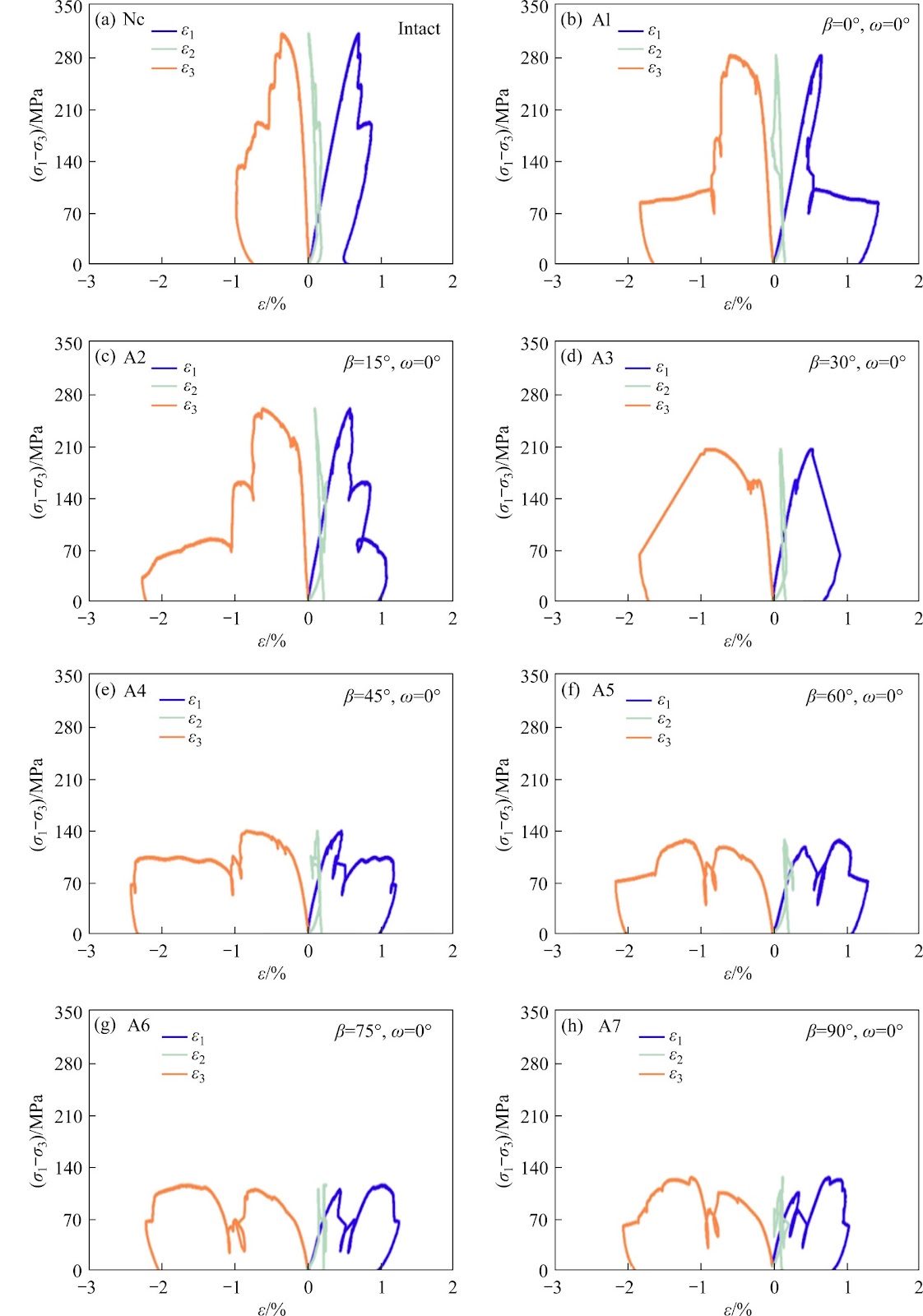
- •• Peak strength of hard rock with a structural plane decreases with loading angle β up to 45°, then stabilizes; intermediate principal stress angle ω has a strengthening effect. • Deformation is predominantly post-peak, with strains ε1 and ε3 2–3 times higher than intact rock, highlighting brittle-ductile transition under true triaxial stress. • Failure mode is strongly controlled by the structural plane when ω=0°, while at ω=90° failure localizes near the σ3 surface, indicating distinct anisotropic failure mechanisms. • Provides critical experimental data for deep rock engineering, aiding design of excavation and support systems in structurally controlled high-stress environments.
Abstract
The spatial relationship between structural planes and principal stresses significantly affects the mechanical properties of deep hard rock. This paper examines the effect of the loading angle under true triaxial compression. While previous studies focused on the angle β between the maximum principal stress and the structural plane, the role of angle ω, between the intermediate principal stress and the structural plane, is often overlooked. Utilizing artificially prefabricated granite specimens with a single non-penetrating structural plane, we set the loading angle β to range from 0° to 90° across seven groups, and assigned ω values of 0° and 90° in two separate groups. The results show that the peak strength is negatively correlated with β up to 45°, beyond which it tends to stabilize. The angle ω exerts a strengthening effect on the peak strength. Deformation mainly occurs post-peak, with the strain values ε1 and ε3 reaching levels 2−3 times higher than those in intact rock. The structural plane significantly influences failure mode when ω=0°, while failure localizes near the σ3 surface of the specimens when ω=90°. The findings enhance data on structural plane rocks under triaxial compression and inform theoretical research, excavation, and support design of rock structures.
1. Introduction
The structural plane, a critical component of rock masses, plays an essential role in determining strength and failure responses [1 −6]. During engineering construction, a variety of structural failures can manifest, such as unloading cracks along structural planes, block collapse, landslides influenced by structural or stress-structure interaction, and rock bursts dictated by structural constraints [7−11]. These issues are more acute in deep environments subjected to high stress, where the impact of structural planes on rock failure is more pronounced compared to shallow-buried engineering projects [12 −14]. Consequently, comprehending the fundamental mechanical behaviors of rock masses that include structural planes is essential, especially in high-stress conditions [15, 16]. This understanding is key to managing and mitigating the risks associated with complex geological conditions in deep engineering projects.
In three-dimensional stress environments, understanding the spatial relationship between structural planes and the principal stresses is crucial for determining the failure characteristics of rock mass. These relationships are defined by the loading angle β, which is the angle between the maximum principal stress and the structural plane, and the loading angle ω, the angle between the minimum principal stress and the structural plane [17, 18], as illustrated in Figure 1(a). After tunnel excavation, this relationship becomes more complex due to the interplay between structural planes, redistributed stress, and the tunnel’s empty face [19 −22]. In certain spatial configurations, these factors can lead to various types of structural rock mass disasters [23−26]. Early scholars who conducted research on this topic include JAEGER [27, 28], DONATH [29, 30], CHENEVERT and GATLIN [31], MCLAMORE and GRAY [32], and POMEROY et al [33]. Under uniaxial and conventional triaxial compression conditions, the strength of layered rocks exhibits “U-shaped”, “wavy”, and “shoulder-shaped” patterns [34] as the loading angle β changes. Moreover, the maximum strength typically occurs when β is either 0° or 90°, with β=90° being the most frequent. The minimum strength, on the other hand, often occurs between β =20° and 45° , most often occurring near β=30°. Additionally, the variation in rock specimen strength with β is influenced by confining pressure, where an increase in confining pressure typically leads to a decrease in strength anisotropy [35]. However, since the stress state achieved under conventional loading conditions is relatively simple, it cannot fully reflect the high true triaxial stress state encountered in deep engineering projects, nor can it adequately investigate the effect of loading angle ω. Therefore, its applicability to field problems is limited [17, 36, 37].
Loading authentic research manuscript (Pages 1–5)...
XU Huai-sheng, LI Shao-jun, XU Ding-ping, LIU Xu-feng, FENG Guang-liang, WANG Zhao-feng (2025). Strength and failure characteristics of hard rock containing a single structural plane under varied loading angles: A true triaxial investigation. Journal of Central South University. https://doi.org/10.1007/s11771-025-5965-8
Research & Educational Purpose Only:The translations, structured abstracts, analytical annotations, and data reports provided by SinoTechIntel are intended exclusively for academic research, internal corporate R&D, and educational benchmarking. They do not constitute formal engineering, chemical safety, legal, or professional advice.
Copyright & Intellectual Property Notice: Original copyright of the underlying source articles and experimental data remains with the respective authors, institutions, and original publishing journals. SinoTechIntel claims intellectual property only over its proprietary translations, analytical syntheses, and AEO structured enhancements in accordance with international fair use and academic citation principles.
Frequently Asked Questions
What is the significance of loading angles β and ω in true triaxial compression?
β is the angle between the maximum principal stress and the structural plane, while ω is the angle between the intermediate principal stress and the structural plane. Both control the spatial relationship between stress and structure, which critically influences the strength and failure mode of rock masses. Previous studies largely ignored ω; this research explicitly investigates its effect.
How does the peak strength of hard rock with a structural plane change with loading angle β?
The peak strength is negatively correlated with β up to 45°, meaning strength decreases as β increases from 0° to 45°. Beyond 45°, the strength tends to stabilize. This behavior is typical of layered or jointed rocks under compression.
What role does the intermediate principal stress angle ω play in rock failure?
The angle ω exerts a strengthening effect on the peak strength. The study found that at ω=0°, the structural plane significantly influences the failure mode, whereas at ω=90°, failure localizes near the σ3 surface. This highlights that ω must be considered to fully understand true triaxial behavior.
What are the practical implications of this study for deep rock engineering?
The findings provide quantitative data on the strength and deformability of hard rock containing structural planes under realistic true triaxial stress states. This informs the design of excavations, support systems, and stability analyses in deep mining, tunnelling, and geotechnical projects where structural-controlled failures are a risk.
How was the experimental study designed?
Artificially prefabricated granite specimens with a single non-penetrating structural plane were tested under true triaxial compression. The loading angle β was varied from 0° to 90° in seven groups, and ω was set to either 0° or 90° in two separate groups, allowing independent assessment of both angles.
Related Technical Papers & Translations

Design and optimization of a high-efficiency distillation process for cellulosic fuel ethanol integrated with thermal coupling and molecular sieve adsorption
To address the challenges of high energy consumption and prominent costs in the traditional three-columns distillation process for cellulosic fuel ethanol, a distillation—molecular sieve coupling separation process is proposed. This process integrates a three-column (crude distillation column, first distillation column, second distillation column) system with a 3A molecular sieve adsorption deep dehydration unit. A thermal coupling network is constructed via differential pressure design (steam from medium/high-pressure columns as mutual heat sources, reboiler liquid waste heat for feed preheating), and molecular sieve adsorption conditions are optimized. The study first performs a thermodynamic consistency test on the ethanol—water system, determines optimal non-random two-liquid (NRTL) model binary interaction parameters via experimental data regression for Aspen Plus simulation. Aiming at minimum total annual cost (TAC), Aspen Plus is used to optimize process parameters (theoretical tray number, feed location, reflux ratio, side-draw position, etc.). Economic analysis shows this process reduces CO2 emission costs by 27.56%, TAC by 15.58% (to 5.123 × 10⁶ USD·a-1), and increases ethanol purity to >99.6%, providing an effective solution for green, efficient separation.

A cohesion loss model for determining residual strength of deep bedded sandstone
Rock residual strength, as an important input parameter, plays an indispensable role in proposing the reasonable and scientific scheme about stope design, underground tunnel excavation and stability evaluation of deep chambers. Therefore, previous residual strength models of rocks established were reviewed. And corresponding related problems were stated. Subsequently, starting from the effects of bedding and whole life-cycle evolution process, series of triaxial mechanical tests of deep bedded s

Federated model with contrastive learning and adaptive control variates for human activity recognition
Recent attention to privacy issues demands a communication-safe method for training human activity recognition (HAR) models on client activity data. Federated learning (FL) has become a compelling technique to facilitate model training between the server and clients while preserving data privacy. However, classical FL methods often assume independent and identically distributed (IID) data among clients. This assumption does not hold true in practical scenarios. Human activity in real-world scena