Key Takeaways & Executive Findings
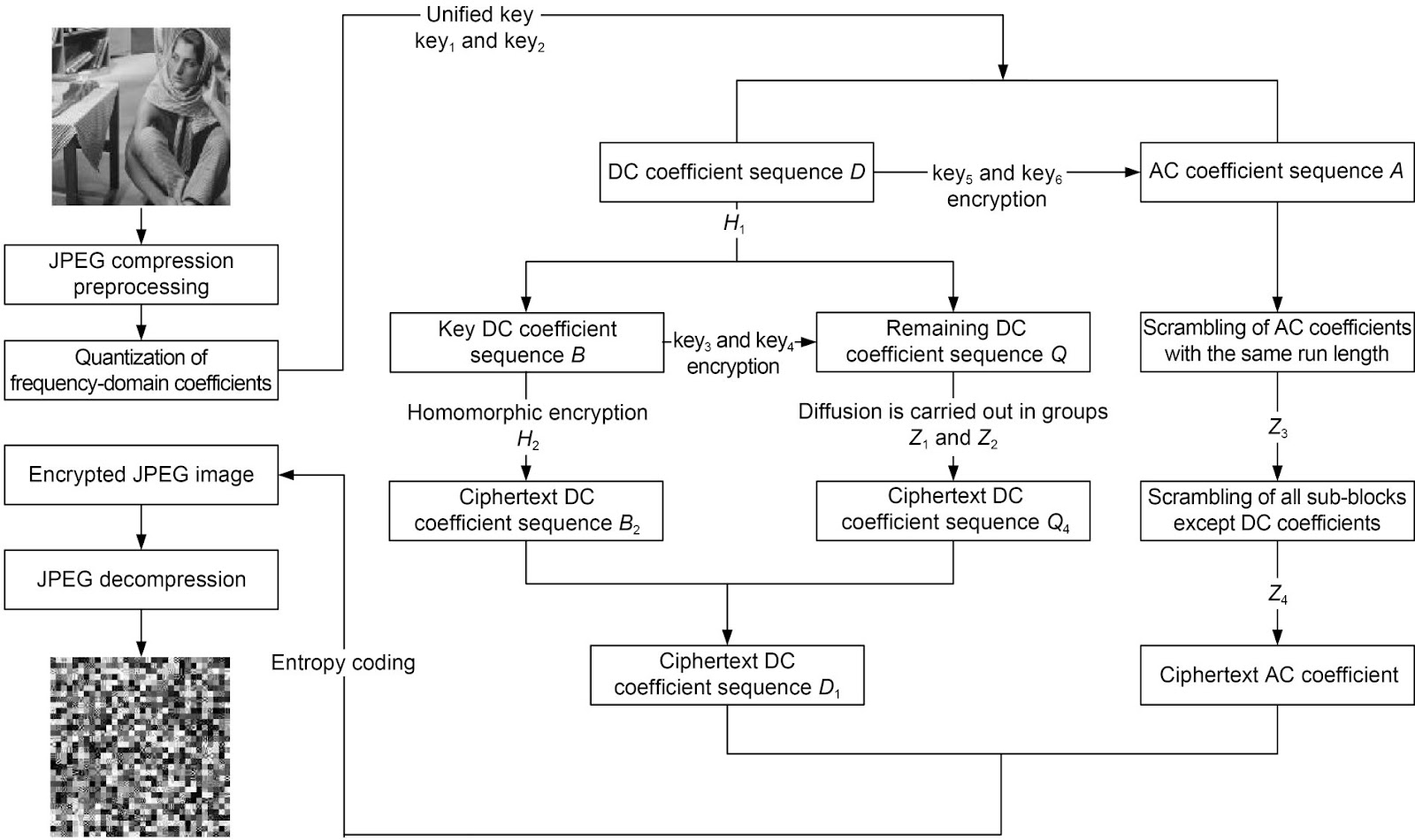
- •• Proposes SPJEU, a self-sufficient plaintext-related JPEG image encryption scheme that eliminates the need to transmit plaintext-related extra data. • Uses a unified key to select DC coefficients for homomorphic encryption and group diffusion, with AC coefficients permuted based on run length. • Resists chosen plaintext attacks while simplifying key management and preserving JPEG format compatibility. • Achieves minimal file size increment after encryption, balancing security and compression efficiency.
Abstract
In recent research on image encryption, many schemes associate the key generation mechanism with the plaintext to resist chosen plaintext attacks. However, when the sender encrypts many images, a large amount of additional data related to the plaintext need to be transmitted, which leads to problems such as high transmission costs, high requirements for key storage space, and complex key management. Therefore, in this paper, we propose a self-sufficient plaintext-related JPEG image encryption scheme based on a unified key (SPJEU). This scheme establishes the connection between the plaintext and the key by selecting the direct current (DC) coefficients in the JPEG image through a unified key. Homomorphic encryption is applied to the selected DC coefficients, allowing plaintext information to be decrypted directly from the ciphertext domain using a specific calculation method. The remaining DC coefficients are encrypted through group diffusion, and the alternating current (AC) coefficients are grouped and permuted based on the run length. Extensive experiments show that our scheme can resist chosen plaintext attacks, avoid transmitting plaintext-related additional data in the communication channel, and simplify key management. This scheme also ensures the security and format compatibility of the ciphertext image, and the file increment after encryption is very small.
1. Introduction
Digital images are important multimedia resources on the Internet, and many are posted on network platforms every day. For convenience, users store or share a large amount of online image data to the cloud. To prevent privacy leakage, the most common solution is image encryption (Li M et al., 2022). However, traditional encryption methods such as advanced encryption standard (AES) and data encryption standard (DES) are not suitable for image encryption because the data contained in the image are redundant and correlated (Liu et al., 2016).
Effective image encryption can be performed in either the spatial domain or the frequency domain. Spatial domain encryption involves encrypting the pixels of the image directly. Frequency domain encryption means that the image is transformed from the spatial domain to the frequency domain using transforms such as Fourier, discrete cosine, or wavelet, and the coefficients in the frequency domain are encrypted (Refregier and Javidi, 1995).
The main techniques used in both spatial image encryption and frequency image encryption are scrambling and diffusion (Zheng et al., 2017; Yi et al., 2018; Mohammadi et al., 2020; Xian et al., 2022). For example, Yi et al. (2018) and Mohammadi et al. (2020) used a stream cipher to encrypt images by block-based scrambling and pixel-XOR diffusion. Zheng et al. (2017) combined DNA encoding with an XOR operation. Xian et al. (2022) used the spiral-transform-based fractal sorting matrix (STFSM) chaotic system to scramble and diffuse images. At present, the most commonly used image format on the Internet is JPEG, so it is meaningful to encrypt JPEG images (Li WH and Yuan, 2007).
Loading authentic research manuscript (Pages 1–5)...
Ming LI, Wenwen ZHOU, Mengdie WANG, Yushu ZHANG, Yong XIANG (2025). SPJEU: a self-sufficient plaintext-related JPEG image encryption scheme based on a unified key. Frontiers of Information Technology & Electronic Engineering. https://doi.org/10.1631/FITEE_2400721
Research & Educational Purpose Only:The translations, structured abstracts, analytical annotations, and data reports provided by SinoTechIntel are intended exclusively for academic research, internal corporate R&D, and educational benchmarking. They do not constitute formal engineering, chemical safety, legal, or professional advice.
Copyright & Intellectual Property Notice: Original copyright of the underlying source articles and experimental data remains with the respective authors, institutions, and original publishing journals. SinoTechIntel claims intellectual property only over its proprietary translations, analytical syntheses, and AEO structured enhancements in accordance with international fair use and academic citation principles.
Frequently Asked Questions
What is SPJEU?
SPJEU (Self-sufficient Plaintext-related JPEG Image Encryption based on a Unified Key) is a novel JPEG image encryption scheme that establishes the connection between plaintext and key without transmitting extra plaintext-related data, using homomorphic encryption on selected DC coefficients and group diffusion/permutation for other coefficients.
How does SPJEU resist chosen plaintext attacks?
By making the key generation dependent on the plaintext via a unified key selecting DC coefficients, while avoiding the need to transmit plaintext-related auxiliary data, thus ensuring security against chosen plaintext attacks.
Does SPJEU preserve JPEG format compatibility?
Yes, the scheme ensures security and format compatibility of the ciphertext image, with a very small file increment after encryption.
What techniques are used in SPJEU?
It applies homomorphic encryption to selected DC coefficients, group diffusion for remaining DC coefficients, and run-length-based grouping and permutation for AC coefficients.
What are the advantages of SPJEU over existing encryption schemes?
It simplifies key management, reduces transmission costs by avoiding plaintext-related additional data, and maintains JPEG compression efficiency with minimal file size increase.
Related Technical Papers & Translations

Design and optimization of a high-efficiency distillation process for cellulosic fuel ethanol integrated with thermal coupling and molecular sieve adsorption
To address the challenges of high energy consumption and prominent costs in the traditional three-columns distillation process for cellulosic fuel ethanol, a distillation—molecular sieve coupling separation process is proposed. This process integrates a three-column (crude distillation column, first distillation column, second distillation column) system with a 3A molecular sieve adsorption deep dehydration unit. A thermal coupling network is constructed via differential pressure design (steam from medium/high-pressure columns as mutual heat sources, reboiler liquid waste heat for feed preheating), and molecular sieve adsorption conditions are optimized. The study first performs a thermodynamic consistency test on the ethanol—water system, determines optimal non-random two-liquid (NRTL) model binary interaction parameters via experimental data regression for Aspen Plus simulation. Aiming at minimum total annual cost (TAC), Aspen Plus is used to optimize process parameters (theoretical tray number, feed location, reflux ratio, side-draw position, etc.). Economic analysis shows this process reduces CO2 emission costs by 27.56%, TAC by 15.58% (to 5.123 × 10⁶ USD·a-1), and increases ethanol purity to >99.6%, providing an effective solution for green, efficient separation.

A cohesion loss model for determining residual strength of deep bedded sandstone
Rock residual strength, as an important input parameter, plays an indispensable role in proposing the reasonable and scientific scheme about stope design, underground tunnel excavation and stability evaluation of deep chambers. Therefore, previous residual strength models of rocks established were reviewed. And corresponding related problems were stated. Subsequently, starting from the effects of bedding and whole life-cycle evolution process, series of triaxial mechanical tests of deep bedded s

Federated model with contrastive learning and adaptive control variates for human activity recognition
Recent attention to privacy issues demands a communication-safe method for training human activity recognition (HAR) models on client activity data. Federated learning (FL) has become a compelling technique to facilitate model training between the server and clients while preserving data privacy. However, classical FL methods often assume independent and identically distributed (IID) data among clients. This assumption does not hold true in practical scenarios. Human activity in real-world scena