Key Takeaways & Executive Findings
- •• Investigates the heterogeneous multi-task allocation (HMTA) problem for hybrid spatial crowdsourcing scenarios and provides a formal problem definition. • Proposes a role division approach embedded with an individual sorting model (RD-ISM) based on a batch-based mode (BBM) to prioritize tasks and workers. • Designs a role division model based on an attraction–repulsion mechanism to effectively match heterogeneous tasks and workers. • Verifies the effectiveness and scalability of the approach using real and synthetic datasets, with comparative analysis against other algorithms.
Abstract
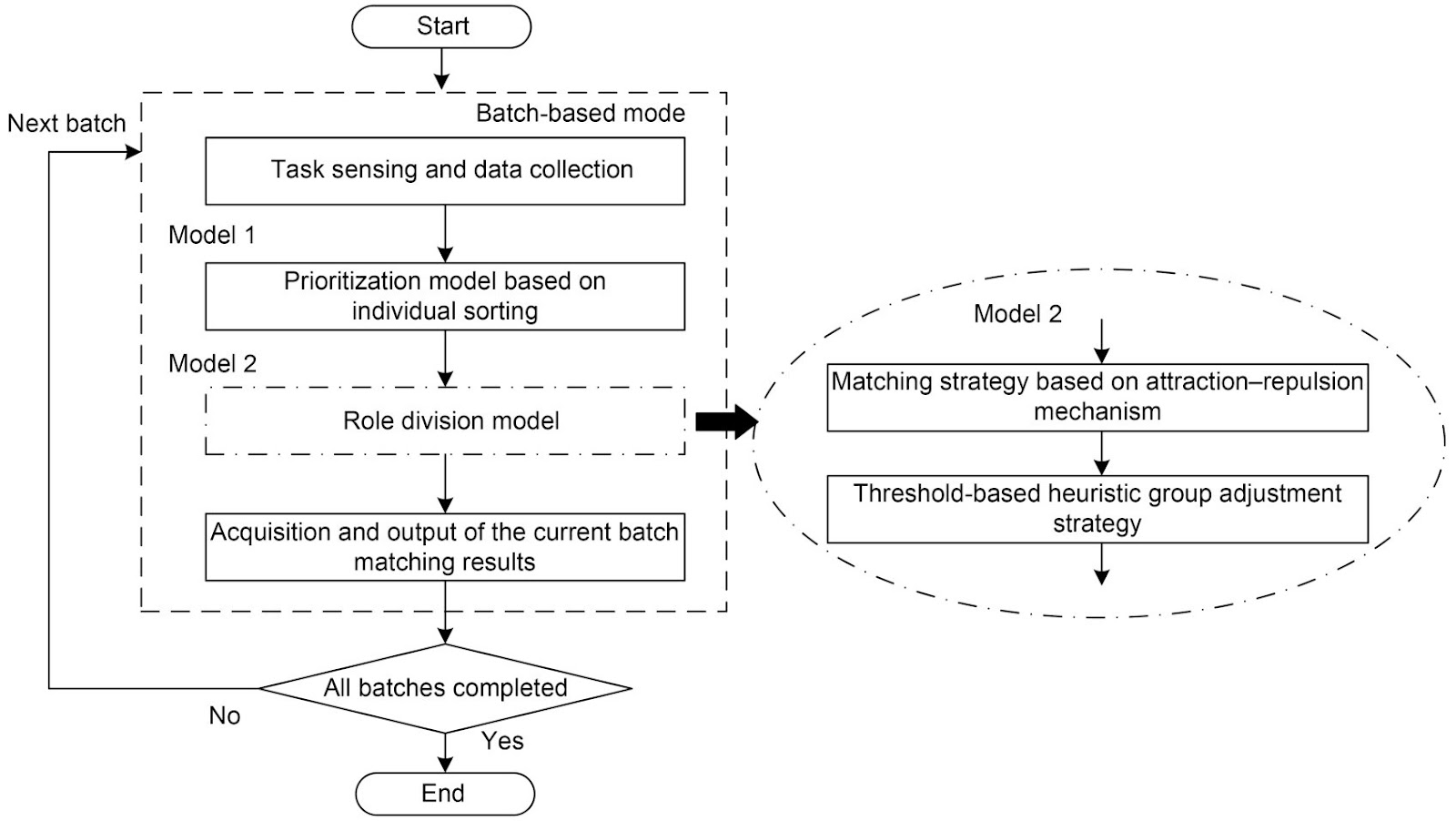
Spatial crowdsourcing (SC), as an effective paradigm for accomplishing spatiotemporal tasks, has gradually attracted widespread attention from both industry and academia. With the advancement of mobile technology, the service modes of SC have become more diversified and flexible, aiming to better meet the variable requirements of users. However, most research has focused on homogeneous task allocation problems under a single service model, without considering the individual differences among task requirements and workers. Consequently, many of these studies fail to achieve satisfactory outcomes in real scenarios. Based on real service scenarios, in this study, we investigate a heterogeneous multi-task allocation (HMTA) problem for hybrid scenarios and provide a formal description and definition of the problem. To solve the problem, we propose a role division approach embedded with an individual sorting model (RD-ISM). This approach is implemented based on a batch-based mode (BBM) and consists of two parts. First, an individual sorting model is introduced to determine the sequence of objects based on spatiotemporal attributes, prioritizing tasks and workers. Second, a role division model is designed based on an attraction–repulsion mechanism to match tasks and workers. Following several iterations over multiple batches, the approach obtains the final matching results. The effectiveness of the approach is verified using real and synthetic datasets and its performance is demonstrated through comparisons with other algorithms. Additionally, the impact of different parameters within the approach is investigated, confirming its scalability.
1. Introduction
In recent years, with the development of information technology and the rapid popularization of mobile terminal devices, spatial crowdsourcing (SC) has become an effective model for accomplishing spatiotemporal tasks in the real world (Guo et al., 2018). This approach has gradually attracted widespread attention from both industry and academia (Wang L et al., 2018). SC leverages the mobile Internet to integrate and schedule idle offline resources through online recruitment, aiming for efficient sharing of resources (Chen et al., 2014). By using SC platforms, mobile workers can be recruited to handle various complex, large-scale, and distributed spatiotemporal tasks that are difficult for computers or a few experts to accomplish (Gong et al., 2020).
With the rapid development of the online-to-offline business models, SC has been widely applied across various industries (Tong et al., 2017). These diverse SC platforms are gradually becoming integrated into people’s daily lives, playing a significant role in areas like social governance and traffic management. In terms of transportation management, the time constraints and spatial location changes involved in residents’ travel can be regarded as typical spatiotemporal tasks (Mazzetto, 2024). Shared mobility platforms of SC have reshaped the urban transportation industry ecosystem, and numerous related SC platforms have emerged, such as Uber, DiDi, and Gofun (Ray et al., 2023). According to the urban traffic operation report released by DiDi, the number of daily trips facilitated by the platform has exceeded 30 million people (Feng and Xiao, 2024).
Loading authentic research manuscript (Pages 1–5)...
Zhenhui FENG, Renbin XIAO, Mingzhi XIAO (2025). Spatial crowdsourcing task allocation for heterogeneous multi-task hybrid scenarios: a model-embedded role division approach. Frontiers of Information Technology & Electronic Engineering. https://doi.org/10.1631/FITEE_2500035
Research & Educational Purpose Only:The translations, structured abstracts, analytical annotations, and data reports provided by SinoTechIntel are intended exclusively for academic research, internal corporate R&D, and educational benchmarking. They do not constitute formal engineering, chemical safety, legal, or professional advice.
Copyright & Intellectual Property Notice: Original copyright of the underlying source articles and experimental data remains with the respective authors, institutions, and original publishing journals. SinoTechIntel claims intellectual property only over its proprietary translations, analytical syntheses, and AEO structured enhancements in accordance with international fair use and academic citation principles.
Frequently Asked Questions
What is the heterogeneous multi-task allocation (HMTA) problem in spatial crowdsourcing?
The HMTA problem addresses the challenge of efficiently assigning multiple heterogeneous tasks to workers in hybrid spatial crowdsourcing scenarios, considering individual differences in task requirements and worker capabilities, beyond homogeneous task allocation under a single service model.
What is the role division approach embedded with an individual sorting model (RD-ISM)?
RD-ISM is a novel method for solving the HMTA problem, implemented in a batch-based mode. It comprises two main components: an individual sorting model that prioritizes tasks and workers based on spatiotemporal attributes, and a role division model using an attraction–repulsion mechanism to match tasks and workers through iterative batches.
What are the main components of the RD-ISM approach?
The approach consists of two parts: (1) an individual sorting model to determine the sequence of objects based on spatiotemporal attributes, prioritizing tasks and workers; and (2) a role division model designed on an attraction–repulsion mechanism to match tasks and workers, iterating over multiple batches to obtain final results.
How is the effectiveness of the proposed approach verified?
The effectiveness is validated using both real and synthetic datasets, with performance comparisons against other algorithms. The impact of various parameters is also investigated, confirming the approach's scalability.
What are the potential applications of this research?
The research can be applied to various spatial crowdsourcing platforms, such as shared mobility services (e.g., Uber, DiDi), social governance, and traffic management, to improve task allocation efficiency and service quality in complex real-world scenarios.
Related Technical Papers & Translations

Design and optimization of a high-efficiency distillation process for cellulosic fuel ethanol integrated with thermal coupling and molecular sieve adsorption
To address the challenges of high energy consumption and prominent costs in the traditional three-columns distillation process for cellulosic fuel ethanol, a distillation—molecular sieve coupling separation process is proposed. This process integrates a three-column (crude distillation column, first distillation column, second distillation column) system with a 3A molecular sieve adsorption deep dehydration unit. A thermal coupling network is constructed via differential pressure design (steam from medium/high-pressure columns as mutual heat sources, reboiler liquid waste heat for feed preheating), and molecular sieve adsorption conditions are optimized. The study first performs a thermodynamic consistency test on the ethanol—water system, determines optimal non-random two-liquid (NRTL) model binary interaction parameters via experimental data regression for Aspen Plus simulation. Aiming at minimum total annual cost (TAC), Aspen Plus is used to optimize process parameters (theoretical tray number, feed location, reflux ratio, side-draw position, etc.). Economic analysis shows this process reduces CO2 emission costs by 27.56%, TAC by 15.58% (to 5.123 × 10⁶ USD·a-1), and increases ethanol purity to >99.6%, providing an effective solution for green, efficient separation.

A cohesion loss model for determining residual strength of deep bedded sandstone
Rock residual strength, as an important input parameter, plays an indispensable role in proposing the reasonable and scientific scheme about stope design, underground tunnel excavation and stability evaluation of deep chambers. Therefore, previous residual strength models of rocks established were reviewed. And corresponding related problems were stated. Subsequently, starting from the effects of bedding and whole life-cycle evolution process, series of triaxial mechanical tests of deep bedded s

Federated model with contrastive learning and adaptive control variates for human activity recognition
Recent attention to privacy issues demands a communication-safe method for training human activity recognition (HAR) models on client activity data. Federated learning (FL) has become a compelling technique to facilitate model training between the server and clients while preserving data privacy. However, classical FL methods often assume independent and identically distributed (IID) data among clients. This assumption does not hold true in practical scenarios. Human activity in real-world scena