Key Takeaways & Executive Findings
- •• The quaternary system K+, NH4+, Ca2+//Cl−-H2O exhibits complex phase equilibria with formation of solid solutions and double salts at all studied temperatures. • At 298.2 K, the phase diagram shows three invariant points and five crystalline regions, while at 323.2 and 348.2 K, it expands to five invariant points and seven regions, indicating increased complexity with temperature. • The solid solution (KCl)x(NH4Cl)1−x has the largest crystallization region at all temperatures, making it the most readily crystallized phase in the system. • The hydration state of CaCl2 changes with temperature: CaCl2·6H2O at 298.2 K and CaCl2·2H2O at 323.2 and 348.2 K, affecting the overall phase behavior. • The findings provide essential data for optimizing extraction and separation processes of potassium, ammonium, and calcium from deep brine resources.
Abstract
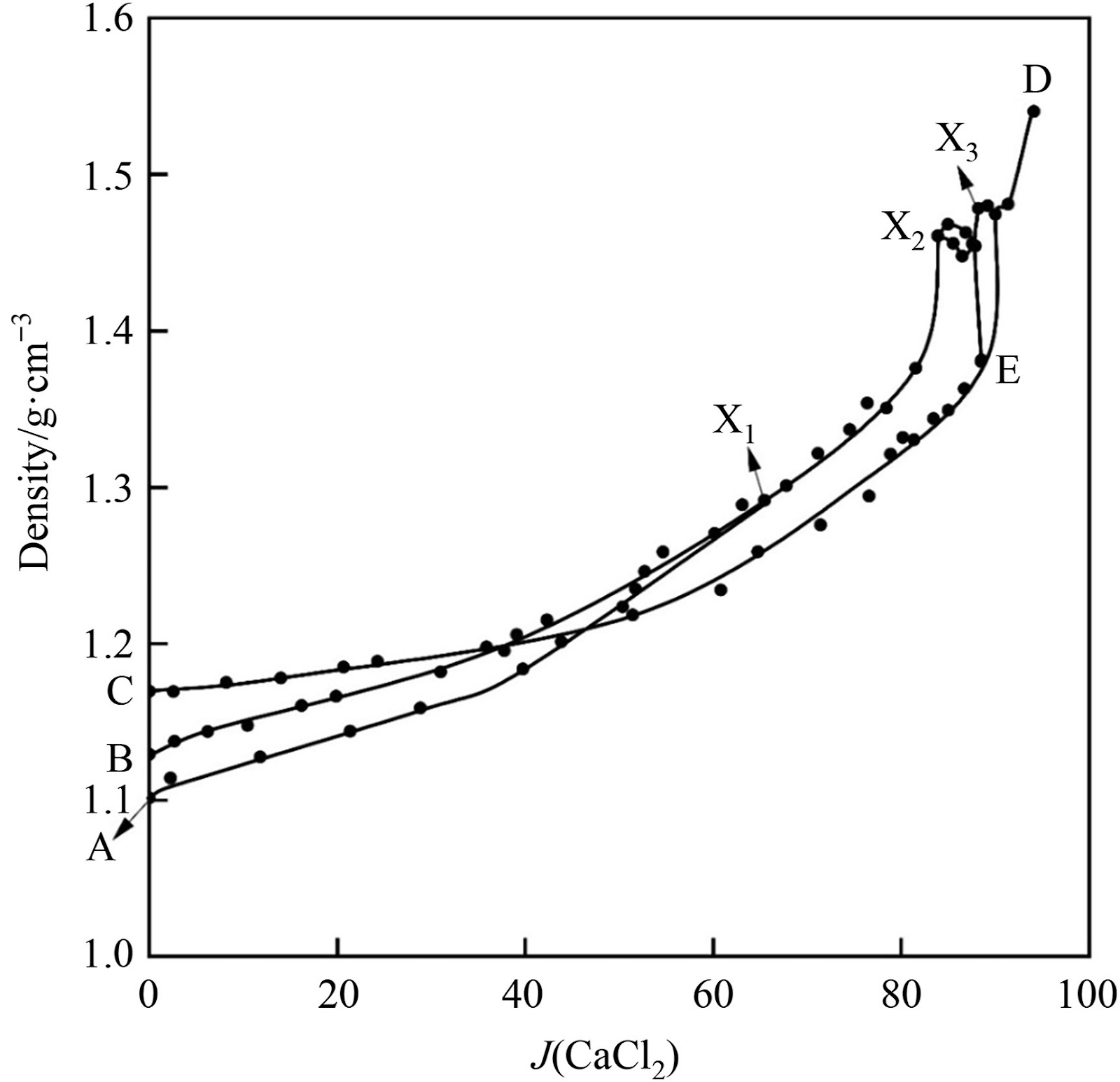
In order to obtain the crystalline forms of the salts of the potassium, ammonium, calcium coexisting chloride system, the phase equilibria relationship of quaternary system K+, NH4+, Ca2+//Cl−-H2O at 298.2, 323.2, and 348.2 K was studied by isothermal dissolution equilibrium method. The solubility and density of equilibrium liquid phases of the system were experimentally determined; X-ray powder diffractometer was used to determine the compositions of the equilibrium solid phase at the quaternary invariant point. It is found that the quaternary system is a complex system at these three temperatures. The phase diagram at 298.2 K consists of three invariant points, seven univariate curves and five crystalline phase regions, forming the solid solutions (NH4Cl)x(KCl)1−x and (KCl)x(NH4Cl)1−x; while at 323.2 and 348.2 K the phase diagram consists of five invariant points, eleven univariate curves and seven crystalline phase regions, the double salts (KCl·CaCl2) and (2NH4Cl·CaCl2·3H2O), solid solutions (KCl)x(NH4Cl)1−x and (NH4Cl)x(KCl)1−x were formed. Among them, the crystalline phase region of solid solution (KCl)x(NH4Cl)1−x is the largest at three temperatures, indicating that it is the easiest to crystallize in this system. Comparing the phase diagrams of the quaternary system at 298.2, 323.2, and 348.2 K, it can be seen that the crystalline form of CaCl2 changes with the increase of temperature: CaCl2·6H2O at 298.2 K, CaCl2·2H2O at 323.2 and 348.2 K. From 323.2 to 348.2 K, the crystalline phase regions of (KCl·CaCl2) and (2NH4Cl·CaCl2·3H2O) increased gradually.
1. Introduction
China is a large agricultural country, and also a big country of potassium salt consumption and import. The rational exploitation and utilization of potassium salt is directly related to national food security [1,2]. The global potash (potassium chloride equivalent) reserves are 14.9 billion tons, and the resources are 69 billion tons, mainly distributed in Russia, Canada, Belarus, and Turkmenistan. China's potash reserves are 170 million tons, accounting for only 5.15% of the world's total potash reserves [3]. The occurrence form of potassium resources in China has its particularity, 98% of the proven potassium resources are abundant in liquid brine potassium deposits, which mainly distributed in salt lake brines in Qinghai, Xinjiang and Xizang [4,5], as well as deep brine represented by Sichuan Basin, Jianghan Basin and Qaidam Basin [6-8]. Among them, the concentration of K+, Ca2+ and NH4+ in the Xuanhan deep brine in Northeast Sichuan is 25.955, 10.877, and 0.816 g·L−1 [6]. Nanyishan deep brine in the Qaidam Basin is a calcium chloride type with high salinity (118.2-287.9 g·L−1), high calcium (14.73-16.09 g·L−1), and the content of potassium is 5.21-7.66 g·L−1, ammonium is 0.143 g·L−1 [9], which has high development and utilization value.
In addition, due to the particularity of its occurrence state, deep brine has the characteristics of deep burial and high brine temperature. For example, the burial depth of brine in northeastern Sichuan is 1000-3260 m, the occurrence temperature of brine is mostly concentrated in 296.2-348.2 K. At the same time, the deep brine also contains ammonium and calcium, which is significantly different from the salt lake brine system and seawater system, it may form double salts or solid solutions with coexisting potassium, which makes the ion interaction relationship complex and increases the difficulty of salt separation. Therefore, to obtain the salt interaction relationship of the chlorides type solution containing potassium, ammonium and calcium at multi-temperature, the phase equilibria of system K+, NH4+, Ca2+//Cl−-H2O is necessary.
Loading authentic research manuscript (Pages 1–5)...
Fuyu Zhuge, Nan Zhang, Haiying Tang, Qi Li, Niancu Chen, Xudong Yu (2024). Solid–liquid phase equilibria in the aqueous system containing the chlorides of potassium, ammonium, and calcium at 298.2, 323.2, and 348.2 K. Chinese Journal of Chemical Engineering. https://doi.org/10.1016/j_cjche_1448
Research & Educational Purpose Only:The translations, structured abstracts, analytical annotations, and data reports provided by SinoTechIntel are intended exclusively for academic research, internal corporate R&D, and educational benchmarking. They do not constitute formal engineering, chemical safety, legal, or professional advice.
Copyright & Intellectual Property Notice: Original copyright of the underlying source articles and experimental data remains with the respective authors, institutions, and original publishing journals. SinoTechIntel claims intellectual property only over its proprietary translations, analytical syntheses, and AEO structured enhancements in accordance with international fair use and academic citation principles.
Frequently Asked Questions
What is the main objective of this study?
The main objective is to determine the phase equilibria of the quaternary system K+, NH4+, Ca2+//Cl−-H2O at 298.2, 323.2, and 348.2 K to understand the crystalline forms and interactions of potassium, ammonium, and calcium chlorides, which is essential for the extraction and separation of these salts from deep brine resources.
What experimental method was used?
The isothermal dissolution equilibrium method was employed to study the phase equilibria. Solubility and density of equilibrium liquid phases were measured, and X-ray powder diffraction was used to identify the compositions of solid phases at invariant points.
What are the key findings regarding solid phases?
At 298.2 K, the system forms solid solutions (NH4Cl)x(KCl)1−x and (KCl)x(NH4Cl)1−x. At 323.2 and 348.2 K, additional double salts (KCl·CaCl2) and (2NH4Cl·CaCl2·3H2O) appear. The solid solution (KCl)x(NH4Cl)1−x has the largest crystallization region at all temperatures.
How does temperature affect the phase diagram?
As temperature increases from 298.2 K to 323.2 and 348.2 K, the number of invariant points increases from three to five, and the number of crystalline regions increases from five to seven. The hydration state of CaCl2 changes from CaCl2·6H2O at 298.2 K to CaCl2·2H2O at higher temperatures.
Why is this study significant for industrial applications?
The study provides crucial phase equilibrium data for the design of separation and crystallization processes for potassium, ammonium, and calcium salts from deep brine, which is important for the efficient utilization of these resources in China.
Related Technical Papers & Translations

Design and optimization of a high-efficiency distillation process for cellulosic fuel ethanol integrated with thermal coupling and molecular sieve adsorption
To address the challenges of high energy consumption and prominent costs in the traditional three-columns distillation process for cellulosic fuel ethanol, a distillation—molecular sieve coupling separation process is proposed. This process integrates a three-column (crude distillation column, first distillation column, second distillation column) system with a 3A molecular sieve adsorption deep dehydration unit. A thermal coupling network is constructed via differential pressure design (steam from medium/high-pressure columns as mutual heat sources, reboiler liquid waste heat for feed preheating), and molecular sieve adsorption conditions are optimized. The study first performs a thermodynamic consistency test on the ethanol—water system, determines optimal non-random two-liquid (NRTL) model binary interaction parameters via experimental data regression for Aspen Plus simulation. Aiming at minimum total annual cost (TAC), Aspen Plus is used to optimize process parameters (theoretical tray number, feed location, reflux ratio, side-draw position, etc.). Economic analysis shows this process reduces CO2 emission costs by 27.56%, TAC by 15.58% (to 5.123 × 10⁶ USD·a-1), and increases ethanol purity to >99.6%, providing an effective solution for green, efficient separation.

A cohesion loss model for determining residual strength of deep bedded sandstone
Rock residual strength, as an important input parameter, plays an indispensable role in proposing the reasonable and scientific scheme about stope design, underground tunnel excavation and stability evaluation of deep chambers. Therefore, previous residual strength models of rocks established were reviewed. And corresponding related problems were stated. Subsequently, starting from the effects of bedding and whole life-cycle evolution process, series of triaxial mechanical tests of deep bedded s

Federated model with contrastive learning and adaptive control variates for human activity recognition
Recent attention to privacy issues demands a communication-safe method for training human activity recognition (HAR) models on client activity data. Federated learning (FL) has become a compelling technique to facilitate model training between the server and clients while preserving data privacy. However, classical FL methods often assume independent and identically distributed (IID) data among clients. This assumption does not hold true in practical scenarios. Human activity in real-world scena