Key Takeaways & Executive Findings
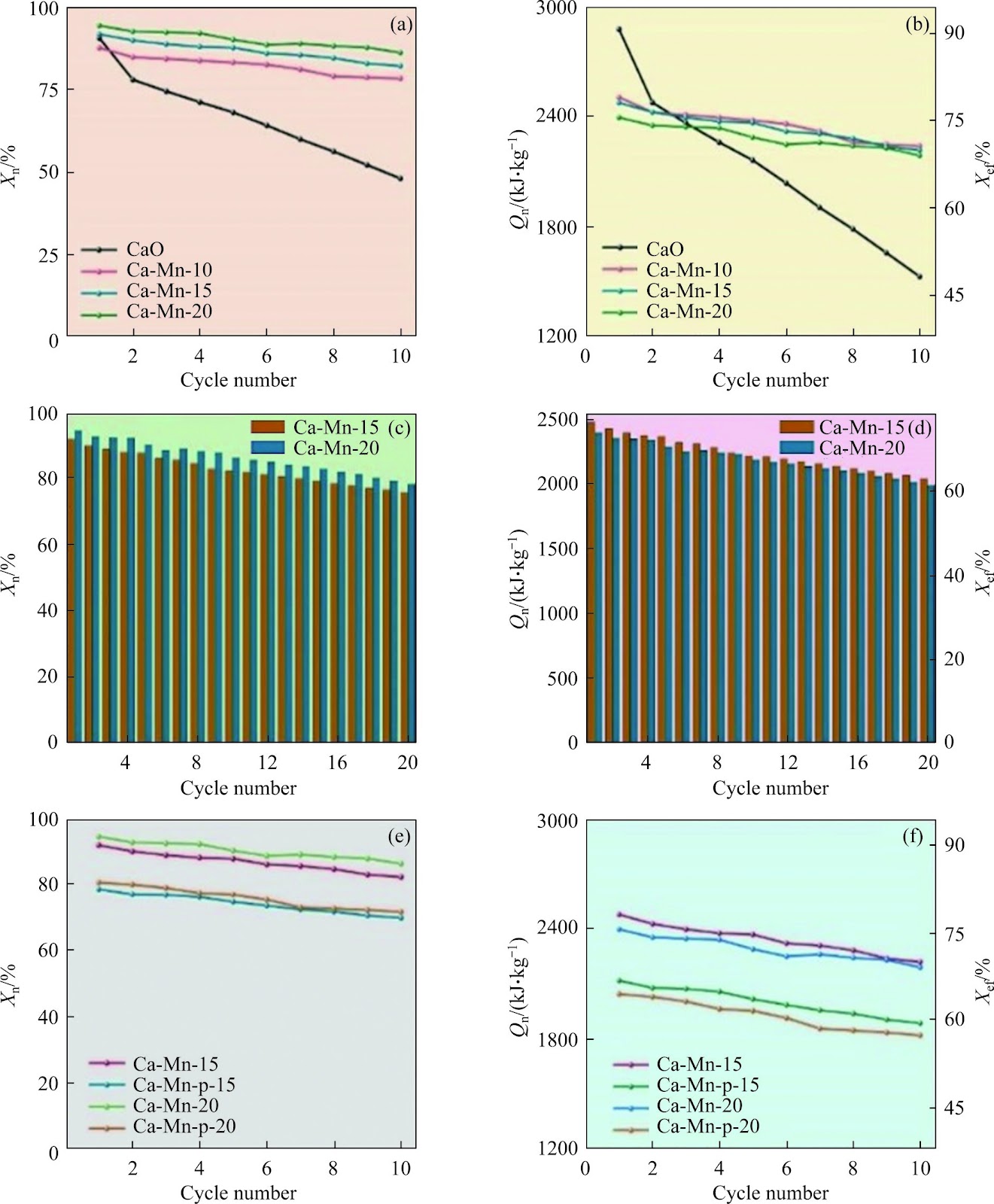
- •• Mn-doped CaO-based heat carriers with finely dispersed Ca2MnO4 inert support effectively resist CaCO3/CaO sintering, maintaining ~2000 kJ/kg energy storage density over 20 cycles. • The dark Ca2MnO4 phase markedly enhances direct solar absorption of CaO-based heat carriers, addressing the poor optical absorption of white CaO. • Granulated pellets exhibit excellent attrition resistance with only 9.85 wt% mass loss after 3200 mechanical cycles, supporting practical reactor applications. • The combined thermochemical and optical improvements position Mn-doped CaO carriers as promising candidates for concentrated solar power energy storage.
Abstract
CaO-based heat carriers have shown great prospects for thermochemical energy storage in concentrated solar power systems due to the features such as rich reserves, environmental safety, high energy storage densities and high operation temperatures. However, the density decay because of sintering and poor direct solar absorption of white CaO-based heat carriers are the two main obstacles lying on the way to the realistic applications. This work introduced dark Mn-based inert support into calcium heat carriers, attempting to solve the above problems simultaneously. As an inert support, the finely dispersed Ca2MnO4 functioned as the metal framework to resist CaCO3/CaO sintering. Consequently, the cyclic stability of CaO-based heat carriers, resulting in the high energy storage densities of ~2000 kJ/kg even over 20 cycles. As a dark material, Ca2MnO4 successfully darkened CaO-based heat carriers, thereby greatly enhanced the direct solar absorption. In addition, the granulation of CaO-based heat carriers was also studied. The pellets showed satisfactory attrition resistance with only 9.85 wt% mass loss over 3200 cycles. In general, good physicochemical performance of Mn-doped CaO-based heat carrier endows it with great prospects for solar energy storage.
1. Introduction
Fossil fuels, comprising coal, oil and natural gas, account for the largest proportion of global energy consumption. To curb the emission of carbon dioxide (CO2) associated with the use of fossil fuels, renewable energy has garnered global attention. Among the various sources of renewable energy, solar energy stands out due to its cleanliness, abundance and inexhaustibility. The concentrated solar power (CSP) has emerged as a promising technology for harnessing and converting solar energy into electricity and is poised to play a significant role in the future energy landscape [1−7]. Nonetheless, the deployment of solar energy technology has faced a persistent challenge of a significant disparity between energy supply and consumption. In response to this dilemma, the energy storage concept is proposed as a pivotal strategy to rectify the mismatch. The notion of thermal energy storage (TES) was initially introduced and researched in the 1970s as a remedy for the energy crisis. By utilizing energy storage, intermittent solar energy can efficiently meet the demands of space heating and domestic electricity, while also offering a high-quality heat source throughout the year, irrespective of timing or seasonal constraints.
The commonly used energy storage systems in recent years include: 1) sensible thermal energy storage [8−10]; 2) latent energy storage based on phase change materials [11−14]; and 3) thermochemical energy storage (TCES) [15−17]. Several popular TCES materials have been proposed, such as carbonates, oxides, hydroxides, and sulfates. Among these heat carriers, calcium heat carriers have garnered global attention due to its cheapness, environmental friendliness, high energy storage density and heat release temperature [18−21]. In the so-called calcium looping process (CLP) relying on the reversible calcination/carbonation reaction illustrated in Eq. (1), solar energy is concentrated to decompose CaCO3 into CO2 and CaO as products which are then stored separately. When energy is demanded, the stored CaO reacts with CO2, releasing the stored energy through an exothermic carbonation reaction.
Loading authentic research manuscript (Pages 1–5)...
Xu Ting-ting, Feng Qian-nian, Wei Yuan, Fu Rui-cheng, Hu Ying-chao (2025). Solar energy storage by dark Mn-doped CaO-based heat carriers. Journal of Central South University. https://doi.org/10.1007/s11771-025-6037-9
Research & Educational Purpose Only:The translations, structured abstracts, analytical annotations, and data reports provided by SinoTechIntel are intended exclusively for academic research, internal corporate R&D, and educational benchmarking. They do not constitute formal engineering, chemical safety, legal, or professional advice.
Copyright & Intellectual Property Notice: Original copyright of the underlying source articles and experimental data remains with the respective authors, institutions, and original publishing journals. SinoTechIntel claims intellectual property only over its proprietary translations, analytical syntheses, and AEO structured enhancements in accordance with international fair use and academic citation principles.
Frequently Asked Questions
What is the main challenge for CaO-based heat carriers in solar energy storage?
The main challenges are density decay due to sintering and poor direct solar absorption of white CaO-based carriers, both of which limit realistic applications in concentrated solar power systems.
How does Mn doping improve the performance of CaO-based heat carriers?
Mn doping introduces dark Ca2MnO4 as an inert support and solar absorber. It acts as a metal framework to resist CaCO3/CaO sintering and darkens the material, greatly enhancing direct solar absorption while maintaining high cyclic stability.
What energy storage density was achieved after multiple cycles?
The Mn-doped CaO-based heat carriers maintained high energy storage densities of approximately 2000 kJ/kg even after 20 cycles.
Did the study evaluate practical granulation?
Yes, granulated pellets of the heat carriers were tested and showed satisfactory attrition resistance, with only 9.85 wt% mass loss over 3200 cycles.
What is the significance of this research for concentrated solar power?
The dark Mn-doped CaO-based carriers combine stable thermochemical performance with improved solar absorption, making them promising materials for efficient solar energy storage in concentrated solar power systems.
Related Technical Papers & Translations
Design and optimization of a high-efficiency distillation process for cellulosic fuel ethanol integrated with thermal coupling and molecular sieve adsorption
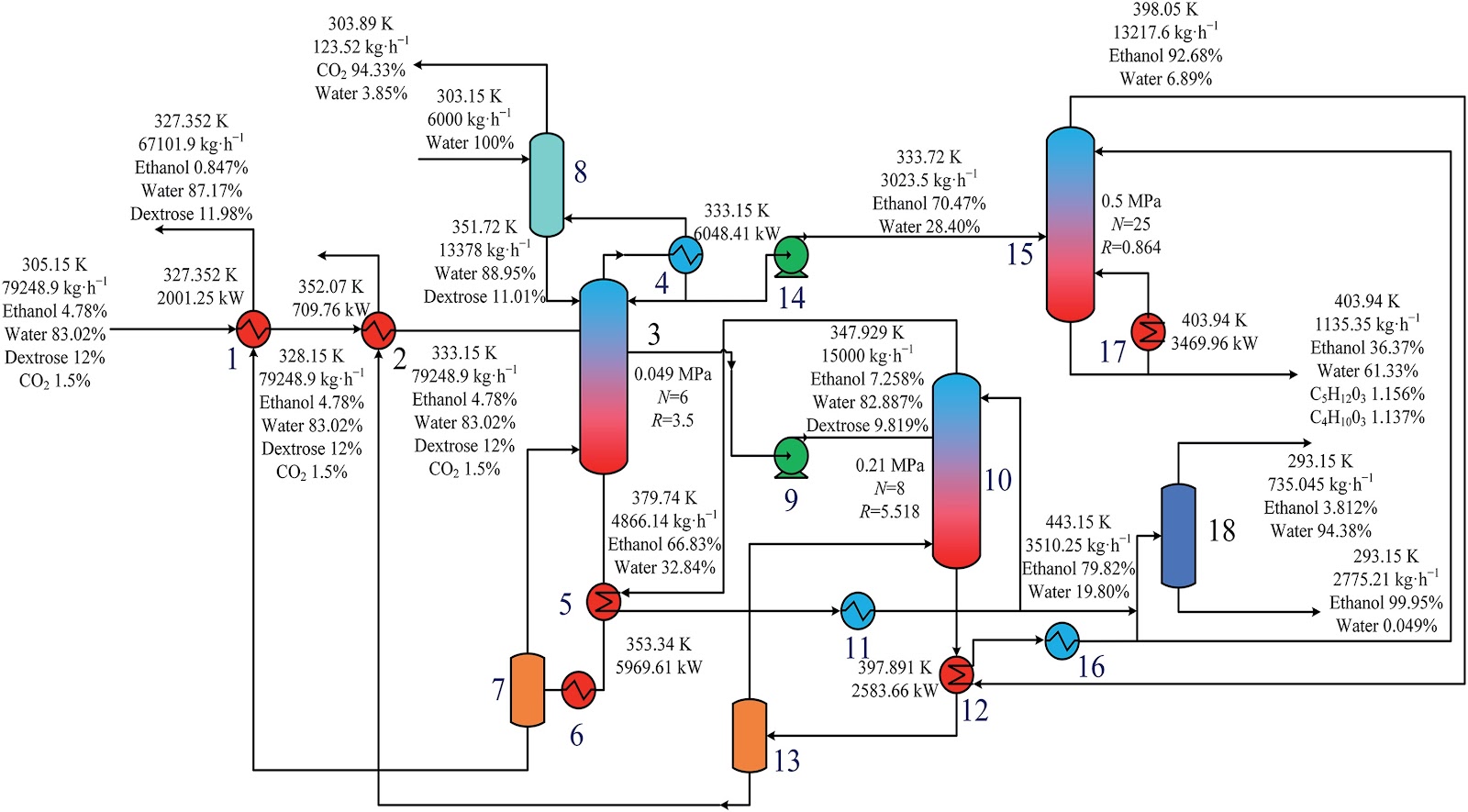
To address the challenges of high energy consumption and prominent costs in the traditional three-columns distillation process for cellulosic fuel ethanol, a distillation—molecular sieve coupling separation process is proposed. This process integrates a three-column (crude distillation column, first distillation column, second distillation column) system with a 3A molecular sieve adsorption deep dehydration unit. A thermal coupling network is constructed via differential pressure design (steam from medium/high-pressure columns as mutual heat sources, reboiler liquid waste heat for feed preheating), and molecular sieve adsorption conditions are optimized. The study first performs a thermodynamic consistency test on the ethanol—water system, determines optimal non-random two-liquid (NRTL) model binary interaction parameters via experimental data regression for Aspen Plus simulation. Aiming at minimum total annual cost (TAC), Aspen Plus is used to optimize process parameters (theoretical tray number, feed location, reflux ratio, side-draw position, etc.). Economic analysis shows this process reduces CO2 emission costs by 27.56%, TAC by 15.58% (to 5.123 × 10⁶ USD·a-1), and increases ethanol purity to >99.6%, providing an effective solution for green, efficient separation.
A cohesion loss model for determining residual strength of deep bedded sandstone
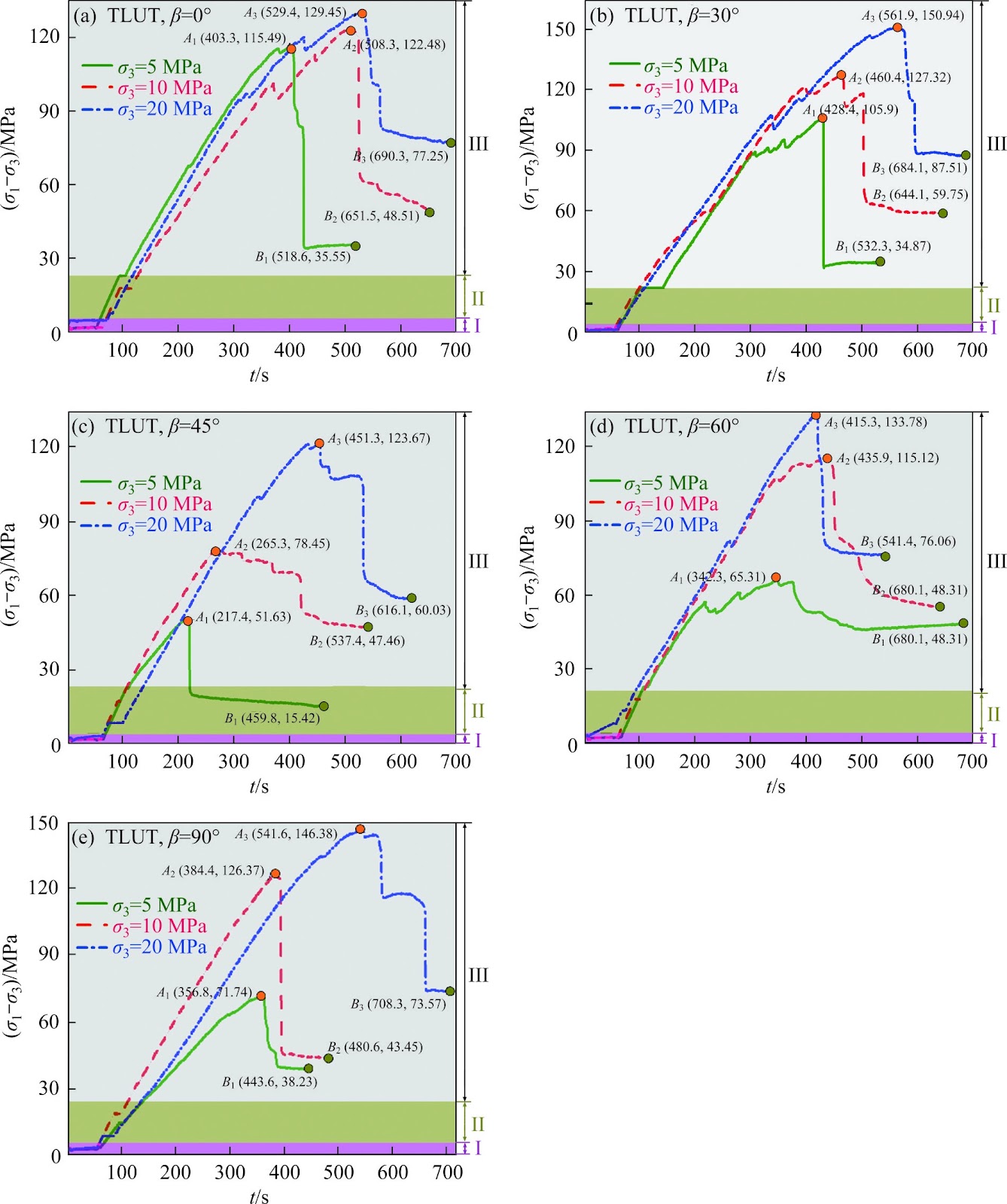
Rock residual strength, as an important input parameter, plays an indispensable role in proposing the reasonable and scientific scheme about stope design, underground tunnel excavation and stability evaluation of deep chambers. Therefore, previous residual strength models of rocks established were reviewed. And corresponding related problems were stated. Subsequently, starting from the effects of bedding and whole life-cycle evolution process, series of triaxial mechanical tests of deep bedded s
Federated model with contrastive learning and adaptive control variates for human activity recognition
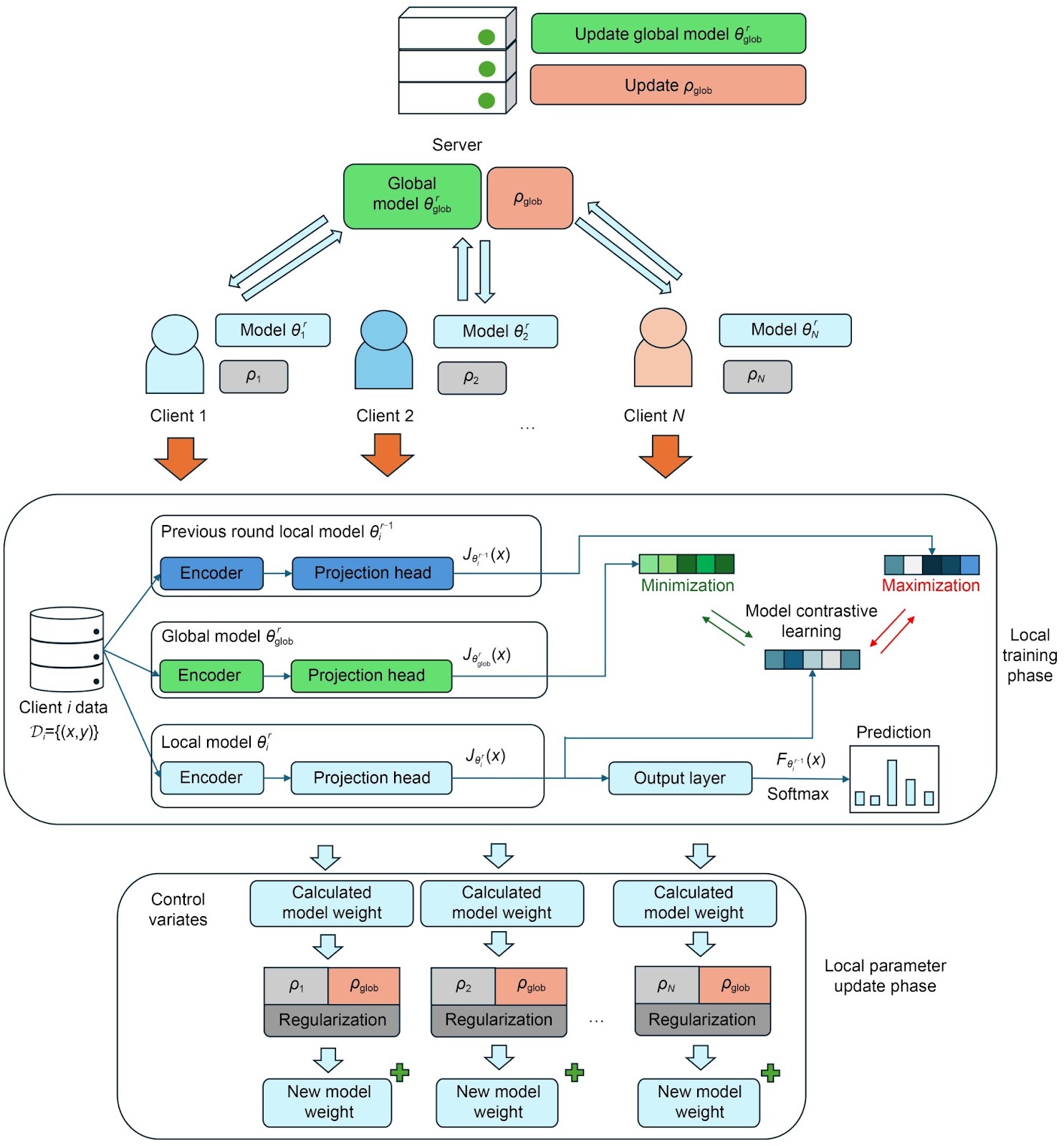
Recent attention to privacy issues demands a communication-safe method for training human activity recognition (HAR) models on client activity data. Federated learning (FL) has become a compelling technique to facilitate model training between the server and clients while preserving data privacy. However, classical FL methods often assume independent and identically distributed (IID) data among clients. This assumption does not hold true in practical scenarios. Human activity in real-world scena