Key Takeaways & Executive Findings
- •• The proposed single-layer chiral metasurface achieves a high circular polarization extinction ratio, overcoming the traditional trade-off between structural complexity and performance. • It directly converts circularly polarized incident light into linearly polarized light, enabling efficient and compact circular polarization detection. • The operating wavelength is tunable by adjusting geometric parameters, offering design flexibility for different applications. • Experimental demonstrations confirm strong circular dichroism with a simplified fabrication process compared to multi-layer or 3D chiral metasurfaces.
Abstract
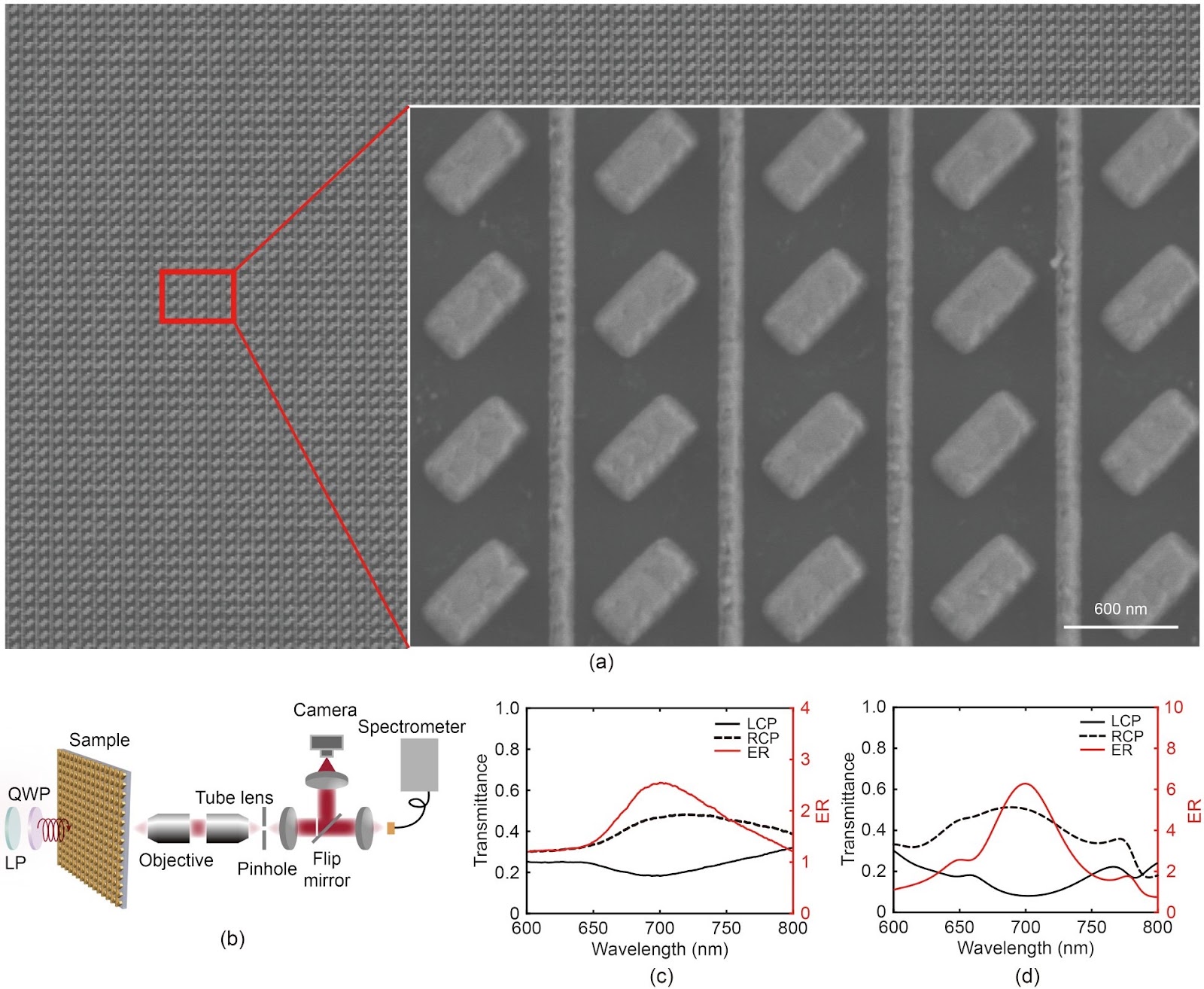
Circular polarizers based on the metasurface suffer from a trade-off between the structural complexity and the polarization extinction ratio (ER). Herein, we present a single-layer chiral metasurface with strong circular dichroism. The structure turns a circularly polarized incident beam into a linearly polarized beam, achieving a high circular polarization ER. The operating wavelength of the proposed metasurface is tunable by changing the geometric parameters. The metasurface’s localized surface plasmon resonances between structures ensure strong chiral optical effects. We further experimentally demonstrate the circular dichroism of the fabricated metasurface.
1. Introduction
Polarization is critical for light. In particular, circularly polarized light (CPL) is widely used in holography (Wang Q et al., 2018; Wan et al., 2022), bioimaging, optical communication (Farshchi et al., 2011), and many other advanced optical technologies (Lin et al., 2004; Garcia et al., 2015). The detection of CPL has a high potential for the development of these optical technologies. Traditional optical CPL detection requires a quarter-wave plate (QWP), a linear polarizer (LP), and other mechanically rotating components. This causes substantial losses in sensitivity and resolution in light detection. However, the progress in optical metasurfaces provides opportunities for ultra-thin CPL detection and manipulation.
Optical metasurfaces are artificial electromagnetic media structured on the subwavelength scale that exhibit unprecedented properties. Over the past few years, optical metasurfaces have been employed for the design and fabrication of optical elements and systems with abilities that surpass the performance of conventional optical elements (Pendry et al., 2006; Soukoulis and Wegener, 2010; Yu et al., 2011; Frese et al., 2019). Specifically, for polarization applications, a three-dimensional (3D) chiral optical metasurface was first proposed to differentiate the handedness of CPL (Hentschel et al., 2017), performing a wider regulation bandwidth and a higher circular polarization extinction ratio (ER). For example, the gold helix achieves an ER of 20 over a wide wavelength range (Gansel et al., 2010). The spiral-type ramp-shaped metamaterial (Rajaei et al., 2019) and the L-shaped metallic strip can also achieve optical chirality (Dietrich et al., 2012). Three-dimensional structures achieve high ERs and broad bandwidths. However, the fabrication of these complicated nanostructures has a high requirement for the equipment and the fabrication procedure, which is a fatal limitation to mass production.
With the development of nanotechnology, planar lithography techniques, such as photolithography and electron-beam lithography, have become mature, and the multi-layer metasurface dominates the research on artificial nanostructures for CPL detection. Multi-layer metasurfaces realize circular dichroism by rotating components of each layer or combining diverse metasurfaces to form a 3D chiral structure (Zhao Y et al., 2012; Wang ZJ et al., 2016; Yun et al., 2017; Bai et al., 2019; Gorkunov et al., 2020; Cen et al., 2022; Zhao X et al., 2022). The ER of a multi-layer metasurface can reach 35 in experiments (Basiri et al., 2019). However, the multi-layer metasurface also suffers from fabrication challenges. For example, aligning vertically adjacent layers always requires a complex fabrication procedure involving multiple lithography and film deposition steps. Single-layer structures can also be chiral and present circular dichroism, providing an alternative that has a simplified fabrication procedure. However, they always suffer from relatively low ERs in simulations (below 20) (Li et al., 2015; Zhang et al., 2017; Ma et al., 2018). To resolve this dilemma, we develop a single-layer chiral metasurface that performs better circular dichroism and demonstrate it both in theory and through experiments. The operating wavelength of the proposed metasurface is tunable by changing geometric parameters.
Loading authentic research manuscript (Pages 1–5)...
Xinjie SUN, Xin HE, Zixin CAI, Xiang HAO (2025). Single-layer chiral metasurface for circularly polarized light detection. Frontiers of Information Technology & Electronic Engineering. https://doi.org/10.1631/FITEE_2400081
Research & Educational Purpose Only:The translations, structured abstracts, analytical annotations, and data reports provided by SinoTechIntel are intended exclusively for academic research, internal corporate R&D, and educational benchmarking. They do not constitute formal engineering, chemical safety, legal, or professional advice.
Copyright & Intellectual Property Notice: Original copyright of the underlying source articles and experimental data remains with the respective authors, institutions, and original publishing journals. SinoTechIntel claims intellectual property only over its proprietary translations, analytical syntheses, and AEO structured enhancements in accordance with international fair use and academic citation principles.
Frequently Asked Questions
What is a chiral metasurface?
A chiral metasurface is a subwavelength-structured artificial electromagnetic medium that exhibits chirality, meaning it responds differently to left-handed and right-handed circularly polarized light. This property enables applications such as circular polarization detection and manipulation.
How does this single-layer metasurface achieve circular polarization detection?
The proposed single-layer chiral metasurface converts a circularly polarized incident beam into a linearly polarized beam. By analyzing the resulting linear polarization, the handedness of the circular polarization can be determined, achieving a high circular polarization extinction ratio.
What is the polarization extinction ratio (ER)?
The polarization extinction ratio (ER) is a figure of merit that quantifies the ability of a device to distinguish between two orthogonal polarization states. A higher ER indicates better discrimination between left-handed and right-handed circular polarizations.
What are the advantages of a single-layer design compared to multi-layer or 3D structures?
Single-layer metasurfaces offer a simplified fabrication process, requiring fewer lithography and deposition steps, which makes them more suitable for mass production. This work demonstrates that a single-layer design can achieve high circular dichroism, overcoming the traditional limitation of low extinction ratios.
How is the operating wavelength of the metasurface tuned?
The operating wavelength can be adjusted by changing the geometric parameters of the metasurface structures, such as their size, shape, and period. This tunability allows the device to be optimized for specific wavelength ranges.
Related Technical Papers & Translations

Design and optimization of a high-efficiency distillation process for cellulosic fuel ethanol integrated with thermal coupling and molecular sieve adsorption
To address the challenges of high energy consumption and prominent costs in the traditional three-columns distillation process for cellulosic fuel ethanol, a distillation—molecular sieve coupling separation process is proposed. This process integrates a three-column (crude distillation column, first distillation column, second distillation column) system with a 3A molecular sieve adsorption deep dehydration unit. A thermal coupling network is constructed via differential pressure design (steam from medium/high-pressure columns as mutual heat sources, reboiler liquid waste heat for feed preheating), and molecular sieve adsorption conditions are optimized. The study first performs a thermodynamic consistency test on the ethanol—water system, determines optimal non-random two-liquid (NRTL) model binary interaction parameters via experimental data regression for Aspen Plus simulation. Aiming at minimum total annual cost (TAC), Aspen Plus is used to optimize process parameters (theoretical tray number, feed location, reflux ratio, side-draw position, etc.). Economic analysis shows this process reduces CO2 emission costs by 27.56%, TAC by 15.58% (to 5.123 × 10⁶ USD·a-1), and increases ethanol purity to >99.6%, providing an effective solution for green, efficient separation.

A cohesion loss model for determining residual strength of deep bedded sandstone
Rock residual strength, as an important input parameter, plays an indispensable role in proposing the reasonable and scientific scheme about stope design, underground tunnel excavation and stability evaluation of deep chambers. Therefore, previous residual strength models of rocks established were reviewed. And corresponding related problems were stated. Subsequently, starting from the effects of bedding and whole life-cycle evolution process, series of triaxial mechanical tests of deep bedded s

Federated model with contrastive learning and adaptive control variates for human activity recognition
Recent attention to privacy issues demands a communication-safe method for training human activity recognition (HAR) models on client activity data. Federated learning (FL) has become a compelling technique to facilitate model training between the server and clients while preserving data privacy. However, classical FL methods often assume independent and identically distributed (IID) data among clients. This assumption does not hold true in practical scenarios. Human activity in real-world scena