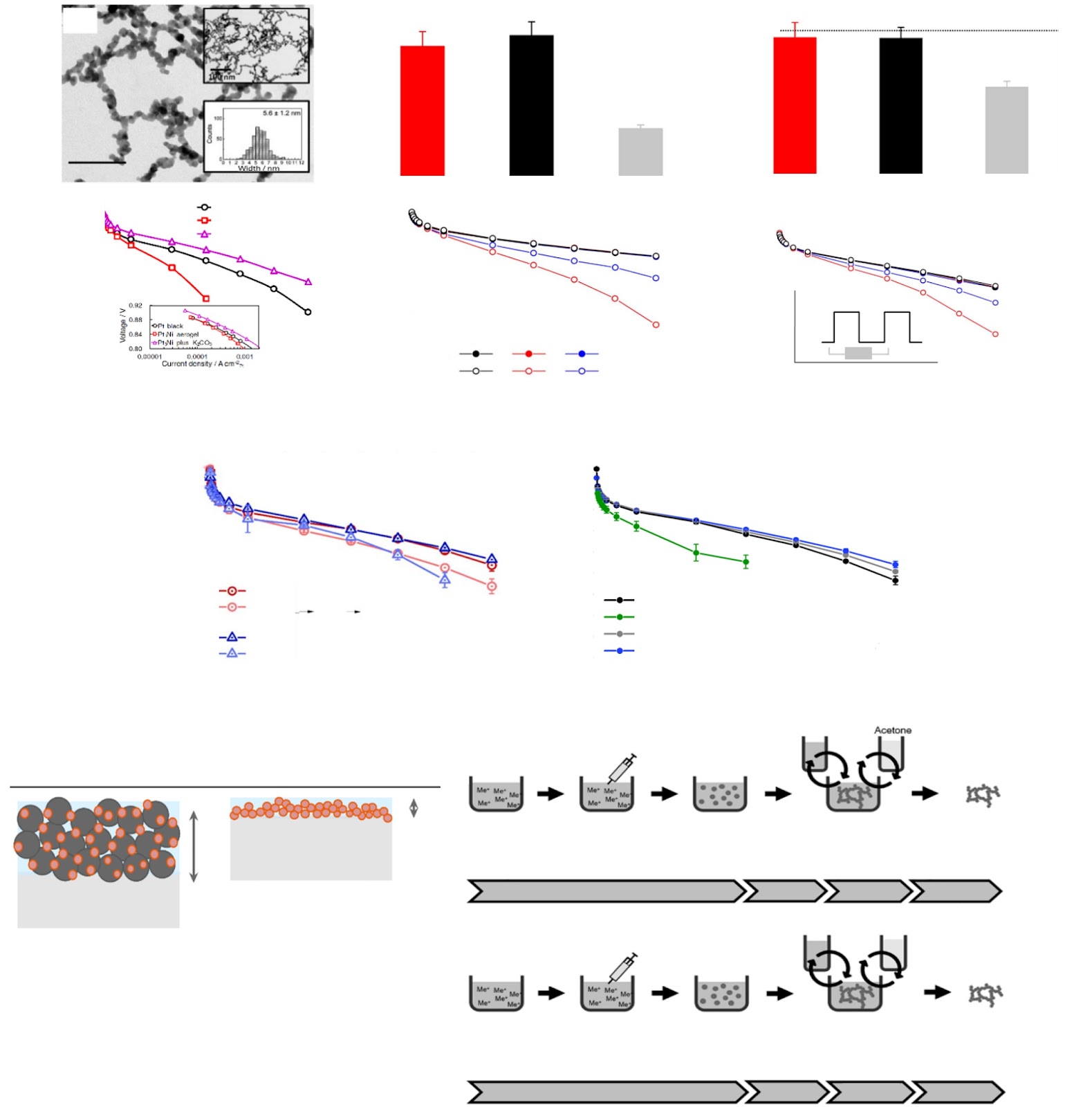
Key Takeaways & Executive Findings
- •• Metal aerogel electrocatalysts combine high electrical conductivity, metallic nature, and hierarchical 3D porosity, enabling excellent Pt utilization and exposure of active sites for ORR. • Several noble metal aerogel catalysts achieve higher mass activity than conventional Pt/C, reaching a mass activity target of 440 A per g Pt at 0.9 V vs. RHE. • The review systematically analyses metal aerogel synthesis, microstructural effects on catalyst layers, fuel cell performance, and state-of-the-art modifications. • Metal aerogels offer a promising pathway to reduce Pt loading and improve ORR stability, with future research focused on integrating these catalysts into realistic fuel cell devices.
Abstract
The development of highly active and stable electrocatalysts for the oxygen reduction reaction (ORR) remains a challenging task for improving the efficiency of fuel cells. Although Pt and Pt–transition metal alloy-based catalysts stand out as practical choices, they suffer from poor Pt utilization and stability. In this regard, highly electrically conducting, purely metallic, hierarchical 3D-porous, and nanowire aerogels as self-supported electrocatalysts have gained interest in recent decades. Metal aerogels are regarded as efficient catalytic materials, especially for electrocatalysis, as they integrate the unique features of both metallic and porous aerogels. In this review, we provide an overview of the recent progress in metal aerogel catalysts for ORR. Metal aerogel catalysts exhibit excellent ORR activity due to their high intrinsic activity arising from excellent Pt utilization and the exposure of active sites due to their metallic nature. Owing to their high Pt utilization, several noble metal aerogel catalysts were found to exhibit higher mass activity than traditional Pt/C catalysts and a mass activity target of 440 A per g Pt at 0.9 V vs. RHE, suggesting the high potential of metal aerogels as ORR catalysts in fuel cells. Herein, we summarize the recent benchmark research outcomes of metal aerogel catalysts for the ORR, their effects on the microstructure of catalyst layers, fuel cell performance, and cutting-edge modifications of recently reported metal aerogel catalysts. We systematically review the various aspects of metal aerogel catalyst synthesis, their advantages over traditional Pt/C catalysts, and ORR kinetics, and provide future research directions and recommendations to further improve and integrate metal aerogel catalysts into realistic fuel cells.
1. Introduction
Energy serves as a fundamental catalyst for productive endeavors, constituting the essential basis of a nation’s economic and social activities [1–2]. Fossil fuel depletion has alarmed industrial sectors into looking for alternative energy sources, energy supply, and the reduction of environmental pollution. The emission of pollutants from fossil fuel-based energy materials, including carbon monoxide, nitrogen oxides, hydrocarbons, and soot particulate matter from carbon-based fuels, adversely affects human health and the environment. Therefore, research has focused on the development of renewable fuels such as H2 by water splitting, electrochemical and photochemical CO2 reduction, and renewable energy sources [3–5].
In this regard, polymer electrolyte membrane (PEM) fuel cells are attracting considerable attention owing to their efficiency and applications in the automotive industry [6]. A fuel cell is an electrochemical device that converts chemical energy into electrical energy using hydrogen fuel and oxygen as oxidants. Electricity generation from fuel cells occurs due to electrochemical reactions at the anode and cathode. The cathodic oxygen reduction reaction (ORR) is kinetically sluggish due to the requirement of a high overpotential for the cleavage of O=O bonds, thus requiring highly efficient platinum-based catalysts that account for the high cost of fuel cells, which hinders commercialization [7].
The mechanism of ORR on the cathode of fuel cells includes (1) adsorption of O2 on the catalyst surface, (2) electron transfer from the catalyst surface to the adsorbed O2, (3) weakening of the O=O bond and cleavage of O=O bond, and (4) formation and desorption of either water (acid electrolyte) or OH− (alkaline electrolyte). The ORR in acidic and alkaline electrolytes proceeds either by a direct 4-electron reduction process to form H2O/OH− or a 2 + 2 reduction process via the formation of H2O2 or HO2− as reaction intermediate products [8–9]. The adsorption of O2 on the electrode surface can occur either in a side-on configuration, also known as the Yeager model, where two oxygen atoms coordinate with the active metal, or in an end-on configuration, also known as the Pauling model, where only one oxygen atom coordinates perpendicularly with the metal atom [10].
Loading authentic research manuscript (Pages 1–5)...
Shaik Gouse Peera, Shaik Ashmath, Seung Won Kim, Tae-Gwan Lee, Myunghwan Byun, Chao Liu (2025). Self-supported metal aerogel electrocatalysts for oxygen reduction reaction: Opportunities and challenges. Journal of Mineral Metallurgy and Materials Science. https://doi.org/10.1007/s12613-026-3386-9
Research & Educational Purpose Only:The translations, structured abstracts, analytical annotations, and data reports provided by SinoTechIntel are intended exclusively for academic research, internal corporate R&D, and educational benchmarking. They do not constitute formal engineering, chemical safety, legal, or professional advice.
Copyright & Intellectual Property Notice: Original copyright of the underlying source articles and experimental data remains with the respective authors, institutions, and original publishing journals. SinoTechIntel claims intellectual property only over its proprietary translations, analytical syntheses, and AEO structured enhancements in accordance with international fair use and academic citation principles.
Frequently Asked Questions
What are metal aerogel electrocatalysts?
Metal aerogels are highly porous, three-dimensional networks of metallic nanowires that combine the electrical conductivity of metals with the high surface area and porosity of aerogels. As self-supported electrocatalysts, they provide excellent active site exposure and Pt utilization for the oxygen reduction reaction.
Why are metal aerogels considered promising for ORR?
Metal aerogels exhibit high intrinsic activity, superior electron transport, and hierarchical porosity, which facilitate efficient mass transport and access to active sites. They also allow for high Pt utilization, leading to higher mass activity compared to traditional Pt/C catalysts.
How do metal aerogel catalysts compare to traditional Pt/C catalysts?
Metal aerogel catalysts have been shown to achieve higher mass activity than Pt/C catalysts, with some reaching a target of 440 A per g Pt at 0.9 V vs. RHE. Their self-supported nature reduces reliance on carbon supports and minimizes Pt loss, enhancing stability and durability.
What is the significance of mass activity in ORR electrocatalysis?
Mass activity is the current per unit mass of precious metal (e.g., Pt) and is a critical parameter for assessing catalyst efficiency. Higher mass activity means better utilization of Pt, which can reduce cost and improve performance in fuel cells.
What are the future research directions for metal aerogel catalysts?
Future research focuses on refining synthesis methods, tailoring pore structures, and integrating metal aerogels into membrane electrode assemblies. The goal is to achieve cost-effective, durable, and high-performance catalysts suitable for commercial fuel cell applications.
Related Technical Papers & Translations

Design and optimization of a high-efficiency distillation process for cellulosic fuel ethanol integrated with thermal coupling and molecular sieve adsorption
To address the challenges of high energy consumption and prominent costs in the traditional three-columns distillation process for cellulosic fuel ethanol, a distillation—molecular sieve coupling separation process is proposed. This process integrates a three-column (crude distillation column, first distillation column, second distillation column) system with a 3A molecular sieve adsorption deep dehydration unit. A thermal coupling network is constructed via differential pressure design (steam from medium/high-pressure columns as mutual heat sources, reboiler liquid waste heat for feed preheating), and molecular sieve adsorption conditions are optimized. The study first performs a thermodynamic consistency test on the ethanol—water system, determines optimal non-random two-liquid (NRTL) model binary interaction parameters via experimental data regression for Aspen Plus simulation. Aiming at minimum total annual cost (TAC), Aspen Plus is used to optimize process parameters (theoretical tray number, feed location, reflux ratio, side-draw position, etc.). Economic analysis shows this process reduces CO2 emission costs by 27.56%, TAC by 15.58% (to 5.123 × 10⁶ USD·a-1), and increases ethanol purity to >99.6%, providing an effective solution for green, efficient separation.

A cohesion loss model for determining residual strength of deep bedded sandstone
Rock residual strength, as an important input parameter, plays an indispensable role in proposing the reasonable and scientific scheme about stope design, underground tunnel excavation and stability evaluation of deep chambers. Therefore, previous residual strength models of rocks established were reviewed. And corresponding related problems were stated. Subsequently, starting from the effects of bedding and whole life-cycle evolution process, series of triaxial mechanical tests of deep bedded s

Federated model with contrastive learning and adaptive control variates for human activity recognition
Recent attention to privacy issues demands a communication-safe method for training human activity recognition (HAR) models on client activity data. Federated learning (FL) has become a compelling technique to facilitate model training between the server and clients while preserving data privacy. However, classical FL methods often assume independent and identically distributed (IID) data among clients. This assumption does not hold true in practical scenarios. Human activity in real-world scena