Key Takeaways & Executive Findings
- •• UV/H2O2 achieved 90% degradation of kathon (CMI-MI) within 20 min at 0.3 mmol·L–1 H2O2, with 35% mineralization after 40 min. • The process is robust across pH 4–10 and unaffected by common anions (SO4^2-, Cl-, NO3-, NH4+), except carbonate which inhibits removal. • UV/H2O2 is more energy-efficient and cost-effective than UV/PS, as indicated by lower EEO values. • Post-treatment biodegradability is significantly enhanced, supporting integration with biological processes for eco-friendly wastewater treatment.
Abstract
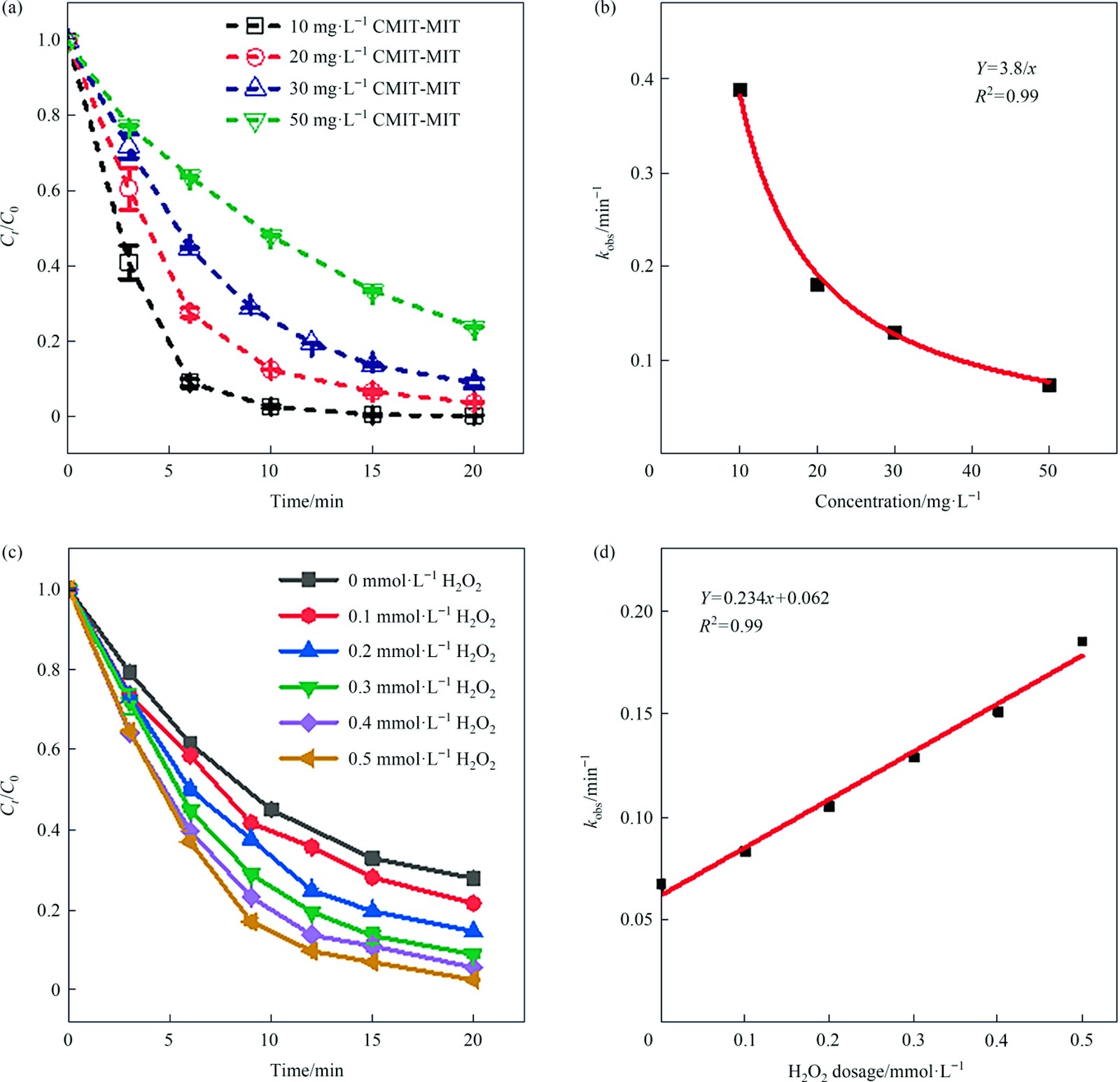
Kathon (CMI-MI), a mixture of 5-chloro-2-methyl-4-isothiazolin-3-one (CMI) and 2-methyl-4-isothiazolin-3-one (MI), was extensively used in industry as a nonoxidizing biocide or disinfectant. However, it would show adverse effects on aquatic life when it is discharged into surface water. In this study, the removal performance, parameter influence, degradation products and enhancement of subsequent biodegradation of CMI-MI in UV/H2O2 system were systematically investigated. The degradation rate of CMI-MI could reach 90% under UV irradiation for 20 min when the dosage of H2O2 was 0.3 mmol·L–1. The DOC (dissolved organic carbon) mineralization rate of CMI-MI could reach 35% under certain conditions ([H2O2] = 0.3 mmol·L–1, UV irradiation for 40 min). kobs was inversely proportional to the concentration of CMI-MI and proportional to the concentration of H2O2. The degradation rate of CMI-MI was almost unchanged in the pH range from 4 to 10. Except the presence of CO3^2- inhibited the removal rate of CMI-MI, SO4^2-, Cl-, NO3-, and NH4+ did not interfere with the degradation of CMI-MI in the system. It was found that UV/H2O2 system had lower energy consumption and more economic advantage compared with UV/PS system by comparing the EEO (electric energy per order) values under the same conditions. Two main organic products were identified, namely HCOOH and CH3NH2. There's also the formation of Cl- and SO4^2-. After UV and UV/H2O2 photolysis, the biochemical properties of CMI-MI solution were obviously improved, especially the UV/H2O2 treatment effect was better, indicating that UV/H2O2 technology is expected to combine with biotechnology to remove CMI-MI effectively and environmentally friendly from wastewater.
1. Introduction
Kathon (CMI-MI), a mixture of 5-chloro-2-methyl-4-isothiazolin-3-one (CMI) and 2-methyl-4-isothiazolin-3-one (MI), was widely used in industry as a nonoxidizing biocide or disinfectant [1,2]. Both in circulating cooling water systems and in cosmetic personal care products (moisturizers, eye shadows, shampoos), CMI-MI is an indispensable ingredient because of its excellent inhibition and killing effect on molds, bacteria and other microorganisms [3–5]. In order to inhibit the breeding of microorganisms and prevent the generation of biological sludge, the added concentration of CMI-MI in the reverse osmosis system and circulating cooling water system is 0.04–2.6 mmol·L–1, 100–300 mg·L–1, respectively [6]. The concentration varies with different adding methods. MI concentration in cosmetics is required to be within 0.01 percent in China, which is attribute to its strong allergenic properties [6]. The structures of CMI and MI were shown in Supplementary Material (Table S1).
With the rapid development of industry, the water consumption and displacement of circulating cooling water are increasing, contributing to the mass release of the residual isothiazolones in wastewater into the natural environment and or sewage treatment plants. Several studies have reported the presence of CMI-MI in natural water bodies or wastewater treatment plants [5,7,8]. The existence of CMI-MI in wastewater treatment plants increased the complexity of water treatment, because of its negative impact on activated sludge activity and nitrification process [9,10]. It is known as pseudo-persistent compounds because CMI-MI was continuously released into the environment with circulating cooling wastewater [11,12].
CMI-MI exposed to the environment poses a potential threat to ecology and human health [13,14]. Several studies have shown that CMI or MI has irreversible toxic effects on many organisms [15–20]. For example, long-term exposure to low levels of MI and related compounds damaged irreparably the immune and nervous systems of mice [15]. The hydrophilic substances MI and CMI exhibited pronounced high cytotoxic effects on the human hepatoblastoma cell line Hep G2, the marine bacterium Vibrio fischeri, and the limnic green alga Scenedesmus vacuolatus [20]. Tang et al. [16] discovered that kathon was highly genotoxic in vitro, which contributed to an increase in the genotoxicity of the reverse osmosis concentrate. In addition, due to the high toxicity of MI/CMI, bactericides lingering in the environment for a long time could induce the development of resistance in bacteria [21]. Thus, it is of great significance to take effective measures to remove CMI-MI from wastewater.
Biodegradation is considered as an efficient, environmentally friendly and low-cost approach to eliminate organic contaminants from the aqueous environment [22]. Microbial me...
Loading authentic research manuscript (Pages 1–5)...
Jinzhi Cui, Guiqiao Wang, Xing Rong, Wensu Gao, Yaxin Lu, Yawen Luo, Lichao Zhang, Zhongfa Cheng, Canzhu Gao (2023). Removal of kathon by UV-C activated hydrogen peroxide: Kinetics, mechanisms, and enhanced biodegradability assessment. Chinese Journal of Chemical Engineering. https://doi.org/10.1016/j_cjche_144876270
Research & Educational Purpose Only:The translations, structured abstracts, analytical annotations, and data reports provided by SinoTechIntel are intended exclusively for academic research, internal corporate R&D, and educational benchmarking. They do not constitute formal engineering, chemical safety, legal, or professional advice.
Copyright & Intellectual Property Notice: Original copyright of the underlying source articles and experimental data remains with the respective authors, institutions, and original publishing journals. SinoTechIntel claims intellectual property only over its proprietary translations, analytical syntheses, and AEO structured enhancements in accordance with international fair use and academic citation principles.
Frequently Asked Questions
What is Kathon and why is it a concern?
Kathon (CMI-MI) is a mixture of two isothiazolinone biocides (CMI and MI) widely used in industrial and consumer products. It poses risks to aquatic life and human health, and its presence in wastewater can disrupt biological treatment processes.
How effective is UV/H2O2 in degrading Kathon?
The UV/H2O2 process achieved 90% degradation of Kathon within 20 minutes at an H2O2 dosage of 0.3 mmol/L, with 35% mineralization after 40 minutes, demonstrating high efficiency.
What are the main degradation products of Kathon in UV/H2O2?
The main organic products identified are formic acid (HCOOH) and methylamine (CH3NH2), along with inorganic ions such as chloride (Cl-) and sulfate (SO4^2-).
Does UV/H2O2 improve the biodegradability of Kathon?
Yes, after UV/H2O2 treatment, the biochemical properties of the Kathon solution were significantly improved, indicating enhanced biodegradability and potential for coupling with biological treatment.
How does UV/H2O2 compare to UV/PS in terms of energy efficiency?
UV/H2O2 has lower energy consumption and is more economical than UV/PS, as indicated by lower electric energy per order (EEO) values under the same conditions.
Related Technical Papers & Translations

Design and optimization of a high-efficiency distillation process for cellulosic fuel ethanol integrated with thermal coupling and molecular sieve adsorption
To address the challenges of high energy consumption and prominent costs in the traditional three-columns distillation process for cellulosic fuel ethanol, a distillation—molecular sieve coupling separation process is proposed. This process integrates a three-column (crude distillation column, first distillation column, second distillation column) system with a 3A molecular sieve adsorption deep dehydration unit. A thermal coupling network is constructed via differential pressure design (steam from medium/high-pressure columns as mutual heat sources, reboiler liquid waste heat for feed preheating), and molecular sieve adsorption conditions are optimized. The study first performs a thermodynamic consistency test on the ethanol—water system, determines optimal non-random two-liquid (NRTL) model binary interaction parameters via experimental data regression for Aspen Plus simulation. Aiming at minimum total annual cost (TAC), Aspen Plus is used to optimize process parameters (theoretical tray number, feed location, reflux ratio, side-draw position, etc.). Economic analysis shows this process reduces CO2 emission costs by 27.56%, TAC by 15.58% (to 5.123 × 10⁶ USD·a-1), and increases ethanol purity to >99.6%, providing an effective solution for green, efficient separation.

A cohesion loss model for determining residual strength of deep bedded sandstone
Rock residual strength, as an important input parameter, plays an indispensable role in proposing the reasonable and scientific scheme about stope design, underground tunnel excavation and stability evaluation of deep chambers. Therefore, previous residual strength models of rocks established were reviewed. And corresponding related problems were stated. Subsequently, starting from the effects of bedding and whole life-cycle evolution process, series of triaxial mechanical tests of deep bedded s

Federated model with contrastive learning and adaptive control variates for human activity recognition
Recent attention to privacy issues demands a communication-safe method for training human activity recognition (HAR) models on client activity data. Federated learning (FL) has become a compelling technique to facilitate model training between the server and clients while preserving data privacy. However, classical FL methods often assume independent and identically distributed (IID) data among clients. This assumption does not hold true in practical scenarios. Human activity in real-world scena