Key Takeaways & Executive Findings
- •• Deep hydrogenation of RP-3 jet fuel significantly improves anti-coking performance while maintaining fuel conversion during pyrolysis. • Increased hydrogenation degree leads to a slight increase in heat sink, attributed to higher H/C ratios. • Aromatics promote coking precursor formation, whereas cycloalkanes act as hydrogen donors to suppress coke deposition. • Modulating fuel composition via hydrogenation offers a promising strategy for upgrading endothermic hydrocarbon fuels.
Abstract
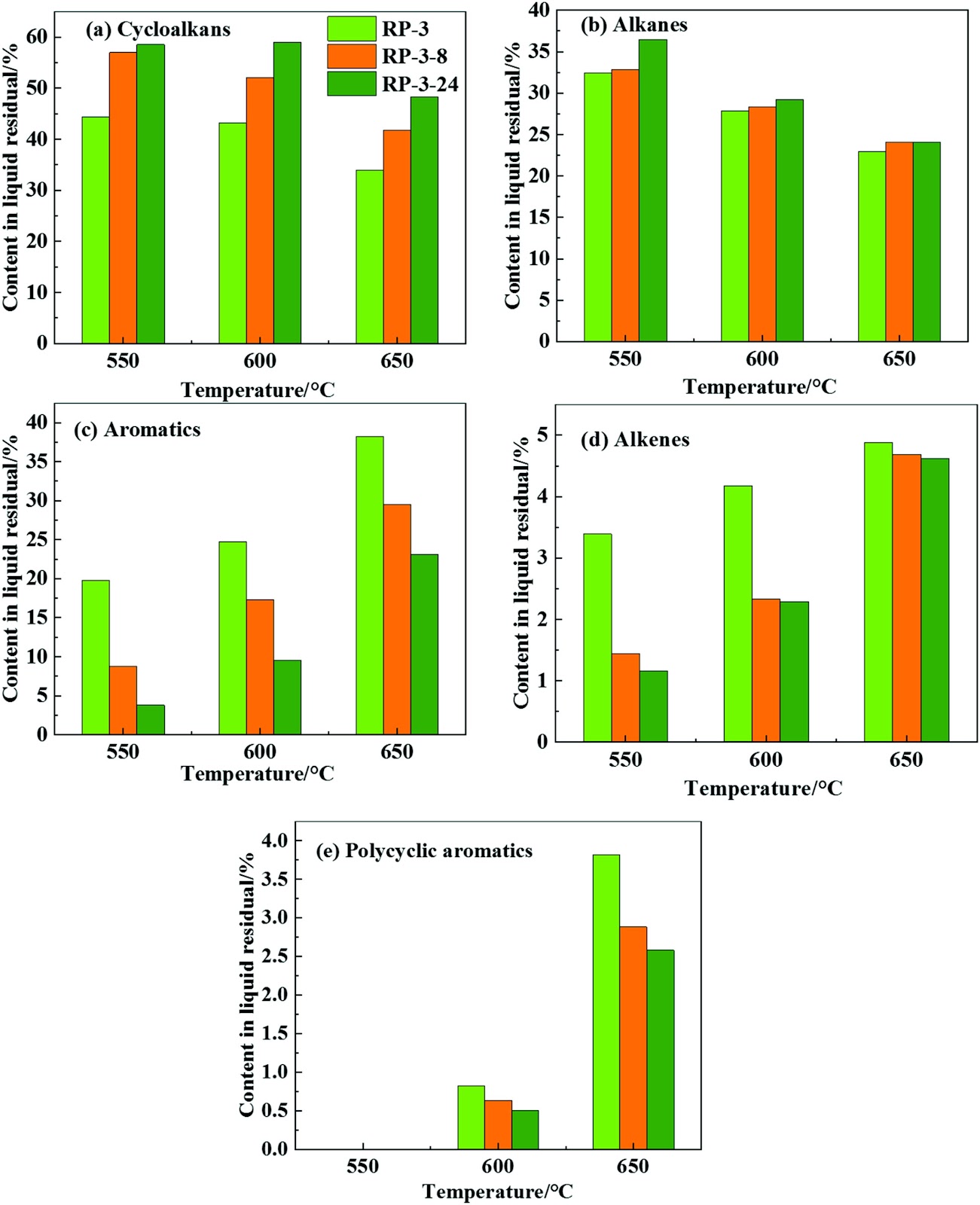
Understanding the relationship between the chemical composition and pyrolysis performance of endothermic hydrocarbon fuel (EHF) is of great significance for the design and optimization of advanced EHFs. In this work, the effect of deep hydrogenation on the pyrolysis of commercial RP-3 is investigated. Fuels with different hydrogenation degrees were obtained by the partially and completely catalytic hydrogenation and their pyrolysis performances were investigated using an apparatus equipped with an electrically heated tubular reactor. The results show that with the increase of hydrogenation degree, fuel conversion almost remains constant during the pyrolysis process (500e650 °C, 4 MPa); however, the heat sink increases slightly, and the anti-coking performance significantly improves, which are highly related to their H/C ratios. Detailed characterisations reveal that the difference of the pyrolysis performance can be ascribed to the content of aromatics and cycloalkanes: the former are prone to initiate secondary reactions to form coking precursors, while the latter could act as the hydrogen donor and release hydrogen, which will terminate the radical propagation reactions and suppress the coke deposition. This work should provide the guidance for upgrading EHFs by modulating the composition of EHFs.
1. Introduction
Thermal management of engine and airframe of aircraft vehicles under the cruising speed up to Mach 5 or higher is a challenging problem. It is generally accepted that the regenerative cooling strategy using on-board endothermic hydrocarbon fuel (EHF) as the coolant is one of the most feasible methods for heat removal [1]. EHF could provide both the physical and excess chemical heat sink through the temperature rise, phase transition, and endothermic thermal cracking reactions when it flows through the micro-channels at very high temperature [2]. However, the formation of coke deposition is inevitable during the thermal cracking process, and the excessive coking may block the channels and nozzles, decrease the heat transfer performance, and even result in the engine failure [3]. Thus, the design of advanced hydrocarbon fuels with higher heat sink and lower coking tendency is of great significance.
The composition of fuel has a significant influence on the pyrolysis performance. Many attempts, such as adding initiators, coking inhibitors and hydrogen donors, have been made to produce EHFs with high heat sink and low coking tendency [4e6]. Specifically, the hydrogenation can simply alter the hydrocarbon compositions, increase the H/C ratio, reduce the contents of unsaturated hydrocarbons, and remove hetero atomic compounds, thus significantly change the properties of the fuel [7]. As reported, the hydrogenation process could be applied in the preparation of synthetic fuel [8]. Recently, our group found that the hydrogenation was a promising approach to improve the thermal oxidative stability of jet fuel via the removal of aromatics and the inherent heteroatomic species (sulphur and phenols), and the neat heating value of jet fuel could also be improved [9]. However, there have been no reports regarding the effects of hydrogenation of jet fuels on the pyrolysis and anti-coking performance.
Loading authentic research manuscript (Pages 1–5)...
Qing Liu, Tinghao Jia, Lun Pan, Jijun Zou, Xiangwen Zhang (2023). Relationship between hydrogenation degree and pyrolysis performance of jet fuel. Chinese Journal of Chemical Engineering. https://doi.org/10.1016/j_cjche_144878520
Research & Educational Purpose Only:The translations, structured abstracts, analytical annotations, and data reports provided by SinoTechIntel are intended exclusively for academic research, internal corporate R&D, and educational benchmarking. They do not constitute formal engineering, chemical safety, legal, or professional advice.
Copyright & Intellectual Property Notice: Original copyright of the underlying source articles and experimental data remains with the respective authors, institutions, and original publishing journals. SinoTechIntel claims intellectual property only over its proprietary translations, analytical syntheses, and AEO structured enhancements in accordance with international fair use and academic citation principles.
Frequently Asked Questions
What is the main objective of this study?
The study investigates the effect of deep hydrogenation on the pyrolysis performance of commercial RP-3 jet fuel, focusing on conversion, heat sink, and anti-coking performance.
How does hydrogenation affect the pyrolysis performance of jet fuel?
Hydrogenation increases the H/C ratio and alters the composition, leading to slightly increased heat sink and significantly improved anti-coking performance, while fuel conversion remains nearly constant.
What are the key factors influencing coke deposition during pyrolysis?
Aromatics promote secondary reactions forming coking precursors, while cycloalkanes act as hydrogen donors, releasing hydrogen to terminate radical propagation and suppress coke deposition.
What is the significance of this research for the aviation industry?
The findings provide guidance for upgrading endothermic hydrocarbon fuels by modulating their composition, which is crucial for thermal management in high-speed aircraft.
What experimental methods were used in this study?
Fuels with different hydrogenation degrees were prepared via catalytic hydrogenation and tested in an electrically heated tubular reactor under supercritical conditions (500-650°C, 4 MPa).
Related Technical Papers & Translations

Design and optimization of a high-efficiency distillation process for cellulosic fuel ethanol integrated with thermal coupling and molecular sieve adsorption
To address the challenges of high energy consumption and prominent costs in the traditional three-columns distillation process for cellulosic fuel ethanol, a distillation—molecular sieve coupling separation process is proposed. This process integrates a three-column (crude distillation column, first distillation column, second distillation column) system with a 3A molecular sieve adsorption deep dehydration unit. A thermal coupling network is constructed via differential pressure design (steam from medium/high-pressure columns as mutual heat sources, reboiler liquid waste heat for feed preheating), and molecular sieve adsorption conditions are optimized. The study first performs a thermodynamic consistency test on the ethanol—water system, determines optimal non-random two-liquid (NRTL) model binary interaction parameters via experimental data regression for Aspen Plus simulation. Aiming at minimum total annual cost (TAC), Aspen Plus is used to optimize process parameters (theoretical tray number, feed location, reflux ratio, side-draw position, etc.). Economic analysis shows this process reduces CO2 emission costs by 27.56%, TAC by 15.58% (to 5.123 × 10⁶ USD·a-1), and increases ethanol purity to >99.6%, providing an effective solution for green, efficient separation.

A cohesion loss model for determining residual strength of deep bedded sandstone
Rock residual strength, as an important input parameter, plays an indispensable role in proposing the reasonable and scientific scheme about stope design, underground tunnel excavation and stability evaluation of deep chambers. Therefore, previous residual strength models of rocks established were reviewed. And corresponding related problems were stated. Subsequently, starting from the effects of bedding and whole life-cycle evolution process, series of triaxial mechanical tests of deep bedded s

Federated model with contrastive learning and adaptive control variates for human activity recognition
Recent attention to privacy issues demands a communication-safe method for training human activity recognition (HAR) models on client activity data. Federated learning (FL) has become a compelling technique to facilitate model training between the server and clients while preserving data privacy. However, classical FL methods often assume independent and identically distributed (IID) data among clients. This assumption does not hold true in practical scenarios. Human activity in real-world scena