Key Takeaways & Executive Findings
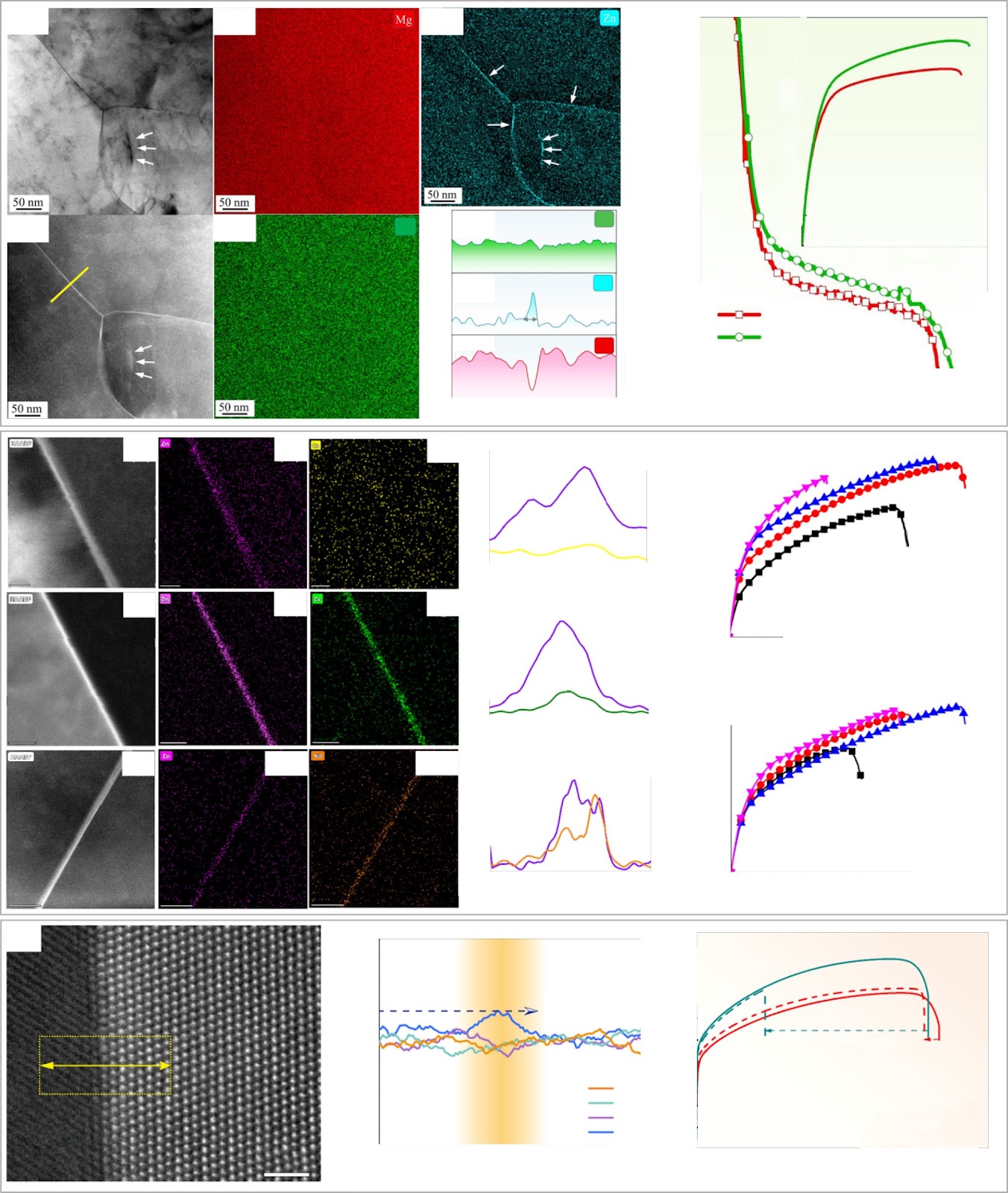
- •• Systematically examines the roles of grain and phase boundaries in high-performance alloys, focusing on crystallographic features and chemical segregation. • Elucidates how interface structures govern electrical conductivity, mechanical strength, toughness, hydrogen embrittlement resistance, and thermal stability. • Integrates big data analytics with advanced experimental and computational methods to develop robust interface design strategies. • Discusses current challenges and future opportunities, offering a roadmap for next-generation high-performance alloy development.
Abstract
High-performance alloys are indispensable in modern engineering because of their exceptional strength, ductility, corrosion resistance, fatigue resistance, and thermal stability, which are all significantly influenced by the alloy interface structures. Despite substantial efforts, a comprehensive overview of interface engineering of high-performance alloys has not been presented so far. In this study, the interfaces in high-performance alloys, particularly grain and phase boundaries, were systematically examined, with emphasis on their crystallographic characteristics and chemical element segregations. The effects of the interfaces on the electrical conductivity, mechanical strength, toughness, hydrogen embrittlement resistance, and thermal stability of the alloys were elucidated. Moreover, correlations among various types of interfaces and advanced experimental and computational techniques were examined using big data analytics, enabling robust design strategies. Challenges currently faced in the field of interface engineering and emerging opportunities in the field are also discussed. The study results would guide the development of next-generation high-performance alloys.
1. Introduction
1. Introduction
High-performance alloys have become essential in various industries, such as aerospace, energy, automotive, and electronics industries, where they are required to reliably perform under extreme conditions [1–3]. The outstanding performance of the alloys is due to the complex interplay of multiple mechanisms, and the role played by interface structures has been identified as the primary determinant [4–14]. Specifically, grain and phase boundaries have been found to strongly affect alloy microstructures, thereby controlling the essential macroscopic alloy properties, such as strength [15–21], ductility [22–25], fatigue resistance [26–28], corrosion resistance [29–34], and thermal stability [35–37]. Ding et al. [38] reported that the distinct chemical boundaries in low-carbon medium-manganese steels refine their martensite–austenite structures, resulting in exceptional strength and adequate ductility. However, despite the widespread recognition of the important role played by rational interface engineering in improving alloy performance, a systematic and comprehensive overview addressing the roles played by various interface types in performance optimization of the alloys is yet to be reported.
From a crystallographic perspective, interface characteristics, including interfacial misorientations, lattice mismatches, coherencies, and orientation relationships, directly influence the plastic deformation mechanisms in alloys, markedly affecting their mechanical properties [39–46]. The misorientation angle and boundary plane orientation in grain boundaries are critical factors that determine the interface energy and mobility of alloys, profoundly affecting the dislocation interactions and boundary sliding [47]. In situ transmission electron microscopy (TEM) revealed that the crystallographic structure of low-angle grain boundaries in titanium modulates its dislocation behavior, thereby enhancing its strength–ductility balance [48]. The coherency and lattice mismatch between adjacent phases of titanium significantly influence its mechanical behavior. High-angle annular dark-field scanning transmission electron microscopy (HAADF-STEM) and atom probe tomography (APT) observations of Ni(Al,Fe) maraging steel showed that its minimal lattice misfit enhanced the precipitate density, resulting in a strength of 2.2 GPa and ductility of 8.2% [49]. The distinct crystallographic attributes of grain and phase boundaries underscore their pivotal role in optimizing the performance of alloys used in specific engineering applications.
Loading authentic research manuscript (Pages 1–5)...
Yuan Zhu, Tongbo Jiang, Honghui Wu, Faguo Hou, Xiaoye Zhou, Feiyang Wang, Shuize Wang, Junheng Gao, Haitao Zhao, Chaolei Zhang (2025). Recent advances and perspectives in interface engineering of high-performance alloys. Journal of Mineral Metallurgy and Materials Science. https://doi.org/10.1007/s12613-025-3234-3
Research & Educational Purpose Only:The translations, structured abstracts, analytical annotations, and data reports provided by SinoTechIntel are intended exclusively for academic research, internal corporate R&D, and educational benchmarking. They do not constitute formal engineering, chemical safety, legal, or professional advice.
Copyright & Intellectual Property Notice: Original copyright of the underlying source articles and experimental data remains with the respective authors, institutions, and original publishing journals. SinoTechIntel claims intellectual property only over its proprietary translations, analytical syntheses, and AEO structured enhancements in accordance with international fair use and academic citation principles.
Frequently Asked Questions
What is interface engineering in the context of high-performance alloys?
Interface engineering involves the deliberate manipulation of grain and phase boundaries to optimize crystallographic characteristics and chemical element segregation, thereby controlling macroscopic properties such as strength, ductility, and corrosion resistance.
How do grain boundaries affect the mechanical properties of alloys?
Grain boundaries influence dislocation interactions and boundary sliding, with misorientation angle and boundary plane orientation determining interface energy and mobility, which in turn affect strength, ductility, and fatigue resistance.
What is the significance of chemical element segregation at interfaces?
Interface segregation enriches or depletes specific alloying elements at boundaries, which can strengthen boundaries or alter precipitate–matrix interfaces, thereby controlling mechanical and functional performance.
What advanced techniques are used for interface analysis?
Advanced techniques include in situ transmission electron microscopy (TEM), high-angle annular dark-field scanning transmission electron microscopy (HAADF-STEM), atom probe tomography (APT), and density functional theory (DFT) calculations, often integrated with big data analytics.
What are the future directions in interface engineering of alloys?
Future directions include overcoming current challenges in understanding complex interface phenomena, leveraging computational and data-driven approaches, and developing robust design strategies for next-generation high-performance alloys.
Related Technical Papers & Translations

Design and optimization of a high-efficiency distillation process for cellulosic fuel ethanol integrated with thermal coupling and molecular sieve adsorption
To address the challenges of high energy consumption and prominent costs in the traditional three-columns distillation process for cellulosic fuel ethanol, a distillation—molecular sieve coupling separation process is proposed. This process integrates a three-column (crude distillation column, first distillation column, second distillation column) system with a 3A molecular sieve adsorption deep dehydration unit. A thermal coupling network is constructed via differential pressure design (steam from medium/high-pressure columns as mutual heat sources, reboiler liquid waste heat for feed preheating), and molecular sieve adsorption conditions are optimized. The study first performs a thermodynamic consistency test on the ethanol—water system, determines optimal non-random two-liquid (NRTL) model binary interaction parameters via experimental data regression for Aspen Plus simulation. Aiming at minimum total annual cost (TAC), Aspen Plus is used to optimize process parameters (theoretical tray number, feed location, reflux ratio, side-draw position, etc.). Economic analysis shows this process reduces CO2 emission costs by 27.56%, TAC by 15.58% (to 5.123 × 10⁶ USD·a-1), and increases ethanol purity to >99.6%, providing an effective solution for green, efficient separation.

A cohesion loss model for determining residual strength of deep bedded sandstone
Rock residual strength, as an important input parameter, plays an indispensable role in proposing the reasonable and scientific scheme about stope design, underground tunnel excavation and stability evaluation of deep chambers. Therefore, previous residual strength models of rocks established were reviewed. And corresponding related problems were stated. Subsequently, starting from the effects of bedding and whole life-cycle evolution process, series of triaxial mechanical tests of deep bedded s

Federated model with contrastive learning and adaptive control variates for human activity recognition
Recent attention to privacy issues demands a communication-safe method for training human activity recognition (HAR) models on client activity data. Federated learning (FL) has become a compelling technique to facilitate model training between the server and clients while preserving data privacy. However, classical FL methods often assume independent and identically distributed (IID) data among clients. This assumption does not hold true in practical scenarios. Human activity in real-world scena