Key Takeaways & Executive Findings
- •• A computation-aided surface charge engineering strategy was developed to enhance the catalytic performance of haloalkane dehalogenase DhaA in organic solvents. • The four-substitution variant E16R/E93R/E121R/E257R exhibited a five-fold improvement in organic solvent resistance and a seven-fold increase in half-life in 40% dimethylsulfoxide. • The overall catalytic performance of the best variant was at least 26 times higher than the wild-type enzyme. • Mechanistic studies revealed that enhanced organic solvent resistance arises from improved structural stability, increased local hydrophobicity, substrate enrichment, and reduced solvent access to the catalytic triad.
Abstract
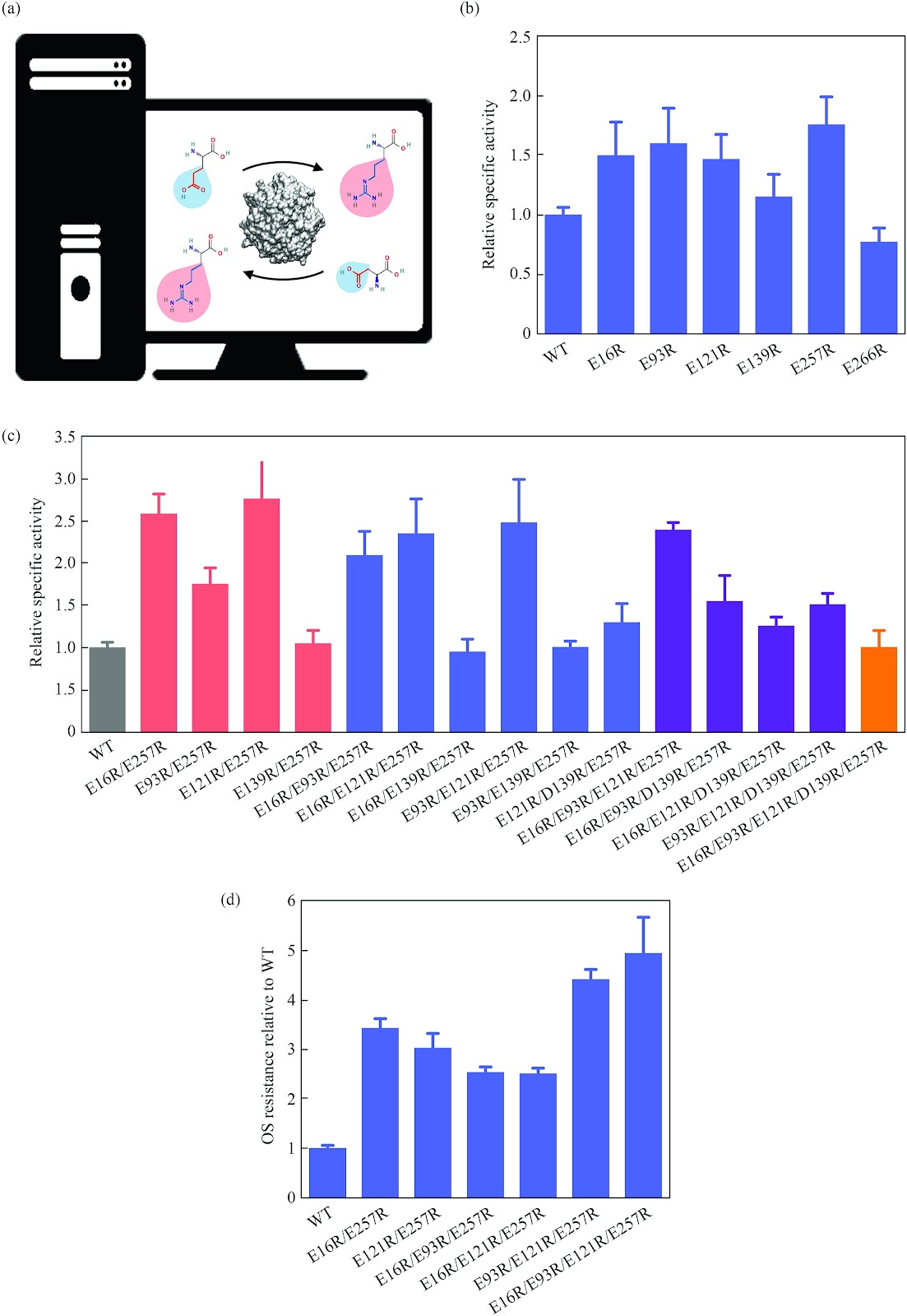
Biocatalysis in organic solvents (OSs) has numerous important applications, but native enzymes in OSs often exhibit limited catalytic performance. Herein, we proposed a computation-aided surface charge engineering strategy to improve the catalytic performance of haloalkane dehalogenase DhaA in OSs based on the energetic analysis of substrate binding to the DhaA surface. Several variants with enhanced OS resistance were obtained by replacing negative charged residues on the surface with positive charged residue (Arg). Particularly, a four-substitution variant E16R/E93R/E121R/E257R exhibited the best catalytic performance (five-fold improvement in OS resistance and seven-fold half-life increase in 40% (vol) dimethylsulfoxide). As a result, the overall catalytic performance of the variant could be at least 26 times higher than the wild-type DhaA. Fluorescence spectroscopy and molecular dynamics simulation studies revealed that the residue substitution mainly enhanced OS resistance from four aspects: (a) improved the overall structural stability, (b) increased the hydrophobicity of the local microenvironment around the catalytic triad, (c) enriched the hydrophobic substrate around the enzyme molecule, and (d) lowered the contact frequency between OS molecules and the catalytic triad. Our findings validate that computation-aided surface charge engineering is an effective and ingenious rational strategy for tailoring enzyme performance in OSs.
1. Introduction
The application of organic solvents (OSs) as reaction media for biocatalysts is indispensable for a broad range of applications in the chemical industries. Enzymatic catalysis in OSs has several advantages, including increased substrate solubility, enhanced selective process, and suppression of unwanted by-product formation [1]. Therefore, non-aqueous biocatalysis in the presence of OSs dramatically lowers the cost of processes [2]. However, the reduced activity, poor stability, and even deactivation of the enzymes by OSs largely limit biocatalytic reactions in neat OSs and aqueous OS mixtures.
Many techniques have been used to explore the interaction between enzymes and OSs from different aspects. For example, conformational changes and structural mobility of enzymes can be experimentally obtained from spectroscopies such as X-ray [3], circular dichroism (CD) [4], or nuclear magnetic resonance [5]. The dynamics of the related solvent shell in aqueous media can be determined adequately by ultrafast fluorescence [6], nuclear Overhauser effect [7], and IR spectra [8]. Furthermore, molecular dynamics (MD) simulations generate a complementary approach to explore the connection between protein dynamics and the stability of enzymes in OSs, which has been proven to exhibit high consistency with numerous experimental measurements [9]. With the help of these techniques, OSs were found to deactivate enzymes mainly via five different mechanisms: (a) conformational changes [10], (b) loss of bound water molecules [11], (c) competitive inhibition [12], (d) interfacial inactivation [13], and (e) thermodynamic stabilization of the substrate ground state [14].
Numerous conventional methods, such as immobilization [15], chemical modification [16], chemical cross-linking [17], and additives [18], have been used to strengthen the stability of enzymes in OSs. In addition, protein-engineering strategies have succeeded in improving the properties of enzymes [18]. As a strategy of protein engineering, protein surface design can not only significantly enhance the stability of enzymes [19] but also change the optimal conditions for enzyme catalysis [20]. Besides, protein surface design has been validated to play an important role in boosting the OS resistance of enzymes [21].
Loading authentic research manuscript (Pages 1–5)...
Yin Wu, Yan Sun (2023). Rational surface charge engineering of haloalkane dehalogenase for boosting the enzymatic performance in organic solvent solutions. Chinese Journal of Chemical Engineering. https://doi.org/10.1016/j_cjche_144877726
Research & Educational Purpose Only:The translations, structured abstracts, analytical annotations, and data reports provided by SinoTechIntel are intended exclusively for academic research, internal corporate R&D, and educational benchmarking. They do not constitute formal engineering, chemical safety, legal, or professional advice.
Copyright & Intellectual Property Notice: Original copyright of the underlying source articles and experimental data remains with the respective authors, institutions, and original publishing journals. SinoTechIntel claims intellectual property only over its proprietary translations, analytical syntheses, and AEO structured enhancements in accordance with international fair use and academic citation principles.
Frequently Asked Questions
What is the main objective of this study?
The main objective is to improve the catalytic performance of haloalkane dehalogenase DhaA in organic solvents through a computation-aided surface charge engineering strategy.
What was the best-performing variant and its improvements?
The best-performing variant was E16R/E93R/E121R/E257R, which exhibited a five-fold improvement in organic solvent resistance and a seven-fold increase in half-life in 40% dimethylsulfoxide, leading to at least 26 times higher overall catalytic performance compared to the wild-type.
How did the researchers evaluate the enhanced organic solvent resistance?
They used fluorescence spectroscopy and molecular dynamics simulations to reveal that the enhanced resistance resulted from improved structural stability, increased hydrophobicity around the catalytic triad, enriched substrate near the enzyme, and reduced contact between solvent molecules and the catalytic triad.
What is the significance of this study for biocatalysis?
This study provides an effective and ingenious rational strategy for tailoring enzyme performance in organic solvents, which is crucial for expanding the industrial applications of biocatalysis in non-aqueous media.
Which enzyme was studied and why is it important?
The enzyme studied is haloalkane dehalogenase DhaA from Rhodococcus rhodochrous. It is important because it catalyzes the hydrolysis of carbon-halogen bonds in halogenated compounds, which are common environmental pollutants and industrial by-products, making it useful for bioremediation and other applications.
Related Technical Papers & Translations

Design and optimization of a high-efficiency distillation process for cellulosic fuel ethanol integrated with thermal coupling and molecular sieve adsorption
To address the challenges of high energy consumption and prominent costs in the traditional three-columns distillation process for cellulosic fuel ethanol, a distillation—molecular sieve coupling separation process is proposed. This process integrates a three-column (crude distillation column, first distillation column, second distillation column) system with a 3A molecular sieve adsorption deep dehydration unit. A thermal coupling network is constructed via differential pressure design (steam from medium/high-pressure columns as mutual heat sources, reboiler liquid waste heat for feed preheating), and molecular sieve adsorption conditions are optimized. The study first performs a thermodynamic consistency test on the ethanol—water system, determines optimal non-random two-liquid (NRTL) model binary interaction parameters via experimental data regression for Aspen Plus simulation. Aiming at minimum total annual cost (TAC), Aspen Plus is used to optimize process parameters (theoretical tray number, feed location, reflux ratio, side-draw position, etc.). Economic analysis shows this process reduces CO2 emission costs by 27.56%, TAC by 15.58% (to 5.123 × 10⁶ USD·a-1), and increases ethanol purity to >99.6%, providing an effective solution for green, efficient separation.

A cohesion loss model for determining residual strength of deep bedded sandstone
Rock residual strength, as an important input parameter, plays an indispensable role in proposing the reasonable and scientific scheme about stope design, underground tunnel excavation and stability evaluation of deep chambers. Therefore, previous residual strength models of rocks established were reviewed. And corresponding related problems were stated. Subsequently, starting from the effects of bedding and whole life-cycle evolution process, series of triaxial mechanical tests of deep bedded s

Federated model with contrastive learning and adaptive control variates for human activity recognition
Recent attention to privacy issues demands a communication-safe method for training human activity recognition (HAR) models on client activity data. Federated learning (FL) has become a compelling technique to facilitate model training between the server and clients while preserving data privacy. However, classical FL methods often assume independent and identically distributed (IID) data among clients. This assumption does not hold true in practical scenarios. Human activity in real-world scena