Key Takeaways & Executive Findings
- •• 100% Cr(VI) removal efficiency achieved within 60 minutes using nZVI@SepH-Mag nanocomposite. • Sepiolite and Fe3O4 enhance nZVI dispersibility and synergistic performance for rapid heavy metal remediation. • Cr(VI) removal mechanism involves adsorption followed by reduction to Cr(III), confirmed by Raman, XRD, and XPS. • Magnetic separation capability enables easy recovery and reusability, offering a scalable solution for water treatment.
Abstract
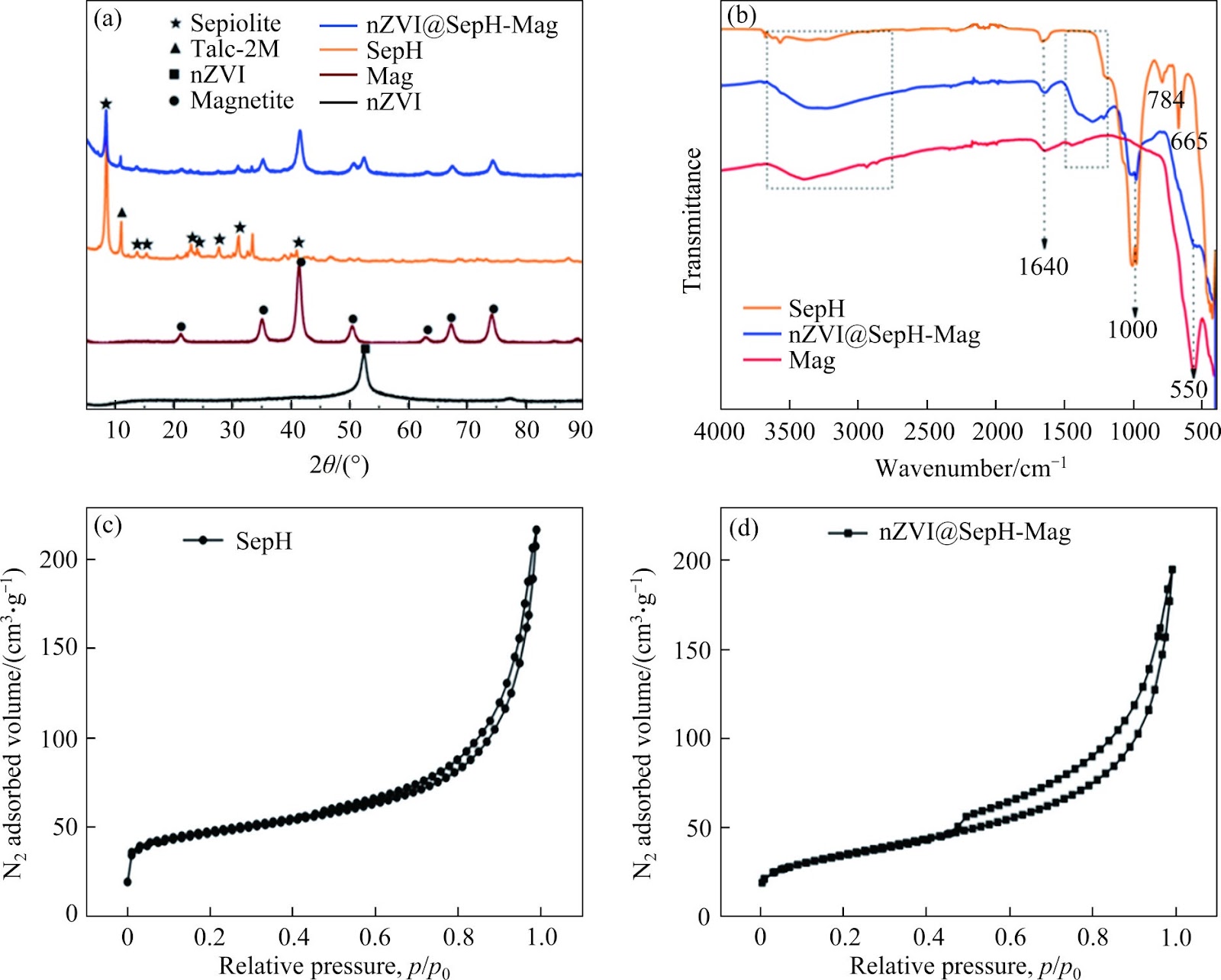
The novel magnetic sepiolite/Fe3O4/zero-valent iron (nZVI) nanocomposite (nZVI@SepH-Mag) was prepared and used to achieve the removal of Cr(VI) in this work. The nZVI@SepH-Mag composites were characterized by XRD, FTIR, BET, SEM and TEM. The characterization results indicated that the structure of the composite consisted of small nanoscale nZVI and magnetite (Mag) particles uniformly anchoring on the surface of acid-activated sepiolite (SepH). Batch experiments were used to analyze the effects of main factors on Cr(VI) removal. A 100% removal efficiency in 60 min and enhanced reaction ratio were reached by the composite comparing other existing materials. The kinetic of the adsorption and possible Cr(VI) removal mechanism of the hybrids were also evaluated and proposed. Based on the removal products identified by Raman, XRD and XPS, a reduction mechanism was proposed. The results indicated that the SepH and Mag can inhibit the agglomeration and enhance the dispersibility of nZVI, and Mag and nZVI displayed good synergetic effects.
1. Introduction
Chromium, like some of its chemical cousins, can be either beneficial or harmful to living things, depending on its form, concentration, and method of absorption. Chromium(III), for example, the metal’s natural state, is stable and an essential nutrient. On the other hand, under oxidizing conditions, Cr is highly soluble and mobile as the Cr(VI) anions chromate (CrO4^2−) and bichromate (HCrO4^−). Cr(VI) is highly reactive and a suspected carcinogen, mutagen and teratogen if inhaled or consumed in contaminated fish or polluted water [1]. Therefore, under reducing conditions, Cr(VI) may convert to Cr(III), which is insoluble, strongly adsorbed onto solid surfaces, and less toxic [2, 3].
Cr(VI) can be removed from solution artificially through traditional methods, such as adsorption [4], electrochemical precipitation [5], ion exchange [6], membrane separation [7], bioremediation [8], photocatalysis [9−11], in situ chemical reduction [12] and their synergy effect [13], among which zero valent iron (ZVI) is the most commonly used and researched reductant [14]. Nevertheless Fe- and Cr-precipitates on granular ZVI surface decrease the performance and efficiency during reaction process [15]. Hence nano zero valent iron (nZVI) was synthesized to remedy those weaknesses. Meanwhile, nZVI modified with surfactants and hybrid nZVI with other materials sprang up to further strengthen the nZVI family [16, 17].
Sepiolite (Sep) is a fibrous clay mineral with a 2:1 layer structure, formed by an alternation of blocks and tunnels that grow up in the fiber direction with a particle size of 0.2−2 μm in length, 100−300 nm in width and 50−100 nm in thickness range [18]. It has captured much attention because of its low cost, high chemical stability, large specific surface area and large thermal stability [19]. Sep as a carrier is used in variety of industries, such as in dyes, pharmaceuticals, papers, drilling fluids, ceramics and detergents [20]. DANESHKHAH et al synthesized sepiolite-supported nZVI (SPT-nZVI), which reduced the agglomeration of nZVI and thereby provided a large reactive surface area. The composite was successfully applied to metoprolol removal. HABISH et al [22] prepared nature Sep and partially acid-activated Sep (AAS) for loading nZVI at different (Sep or AAS)/nZVI ratios in order to achieve the best nZVI dispersibility and the highest adsorption capacity for Cd2+. FU et al [23] imm
Loading authentic research manuscript (Pages 1–5)...
HOU Kai, HUANG Li, CHEN Wei, LI Xue-lian, HE Xi, LIU Ai-fang, DU Juan, ZHAO Yue-jie, YAO Shun, WEI Yu-han, FENG Guo-rui (2025). Rapid removal of Cr(VI) from aqueous solution by novel sepiolite/Fe3O4/nZVI nanocomposite: Material characterizations, enhanced performance in Cr(VI) removal and mechanism. Journal of Central South University. https://doi.org/10.1007/s11771-025-5985-4
Research & Educational Purpose Only:The translations, structured abstracts, analytical annotations, and data reports provided by SinoTechIntel are intended exclusively for academic research, internal corporate R&D, and educational benchmarking. They do not constitute formal engineering, chemical safety, legal, or professional advice.
Copyright & Intellectual Property Notice: Original copyright of the underlying source articles and experimental data remains with the respective authors, institutions, and original publishing journals. SinoTechIntel claims intellectual property only over its proprietary translations, analytical syntheses, and AEO structured enhancements in accordance with international fair use and academic citation principles.
Frequently Asked Questions
What is the removal efficiency of the nZVI@SepH-Mag nanocomposite for Cr(VI)?
The nanocomposite achieved 100% removal efficiency within 60 minutes.
What materials constitute the nZVI@SepH-Mag nanocomposite?
It consists of nanoscale zero-valent iron (nZVI) and magnetite (Fe3O4) nanoparticles uniformly anchored on acid-activated sepiolite.
How does the nanocomposite remove Cr(VI) from water?
The removal involves adsorption of Cr(VI) onto the composite surface followed by reduction to less toxic Cr(III), as confirmed by post-reaction characterization.
What are the advantages of using sepiolite and Fe3O4 in the composite?
Sepiolite and magnetite inhibit nZVI agglomeration, enhance dispersibility, and provide magnetic properties for easy separation and recovery.
Which techniques were used to characterize the composite?
XRD, FTIR, BET, SEM, TEM, Raman, and XPS were employed for characterization and mechanism analysis.
Related Technical Papers & Translations

Design and optimization of a high-efficiency distillation process for cellulosic fuel ethanol integrated with thermal coupling and molecular sieve adsorption
To address the challenges of high energy consumption and prominent costs in the traditional three-columns distillation process for cellulosic fuel ethanol, a distillation—molecular sieve coupling separation process is proposed. This process integrates a three-column (crude distillation column, first distillation column, second distillation column) system with a 3A molecular sieve adsorption deep dehydration unit. A thermal coupling network is constructed via differential pressure design (steam from medium/high-pressure columns as mutual heat sources, reboiler liquid waste heat for feed preheating), and molecular sieve adsorption conditions are optimized. The study first performs a thermodynamic consistency test on the ethanol—water system, determines optimal non-random two-liquid (NRTL) model binary interaction parameters via experimental data regression for Aspen Plus simulation. Aiming at minimum total annual cost (TAC), Aspen Plus is used to optimize process parameters (theoretical tray number, feed location, reflux ratio, side-draw position, etc.). Economic analysis shows this process reduces CO2 emission costs by 27.56%, TAC by 15.58% (to 5.123 × 10⁶ USD·a-1), and increases ethanol purity to >99.6%, providing an effective solution for green, efficient separation.

A cohesion loss model for determining residual strength of deep bedded sandstone
Rock residual strength, as an important input parameter, plays an indispensable role in proposing the reasonable and scientific scheme about stope design, underground tunnel excavation and stability evaluation of deep chambers. Therefore, previous residual strength models of rocks established were reviewed. And corresponding related problems were stated. Subsequently, starting from the effects of bedding and whole life-cycle evolution process, series of triaxial mechanical tests of deep bedded s

Federated model with contrastive learning and adaptive control variates for human activity recognition
Recent attention to privacy issues demands a communication-safe method for training human activity recognition (HAR) models on client activity data. Federated learning (FL) has become a compelling technique to facilitate model training between the server and clients while preserving data privacy. However, classical FL methods often assume independent and identically distributed (IID) data among clients. This assumption does not hold true in practical scenarios. Human activity in real-world scena